
 Codex Illustration
Skinwalkers
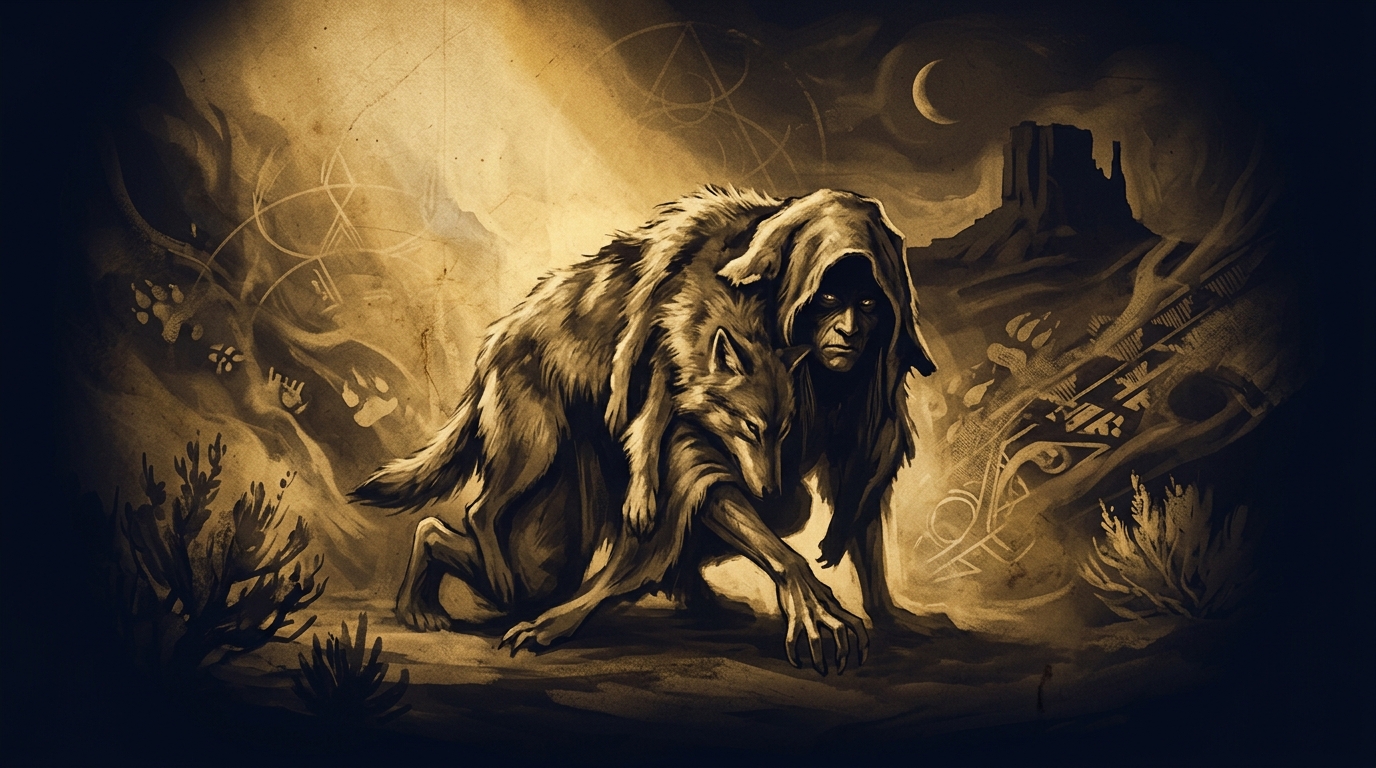
Among the Diné (Navajo) people, the yee naaldlooshii — one who goes on all fours — is a figure of profound dread: a medicine person who has transgressed sacred boundaries to acquire the power of transformation, wearing the skins of the dead to become something no longer fully human. What began as a carefully guarded cultural belief has, in recent decades, been amplified, distorted, and globally broadcast by internet folklore and entertainment media, raising serious questions about cultural appropriation, the ethics of disclosure, and what ancient traditions say about the nature of forbidden power.
Overview
Within Navajo cosmology, the yee naaldlooshii occupies a specific and disturbing category: the witch who has deliberately inverted the path of the healer. Documented principally through the work of anthropologists such as Clyde Kluckhohn — whose 1944 study *Navaho Witchcraft* remains a foundational academic text — this figure is understood within the tradition not as a monster or cryptid in the Western sense, but as a human being who has made a series of profoundly transgressive moral choices. To become a yee naaldlooshii, tradition holds, one must commit an act of ultimate taboo, typically the killing of a close family member, and acquire the *ádił* (corpse powder) and animal skins that enable transformation. The tradition speaks of wolves, coyotes, owls, and other animals as vessels for this corrupted power. It is important to note that Navajo oral tradition treats this subject with great gravity and considerable reticence; many Navajo speakers are reluctant to discuss the details publicly, viewing the act of speaking the name or elaborating on the practices as potentially dangerous.
Academic engagement with the topic is substantial but methodologically constrained. Kluckhohn's ethnographic work, along with later contributions by anthropologists such as Karl W. Luckert and the broader scholarship on Navajo ceremonialism documented by scholars like Charlotte Frisbie, establishes that witchcraft beliefs among the Diné are not peripheral superstition but a coherent system integral to understanding social tension, illness, misfortune, and moral order. Within the Navajo worldview, illness can be the work of witches who deploy *corpse powder* or *skinwalking* against enemies; the community's response involves specific ceremonial healings (*sings* or *chantways*) conducted by Hataalii (ceremonial practitioners). The distinction between those who walk the Hózhó (harmony, balance, beauty) and those who have abandoned it for power is central to Navajo ethics — making the skinwalker figure a moral cautionary tale as much as a supernatural threat.
The cultural trajectory of the skinwalker concept in the late twentieth and early twenty-first centuries represents one of the more dramatic examples of indigenous lore being extracted from its original context. The term gained exponential mainstream traction largely through association with the Skinwalker Ranch property in northeastern Utah — originally dubbed 'Skinwalker Ranch' by journalist George Knapp and researcher Colm Kelleher in their 2005 book *Hunt for the Skinwalker* — a name borrowed from Ute and Navajo regional traditions but applied to a site with no established Navajo connection. Internet communities, horror fiction, and streaming television have further diffused the term into a generalized label for shapeshifting monsters, catastrophically divorced from its specific cultural and spiritual origin. Many Navajo scholars, tribal leaders, and community members have expressed frustration, noting that the commercialization trivializes a tradition that carries real weight, real fear, and real spiritual consequence for living communities.
For the scholar of religion and folklore, the skinwalker tradition invites comparison with a global pattern: the figure of the sorcerer who obtains power by crossing a moral threshold that ordinary practitioners refuse. Parallels appear in European werewolf lore, in the berserker tradition of Norse culture, in West African *àjé* traditions, and in numerous shamanic contexts where transformation is understood as either a gift or a theft, depending on the practitioner's moral orientation. The Navajo tradition, however, is not best understood through these analogies — it has its own internal logic, its own ceremonial responses, and its own profound cosmological framing. Treating it as simply another version of a universal archetype risks collapsing a living, specific tradition into a generic myth.
Key Claims
Timeline
Evidence
Multiple Perspectives
Biblical Lens
Scripture Threads
Sources & Further Study
Questions to Explore
Go Deeper Path
Follow the Thread
Continue the Investigation
You’ve reached the Full Archive portion of this Case File.
Ask the Archivist
about this fileSign in to ask the Archivist
Create a free account to ask the Archivist 1 grounded question each day, cited straight from the CODEX case files.
Discussion
0Share findings, questions, and evidence with fellow Seekers. Be respectful and cite sources where you can.
No comments yet. Be the first to open this thread.