
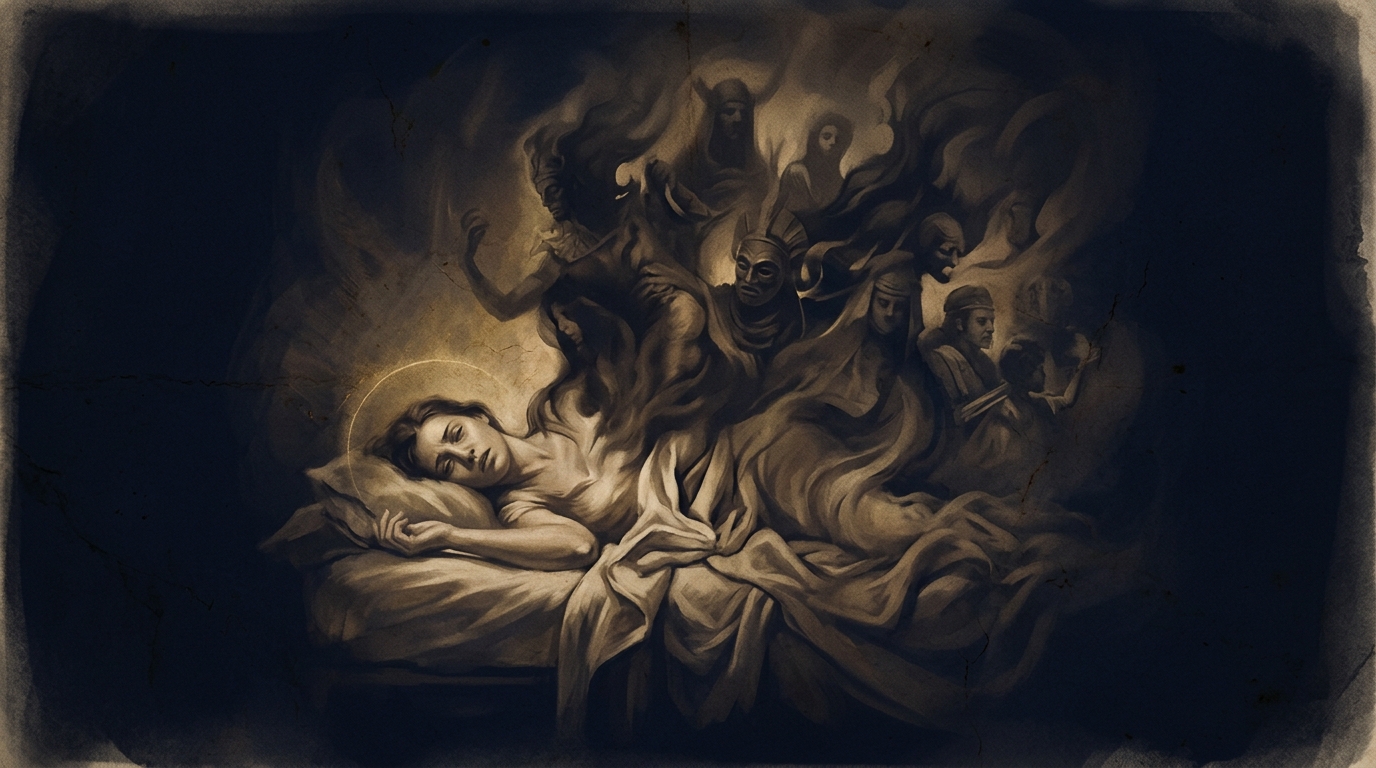
 Codex Illustration
Sleep Paralysis Entities
Across every known culture and recorded era, people awakening in paralyzed terror have reported a crushing presence, a crouching figure, or a malevolent visitor perched upon their chest — an experience neuroscience can partially explain, yet whose uncanny consistency across time and geography continues to unsettle researchers, theologians, and folklorists alike.
Overview
Sleep paralysis is a well-documented neurological event in which a person, transitioning between sleep and wakefulness, regains conscious awareness while the voluntary musculature remains in the atonic state that normally suppresses physical movement during REM sleep. This dissociation — consciousness without motor control — is estimated to affect between 8 and 50 percent of the general population at least once in a lifetime, with higher prevalence in clinical populations experiencing disrupted sleep, anxiety disorders, or narcolepsy. The neuroscience is not seriously contested: polysomnographic studies, sleep laboratory observations, and the documented pharmacology of REM atonia provide a robust mechanistic account. What remains genuinely puzzling is not that people become paralyzed, but what they consistently report seeing.
The phenomenology of sleep paralysis is cross-culturally homogeneous in ways that demand serious attention. Researchers J. A. Cheyne, S. D. Rueffer, and I. R. Newby-Clark, publishing in the journal Consciousness and Cognition (1999), identified three recurrent hallucinatory clusters: an ominous sensed presence perceived nearby but not yet visible; a visible intruder figure at or approaching the bedside; and a suffocating pressure on the chest accompanied by a looming or seated entity. The third cluster — sometimes termed the 'incubus' experience — is the source of centuries of folklore. In Newfoundland English tradition this entity is the 'Old Hag'; in Germanic-Scandinavian tradition it is the 'mare' that gives English its word 'nightmare'; Islamic cultures describe the 'jinn' that press upon sleepers; West African and Caribbean communities report 'kokma' or 'ole higue'; Japanese tradition names the phenomenon 'kanashibari'; and across the ancient world, Mesopotamian, Egyptian, and Hebrew sources all contain probable references to oppressive nocturnal visitors. The sheer convergence of these descriptions — the paralysis, the weight, the presence, the dread — constitutes one of the more extraordinary data points in the comparative phenomenology of altered states.
The scientific consensus holds that the experienced entities are hypnagogic or hypnopompic hallucinations, neurologically generated by the same brain systems that produce vivid dreaming, now intruding into a consciousness that believes itself awake. The threat-detection circuitry of the amygdala, deprived of normal motor corrective feedback, may generate increasingly vivid threat-constructs. Some researchers, including neuroscientist Patrick McNamara, have proposed that the universal character of these visions taps into deep evolutionary threat-recognition templates. Others, working within the broader research program of anomalous experience studies (represented by scholars such as Susan Blackmore, David Hufford, and Carlos Alvarado), note that Hufford's landmark ethnographic work, 'The Terror That Comes in the Night' (1982, University of Pennsylvania Press), demonstrated that experiencers' descriptions were remarkably consistent even when subjects had no prior cultural exposure to sleep paralysis folklore — a finding that complicates purely cultural transmission explanations.
The theological and paranormal dimensions of the question resist easy dismissal precisely because the experiences are so consistent and so affectively overwhelming. Within the Christian theological tradition, a minority of commentators have historically identified such entities with demonic oppression — an interpretation reflected in the medieval Latin term 'incubus' (from 'incumbere,' to lie upon) and the related 'succubus.' Modern charismatic and deliverance ministry literature frequently cites sleep paralysis as a site of genuine spiritual attack, while mainstream Christian scholarship treats such identification with considerable caution. Within the framework developed by scholar Michael Heiser, the category of 'divine council' theology accommodates genuine non-human intelligences operating within the created order, but Heiser himself consistently warned against careless attribution of every anomalous experience to demonic agency. The honest intellectual position is that the neurological account explains the mechanism without necessarily exhausting the meaning — a distinction worth preserving.
Key Claims
Timeline
Evidence
Multiple Perspectives
Biblical Lens
Scripture Threads
Sources & Further Study
Questions to Explore
Go Deeper Path
Follow the Thread
Continue the Investigation
You’ve reached the Full Archive portion of this Case File.
Ask the Archivist
about this fileSign in to ask the Archivist
Create a free account to ask the Archivist 1 grounded question each day, cited straight from the CODEX case files.
Discussion
0Share findings, questions, and evidence with fellow Seekers. Be respectful and cite sources where you can.
No comments yet. Be the first to open this thread.