
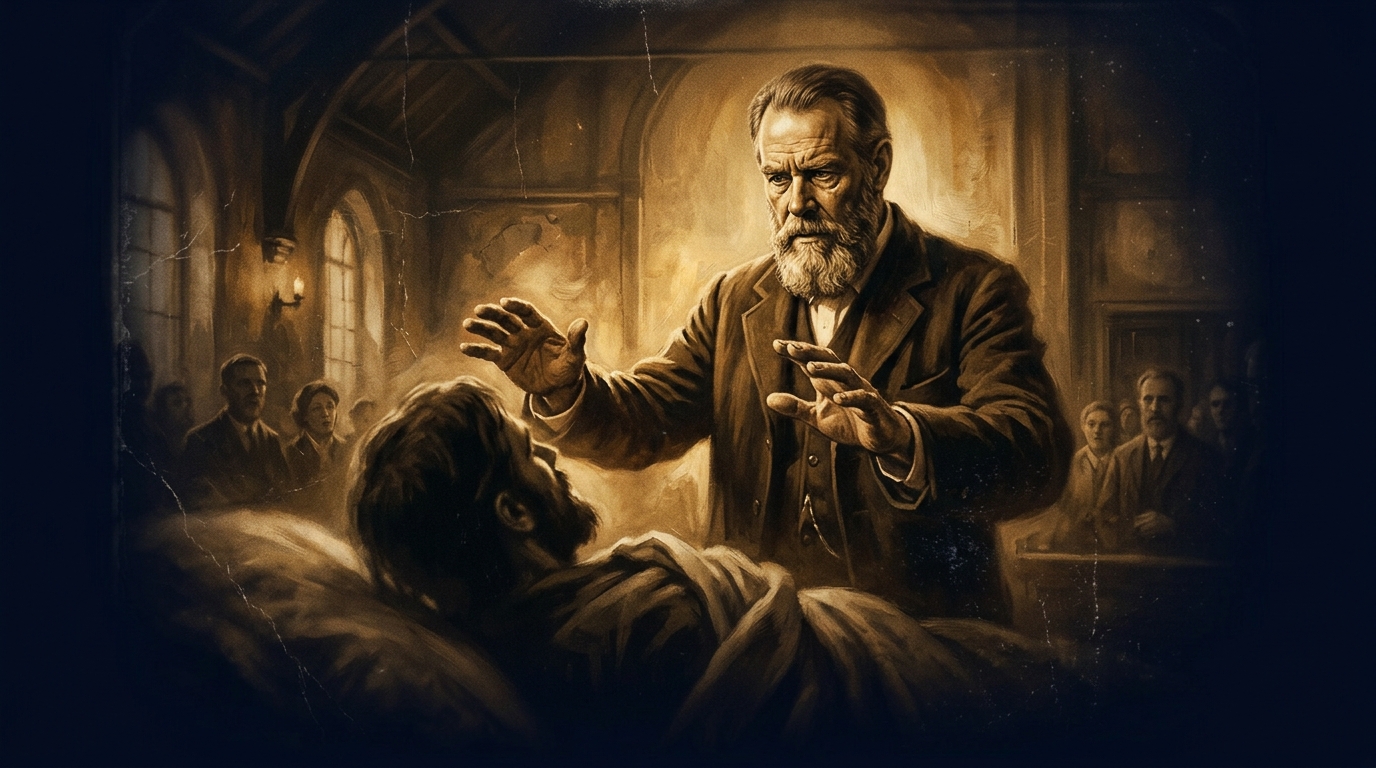
 Codex Illustration
Smith Wigglesworth
A barely-literate Yorkshire plumber who became one of the most formidable figures of early Pentecostalism, Smith Wigglesworth (1859–1947) left behind a trail of documented healings, reported resurrections, and an uncompromising theology of radical faith that still divides historians, theologians, and the devout nearly a century after his death.
Overview
Smith Wigglesworth was born on June 8, 1859, in Menston, Yorkshire, England, into poverty so acute that he worked the fields as a young child and never received a formal education. He could not read until his wife Polly taught him from the Bible itself — a fact he recounted publicly and without embarrassment throughout his ministry. Converted in his early years through Methodist and Salvation Army influences, Wigglesworth worked as a plumber in Bradford and gradually developed a reputation for praying for the sick in local meetings. The transforming catalyst came in 1907, when he traveled to Sunderland to investigate the Azusa Street-connected revival meetings being conducted by Anglican vicar Alexander Boddy at All Saints' Church. It was there, reportedly under the laying on of hands by Mrs. Mary Boddy, that Wigglesworth received what he called the baptism of the Holy Spirit with the evidence of speaking in tongues. By his own account, and by that of multiple witnesses, he returned to Bradford a changed man — and his public ministry entered a new and extraordinary phase.
Over the following four decades, Wigglesworth traveled across Britain, Scandinavia, Australia, New Zealand, South Africa, and the United States, conducting campaigns that drew enormous crowds and generated accounts of remarkable healings. His methods were, by any conventional standard, unconventional. He was known to strike the afflicted — punching or jabbing at tumors or diseased limbs through clothing — insisting he was hitting the affliction and not the person, an explanation his defenders took seriously and his critics found troubling. He was blunt, often abrasive, and operated without apology from a theological framework that can fairly be described as uncompromising: sickness was, in his view, an enemy to be confronted, and faith was not a sentiment but an active, combative force. His sermons were unpolished but widely reported as electrifying, and his phrase "only believe" became something of a ministerial signature. Eyewitness accounts — many recorded in the hagiographic but not entirely uncritical biography by Jack Hywel-Jones and the more widely circulated works of Albert Hibbert — describe healings of cancer, paralysis, blindness, and deafness.
The most extraordinary claims surrounding Wigglesworth are the reported raisings of the dead. Several accounts exist, the most frequently cited involving his own wife Polly, whom he is said to have raised from death by commanding her to return — a story complicated by the fact that Polly Wigglesworth died in 1913 and the documentation is entirely testimonial rather than medical. Additional resurrection accounts, numbering between one and fourteen depending on the source, circulate in Pentecostal literature but rest almost entirely on oral tradition and secondhand reports; none has been subjected to rigorous historical verification. Historians of Pentecostalism, including scholars such as David Dorries and those contributing to the Dictionary of Pentecostal and Charismatic Movements (Burgess and McGee, eds.), treat Wigglesworth as a historically significant figure while approaching the miracle accounts with appropriate methodological caution. The healings cannot be dismissed wholesale — too many independent witnesses across too many countries over too many decades attest to remarkable recoveries — but neither can they be verified to clinical or archival standards, and the interpretive gap between "remarkable recovery" and "miracle" is precisely where honest scholarship must pause.
Wigglesworth occupies a peculiar position in the history of Christian revivalism: he was simultaneously a product of his Wesleyan-holiness roots and a pioneer of Pentecostal power theology, a figure whose methods alarmed even sympathetic observers and whose legacy continues to animate debate about the nature of healing, faith, the charismatic gifts, and the relationship between raw spiritual power and ecclesiastical accountability. He reportedly prophesied a coming revival of Word and Spirit together — a prediction frequently cited in contemporary charismatic and neo-Pentecostal circles, though its original documentation is disputed. He died on March 12, 1947, reportedly while attending a funeral service. His influence on figures such as Lester Sumrall, Oral Roberts, and later generations of healing evangelists is historically traceable and constitutes his most undisputed legacy.
Key Claims
Timeline
Evidence
Multiple Perspectives
Biblical Lens
Scripture Threads
Sources & Further Study
Questions to Explore
Go Deeper Path
Follow the Thread
Continue the Investigation
You’ve reached the Full Archive portion of this Case File.
Ask the Archivist
about this fileSign in to ask the Archivist
Create a free account to ask the Archivist 1 grounded question each day, cited straight from the CODEX case files.
Discussion
0Share findings, questions, and evidence with fellow Seekers. Be respectful and cite sources where you can.
No comments yet. Be the first to open this thread.