
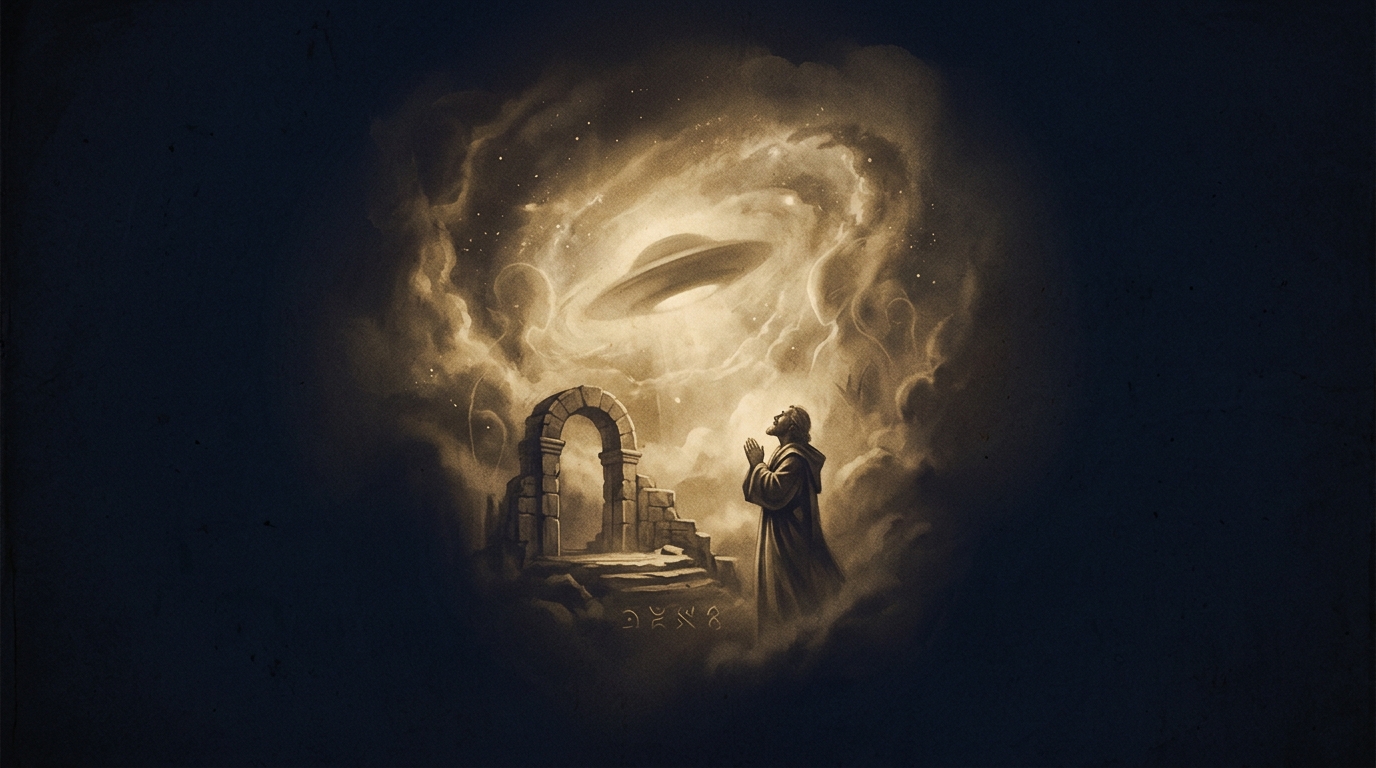
 Codex Illustration
Soft Disclosure
Soft disclosure is the theory — and, some argue, the observable pattern — that governments, intelligence agencies, and media institutions have for decades been deliberately acclimating the public to the reality of UAP and nonhuman intelligence through carefully managed revelations, entertainment, and partial admissions, rather than a single, formal announcement. Whether this represents an orchestrated policy, an emergent cultural process, or a self-fulfilling interpretive framework remains a deeply contested question at the intersection of political science, media theory, and the UAP phenomenon itself.
Overview
The term 'soft disclosure' circulates most heavily within UAP research communities, where it describes a hypothesized strategy in which governments — particularly the United States — release information about unidentified aerial phenomena in incremental, deniable steps rather than through any authoritative, comprehensive public statement. Proponents point to a sequence of events beginning with the 2017 publication of the 'Tic Tac' UAP footage in The New York Times, the establishment of the Pentagon's Advanced Aerospace Threat Identification Program (AATIP), and a succession of congressional hearings and legislative mandates that compelled the Department of Defense to report on UAP. To advocates of the soft-disclosure thesis, these events are not coincidental; they represent the visible surface of a managed, long-term acclimation campaign. Scholars and journalists caution, however, that bureaucratic momentum, genuine national security concerns, and the independent influence of investigative journalism can explain the same sequence without invoking deliberate psychological conditioning.
The cultural dimension of soft disclosure is perhaps its most intellectually interesting thread. Media theorists and UAP researchers alike have noted that commercial entertainment — science-fiction film, television, and fiction — may function as an acclimation mechanism whether or not it is consciously directed. Jacques Vallée, in works such as 'Messengers of Deception' (1979), argued decades ago that the UAP phenomenon arrives embedded in cultural narratives that shape how witnesses interpret and report it, and that intelligence agencies have at times exploited this ambiguity. Richard Dolan, in his two-volume 'UFOs and the National Security State,' documents the documented entanglement of the CIA and other agencies with UFO research organizations and media figures from the 1950s onward — a point of genuine historical record that does not, by itself, confirm a deliberate disclosure strategy but does establish a pattern of institutional interest in controlling the narrative. The documented existence of Operation Mockingbird, the CIA's Cold War media-influence program, provides a plausible structural precedent, though direct evidence linking it to UAP narrative management remains limited.
The modern UAP disclosure era — roughly 2017 to the present — has generated the most substantial recent evidence for the soft-disclosure thesis. The 2021 Office of the Director of National Intelligence Preliminary Assessment on UAP, the 2022 formation of the All-domain Anomaly Resolution Office (AARO), and the remarkable 2023 congressional testimony of David Grusch, a credentialed intelligence official who claimed under oath that the U.S. government possesses retrieved non-human craft and biological material, mark an unmistakable escalation in official engagement. None of these events constitutes confirmation of a formal disclosure strategy; all of them are consistent with one. The epistemological difficulty — distinguishing managed disclosure from organic institutional evolution — is genuinely intractable with publicly available evidence, and careful analysts acknowledge this openly.
A separate but related question concerns the purpose that a soft-disclosure strategy would serve, assuming it exists. Proposed rationales range from the pragmatic (preventing societal panic, protecting classified reverse-engineering programs, managing geopolitical advantage) to the more speculative (preparing the public for contact, conditioning acceptance of a new cosmological worldview, or — in more fringe formulations — engineering a false-flag extraterrestrial event). The most sober analysts, including those within the UAP research mainstream, tend to favor the simpler explanations: that government institutions are genuinely uncertain about what UAP are, that bureaucratic and legal pressures are driving disclosure more than any master plan, and that the 'soft' quality of current disclosure reflects institutional ambivalence rather than sophisticated orchestration. The truth, as with most phenomena at the intersection of secrecy and the unknown, likely resists any single interpretive frame.
Key Claims
Timeline
Evidence
Multiple Perspectives
Biblical Lens
Scripture Threads
Sources & Further Study
Questions to Explore
Go Deeper Path
Follow the Thread
Continue the Investigation
You’ve reached the Full Archive portion of this Case File.
Ask the Archivist
about this fileSign in to ask the Archivist
Create a free account to ask the Archivist 1 grounded question each day, cited straight from the CODEX case files.
Discussion
0Share findings, questions, and evidence with fellow Seekers. Be respectful and cite sources where you can.
No comments yet. Be the first to open this thread.