
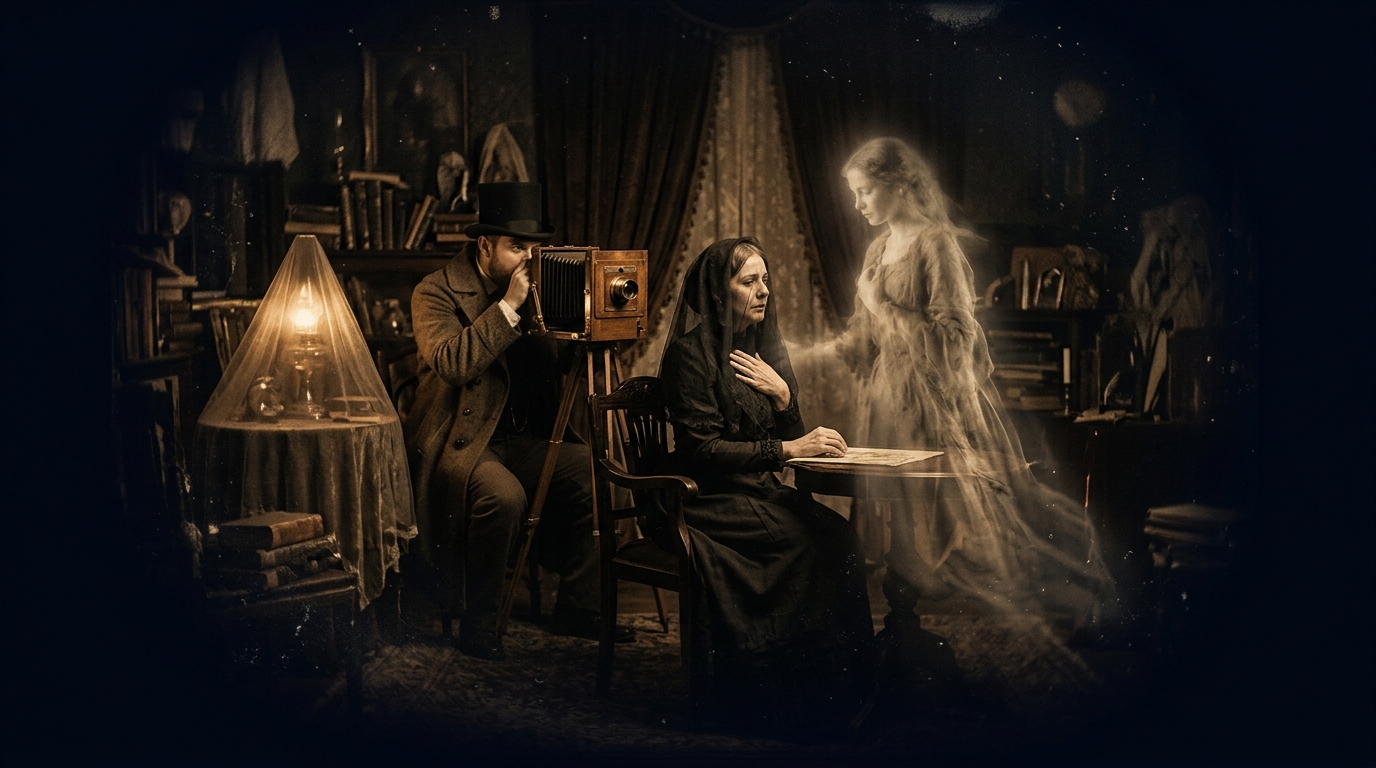
 Codex Illustration
Spirit Photography
Beginning in the 1860s, a wave of photographers claimed to capture the visible forms of the dead on photographic plates, generating both a popular movement of grief-stricken believers and a parallel tradition of exposure, fraud, and courtroom drama that illuminates the fragile boundary between hope, deception, and emerging media technology.
Overview
Spirit photography emerged in the United States in the early 1860s, during a period of profound national grief: the Civil War was producing staggering casualties, and the Spiritualist movement—already a decade old—had primed a substantial portion of the American public to believe that the living might communicate with the recently departed. It was in this atmosphere that Boston jewelry engraver William H. Mumler produced what he claimed were accidental 'extras'—faint, shrouded figures appearing beside living sitters in portrait photographs. Whether genuine visitations or artifacts of an incompletely cleaned glass negative, these images found an immediate and hungry audience. Mumler's most celebrated sitting was that of Mary Todd Lincoln, purportedly photographed with the shadowy figure of her assassinated husband standing behind her. The image remains one of the most discussed photographs of the nineteenth century, though its authenticity was contested even at the time.
The phenomenon quickly migrated to Britain, where it intersected with a more intellectually ambitious form of Spiritualism. Figures such as Frederick Hudson began producing spirit photographs in London by the early 1870s, attracting the attention of scientists and philosophers who were genuinely uncertain whether materialist science had fully mapped the boundaries of the natural world. The Society for Psychical Research (SPR), founded in London in 1882, approached such claims with unusual methodological care. Researchers including Frederic W. H. Myers, Edmund Gurney, and Frank Podmore applied something resembling proto-scientific protocols to evaluate mediumistic and photographic claims—concluding, in almost every examined case, that the photographic evidence did not withstand scrutiny, while occasionally treating certain testimonial cases as requiring further investigation. The SPR's archives represent a genuine historical document of a culture wrestling publicly with questions of death, evidence, and belief.
The mechanisms of fraud were, in retrospect, neither subtle nor difficult to execute. Double exposure—exposing the same photographic plate twice—allowed a 'spirit' form to be superimposed on any portrait sitting. Props, gauze, and pre-prepared positives served similar functions. Mumler himself was tried in New York in 1869 on charges of fraud, with prosecuting witnesses including the showman P. T. Barnum; the case ended in acquittal not because the photographs were vindicated, but because the legal standard of proof for fraud required demonstrating deliberate intent, which the prosecution could not establish to the court's satisfaction. This legal ambiguity became a template: spirit photographers repeatedly evaded definitive legal or scientific condemnation while their methods were steadily dismantled by skeptical investigators including the magician and escape artist Harry Houdini, who made the exposure of Spiritualist fraud a personal crusade in the 1920s.
Spirit photography did not expire with the Victorian era. The early twentieth century produced the Cottingley Fairy photographs (1917), elaborately staged images that briefly convinced even Arthur Conan Doyle, a committed Spiritualist. The Kirlian photography phenomenon of the 1970s rekindled interest in the idea that photographic technology might reveal dimensions of reality invisible to ordinary perception. In the digital age, 'orb' photographs—circular artifacts produced by light reflecting off airborne particles—have generated an enormous popular literature of claimed paranormal evidence. Each iteration repeats the same structural dynamic: a novel photographic technology produces anomalous images; a subset of observers interprets those images as evidence of the unseen; investigators trace the anomaly to a mundane technical cause; and the belief persists regardless. Spirit photography is, in this sense, less a chapter in the history of the paranormal than a recurring case study in the epistemology of grief, the authority of the image, and the social life of evidence.
Key Claims
Timeline
Evidence
Multiple Perspectives
Biblical Lens
Scripture Threads
Sources & Further Study
Questions to Explore
Go Deeper Path
Follow the Thread
Continue the Investigation
You’ve reached the Full Archive portion of this Case File.
Ask the Archivist
about this fileSign in to ask the Archivist
Create a free account to ask the Archivist 1 grounded question each day, cited straight from the CODEX case files.
Discussion
0Share findings, questions, and evidence with fellow Seekers. Be respectful and cite sources where you can.
No comments yet. Be the first to open this thread.