
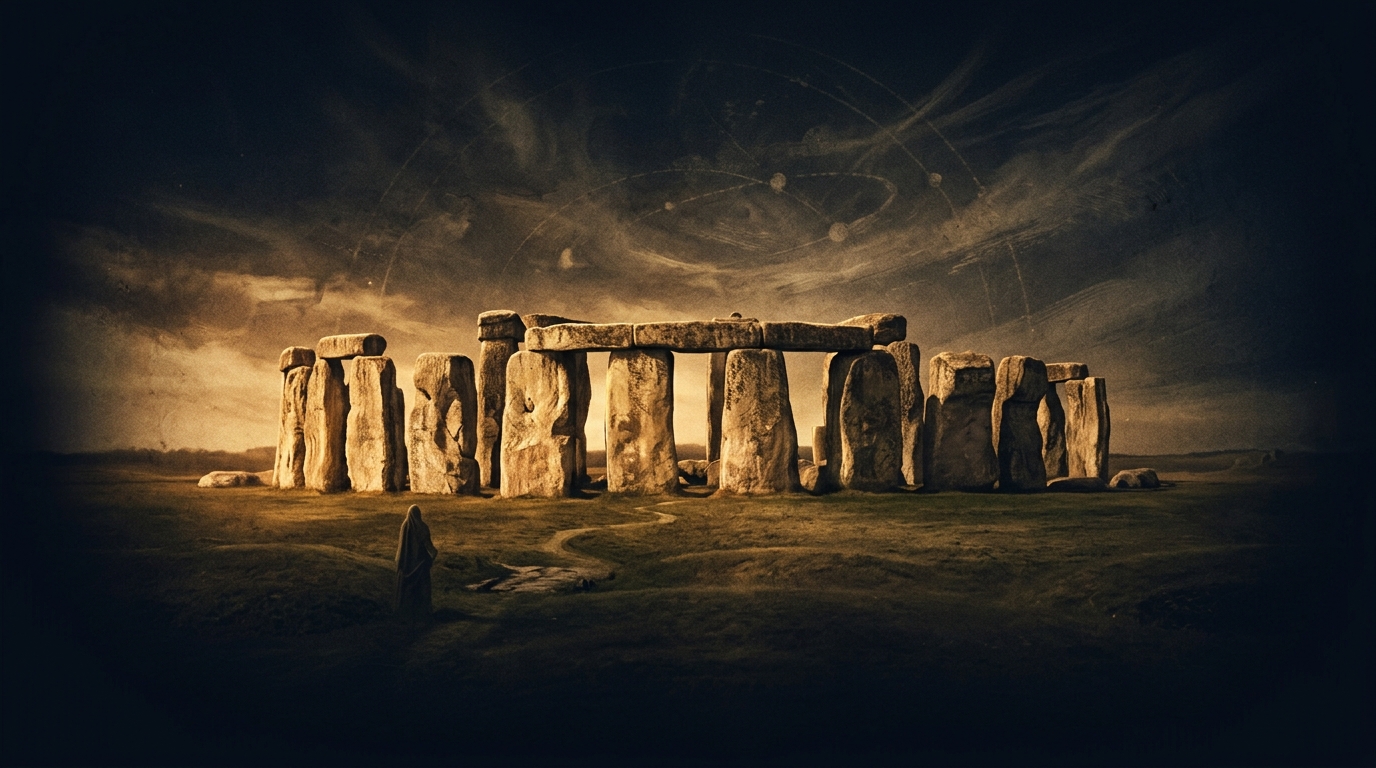
 Codex Illustration
Stonehenge
Rising from the Salisbury Plain in Wiltshire, England, Stonehenge is one of the most meticulously studied yet stubbornly enigmatic prehistoric monuments on earth — a multilayered ritual landscape whose builders, precise purposes, and extraordinary engineering methods remain subjects of active scholarly debate after nearly two centuries of serious investigation.
Overview
Stonehenge as it stands today is the final, weathered expression of a construction sequence spanning roughly fifteen hundred years, from approximately 3000 BC to 1500 BC. Archaeologists have identified at least three major phases of building activity. The earliest work involved the excavation of a circular ditch and bank, along with the probable erection of the now-vanished Aubrey Holes, which may have held upright timbers or bluestones. Centuries later, the bluestones themselves — volcanic dolerite and rhyolite from the Preseli Hills of southwest Wales, some 240 kilometres distant — were transported and erected at the site. The monument's most iconic phase introduced the enormous sarsen sandstone trilithons and the outer circle of sarsen uprights with their lintels, stones weighing between 20 and 50 tonnes that were quarried from Marlborough Downs roughly 25 kilometres to the north. The engineering achievement represented by this final phase remains without fully satisfying explanation, though experimental archaeology has demonstrated several plausible transport and erection methods using sledges, timber rollers, earthen ramps, and rope systems available within Neolithic and early Bronze Age technology.
The astronomical alignment of the monument is one of its most rigorously documented features. The primary axis of Stonehenge is oriented so that at summer solstice sunrise, light entering through the northeast opening falls upon the Altar Stone at the monument's center. At winter solstice sunset, the alignment operates in reverse. Scholars such as Aubrey Burl, and more recently Mike Parker Pearson of University College London, have argued that winter solstice may have been the more ritually significant orientation, consistent with evidence that Stonehenge was associated with the veneration of ancestors and the dead. Parker Pearson's Stonehenge Riverside Project (2003–2009) established a compelling interpretive framework linking Stonehenge to the nearby settlement site of Durrington Walls and the timber circle of Woodhenge, suggesting the entire complex formed a coordinated ceremonial landscape in which the river Avon connected a domain of the living with a domain of the dead.
The question of who built Stonehenge has been substantially advanced by modern isotopic and ancient DNA analysis. Earlier generations associated the monument primarily with the Beaker People, the Bronze Age population whose culture spread across western Europe after approximately 2500 BC. More recent aDNA research, including studies published in Nature (2019) and subsequent work, has confirmed that the Neolithic agricultural communities responsible for the earliest phases of Stonehenge were largely replaced by incoming Beaker-associated populations — a dramatic demographic event whose relationship to the monument's later phases remains under investigation. The bluestones, with their origins in Wales, suggest either long-distance trade networks of extraordinary reach, or, as some researchers have proposed, the dismantling and relocation of a preexisting Welsh monument, a hypothesis given some support by the discovery of Waun Mawn, a dismantled stone circle in Pembrokeshire excavated by Parker Pearson's team.
The cultural afterlife of Stonehenge is itself a subject of considerable scholarly interest. Medieval chroniclers including Geoffrey of Monmouth attributed the monument's construction to the wizard Merlin, who supposedly transported the stones from Ireland by magic — a legend that, while historically valueless, reflects genuine medieval awareness that the monument defied easy explanation. The eighteenth century saw antiquarians including John Aubrey and William Stukeley produce the first systematic surveys, though Stukeley's romantic association of the monument with the ancient Druids — a connection unsupported by chronology, since Stonehenge predates the Druidic tradition by over two millennia — proved extraordinarily durable in popular imagination. The site was designated a UNESCO World Heritage Site in 1986 and continues to attract roughly one million visitors annually, while remaining the subject of active excavation, survey, and isotopic analysis.
Key Claims
Timeline
Evidence
Multiple Perspectives
Biblical Lens
Scripture Threads
Sources & Further Study
Questions to Explore
Go Deeper Path
Follow the Thread
Continue the Investigation
You’ve reached the Full Archive portion of this Case File.
Ask the Archivist
about this fileSign in to ask the Archivist
Create a free account to ask the Archivist 1 grounded question each day, cited straight from the CODEX case files.
Discussion
0Share findings, questions, and evidence with fellow Seekers. Be respectful and cite sources where you can.
No comments yet. Be the first to open this thread.