
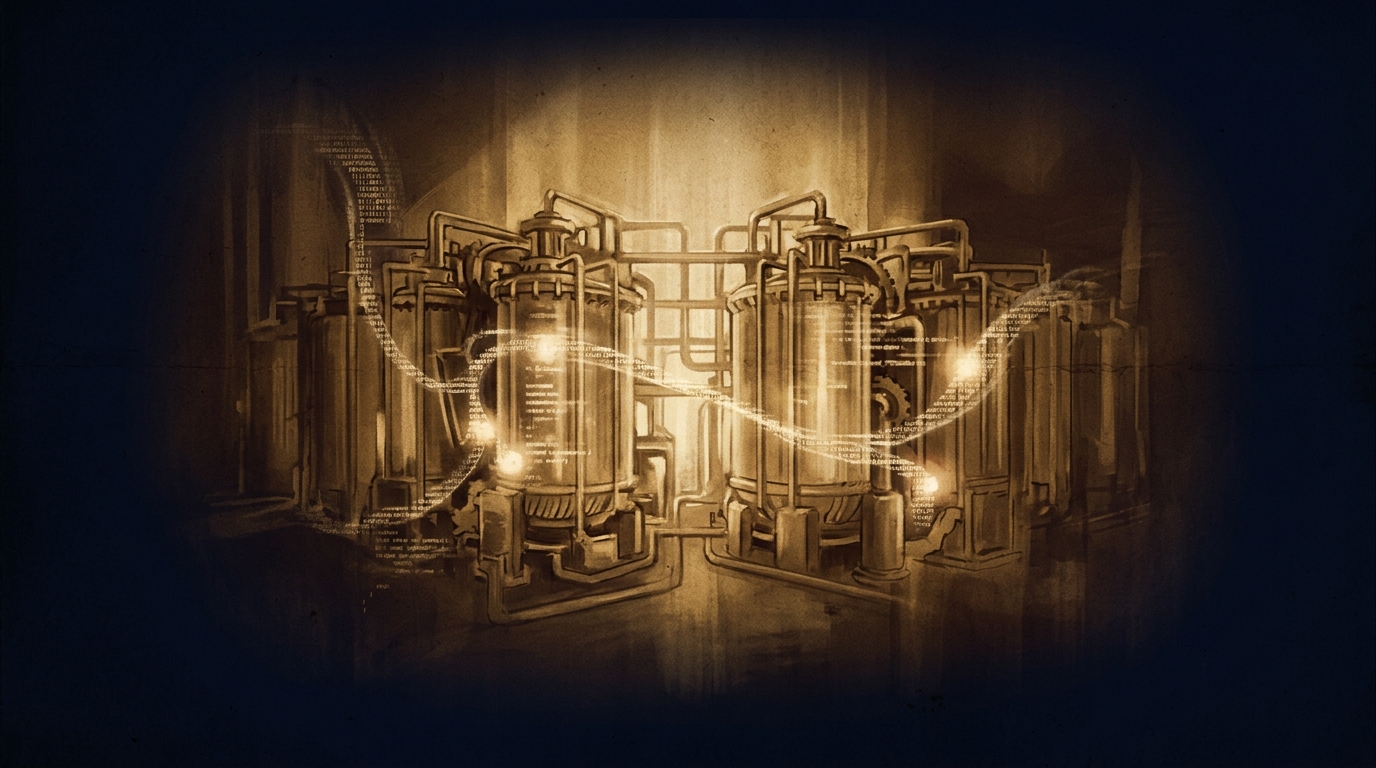
 Codex Illustration
Stuxnet and Cyberwarfare
Stuxnet — a sophisticated malicious computer worm discovered in 2010 — is widely regarded as the world's first confirmed cyberweapon deployed against physical infrastructure, reportedly designed by the United States and Israel to sabotage Iran's nuclear program. Its existence forced a fundamental rethinking of warfare, sovereignty, and the ethics of covert technological power.
Overview
In the summer of 2010, cybersecurity researchers at the Belarusian firm VirusBlkr and, shortly thereafter, analysts at Symantec and Kaspersky Lab identified an unusually sophisticated piece of malware circulating in Iranian industrial networks. What they eventually named 'Stuxnet' was unlike anything previously documented in the wild: a worm of extraordinary complexity — comprising roughly 500 kilobytes of code, exploiting four previously unknown 'zero-day' vulnerabilities simultaneously, and targeting a very specific model of Siemens programmable logic controller used to govern uranium enrichment centrifuges at the Natanz facility in Iran. The worm did not merely surveil or steal data; it physically destroyed hardware while instructing the control systems to report normal operation to their operators. An invisible hand was reaching across international borders to shatter machines — and the machines themselves were made to lie about it.
The technical attribution of Stuxnet to American and Israeli intelligence agencies emerged gradually through investigative journalism and later official acknowledgment. The New York Times journalist David Sanger, drawing on extensive government interviews, reported in 2012 — and elaborated in his book Confront and Conceal — that the operation was code-named 'Olympic Games' and had been initiated under the George W. Bush administration and accelerated under President Barack Obama. The operation reportedly set back Iran's uranium enrichment program by destroying an estimated one thousand centrifuges over a period of roughly eighteen months, between approximately 2007 and 2010. The worm appears to have escaped into the broader internet inadvertently, an unintended consequence that allowed the global cybersecurity community to dissect it. Iran's nuclear program, though delayed, was not halted.
The broader implications of Stuxnet extend far beyond the specific geopolitical contest between the United States, Israel, and Iran. It established a new category of state-sponsored action: the offensive cyberweapon designed to produce kinetic, physical effects without a formal declaration of war, without soldiers crossing a border, and without public accountability. Legal scholars, ethicists, and military strategists have since debated whether such operations constitute acts of war under international law, particularly in light of the United Nations Charter's prohibition on the 'use of force' between states. The Tallinn Manual, a non-binding but influential academic document produced under NATO auspices beginning in 2009, attempted to apply existing law-of-armed-conflict principles to cyberspace — though its conclusions remain contested among governments and legal authorities.
In the years following Stuxnet's discovery, its legacy has bifurcated. On one side, it inspired a generation of increasingly destructive cyberweapons, including Flame, Duqu, and Industroyer, the last of which disrupted Ukrainian electrical infrastructure in 2016 — an attack attributed to Russian military intelligence. On the other side, Stuxnet prompted a surge in global investment in industrial control system security, threat intelligence, and international cyber norms diplomacy. It remains a case study in the paradox of precision covert action: an operation designed to be surgically targeted became a template for indiscriminate proliferation, as its techniques were studied, adapted, and redeployed by state and non-state actors alike. The archive of human history now contains a new kind of weapon — one that kills machines quietly, in the dark, while making them smile.
Key Claims
Timeline
Evidence
Multiple Perspectives
Biblical Lens
Scripture Threads
Sources & Further Study
Questions to Explore
Go Deeper Path
Follow the Thread
Continue the Investigation
You’ve reached the Full Archive portion of this Case File.
Ask the Archivist
about this fileSign in to ask the Archivist
Create a free account to ask the Archivist 1 grounded question each day, cited straight from the CODEX case files.
Discussion
0Share findings, questions, and evidence with fellow Seekers. Be respectful and cite sources where you can.
No comments yet. Be the first to open this thread.