
 Codex Illustration
Sumer and the First Cities
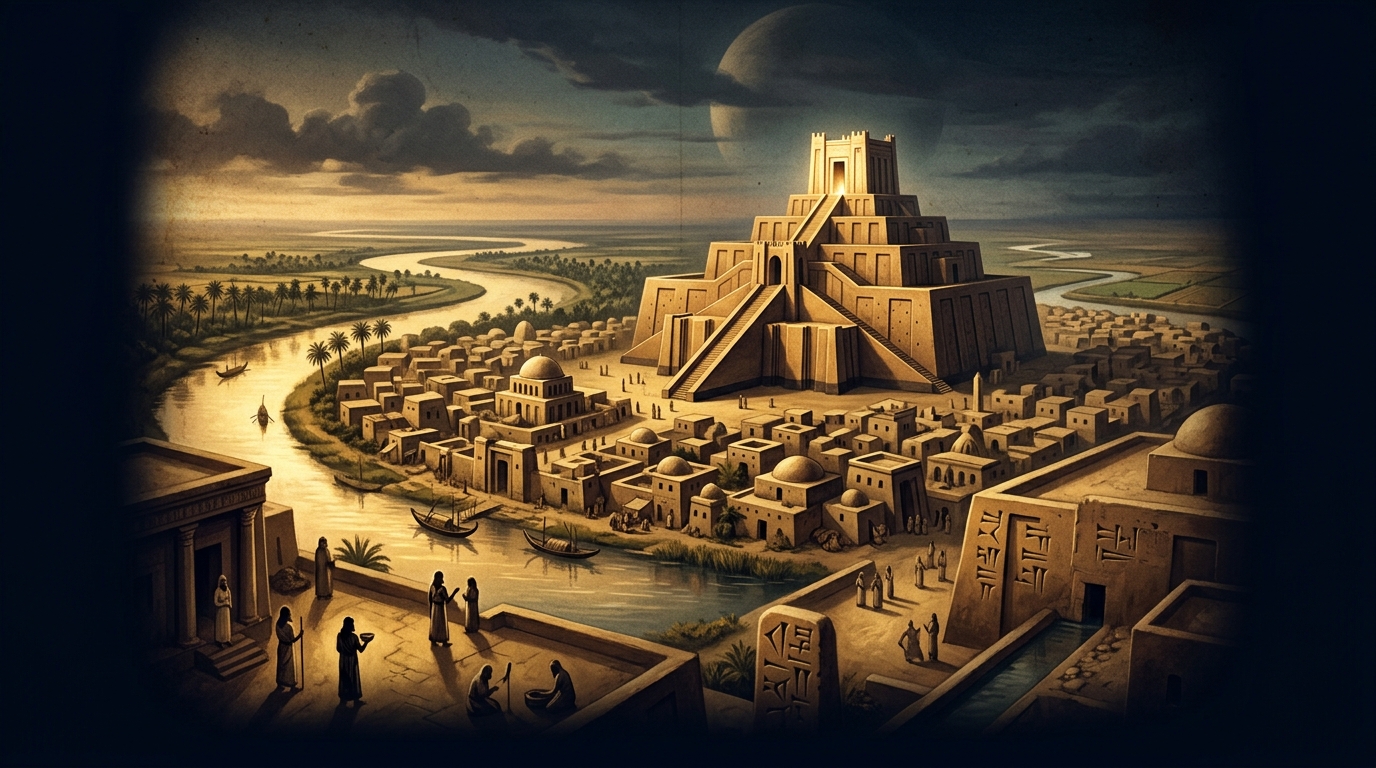
In the river plains of southern Mesopotamia, roughly 5,000 years ago, humanity built its first cities—inventing writing, codified law, monumental architecture, and cosmological myth on an unprecedented scale. Sumer remains one of the most consequential and debated civilizations in the study of human origins.
Overview
Sumer, located in the alluvial flatlands between the Tigris and Euphrates rivers in what is now southern Iraq, is widely recognized by mainstream scholarship as one of the earliest cradles of urban civilization. By approximately 3500–3000 BC, settlements such as Uruk, Eridu, Lagash, Nippur, and Ur had developed into complex city-states with centralized administration, monumental temple architecture (the ziggurat), irrigation agriculture, and—critically—the world's first known writing system: cuneiform. This script, pressed into wet clay tablets, preserves the oldest literature, legal codes, hymns, astronomical records, and mythological narratives yet discovered, making Sumer an irreplaceable window into early human intellectual and religious life.
The civilization's origins remain a subject of scholarly debate. The Ubaid period (c. 6500–3800 BC) represents the archaeological predecessor culture, during which communal temples and village-based agriculture first appeared. The subsequent Uruk period (c. 4000–3100 BC) saw an explosion of urban complexity, long-distance trade networks stretching from Anatolia to the Indus Valley, and the emergence of a priestly-administrative class. Sumerian city-states were theocratic in character: each city was considered the earthly estate of a patron deity, managed by a priest-king (en or lugal) on that deity's behalf. The great ziggurats—stepped temple platforms rising above the flat plain—were conceived as cosmic mountains, meeting points between heaven and earth.
Sumerian religion produced a rich pantheon of deities—An, Enlil, Enki, Inanna, Nanna, and dozens more—organized in a hierarchical divine assembly that bears striking structural resemblance to the Divine Council frameworks found in ancient Canaanite and Hebrew literature. The myths surrounding these gods, including the Eridu Genesis flood narrative, the descent of Inanna to the underworld, and the Gilgamesh cycle, anticipate themes that reappear across Near Eastern cultures for millennia. Scholars in the field of comparative ancient Near Eastern studies, including Thorkild Jacobsen, Samuel Noah Kramer, and more recently scholars at the Oriental Institute, have systematically documented the theological and literary continuities between Sumerian, Akkadian, Babylonian, and biblical traditions.
The civilization was eventually absorbed by the Akkadian Empire under Sargon of Akkad (c. 2334 BC), though Sumerian cultural and religious forms persisted under Akkadian, Babylonian, and Assyrian rule for nearly two millennia. Sumerian itself survived as a liturgical and scholarly language long after it ceased to be spoken natively—an ancient analogue to Latin's role in medieval Europe. The decipherment of cuneiform in the nineteenth century, led by figures such as Henry Rawlinson and George Smith, opened an entirely new chapter in our understanding of biblical backgrounds, comparative mythology, and the deep history of human civilization.
Timeline
Evidence
Multiple Perspectives
Biblical Lens
Scripture Threads
Sources & Further Study
Questions to Explore
Follow the Thread
Continue the Investigation
You’ve reached the Full Archive portion of this Case File.
Ask the Archivist
about this fileSign in to ask the Archivist
Create a free account to ask the Archivist 1 grounded question each day, cited straight from the CODEX case files.
Discussion
0Share findings, questions, and evidence with fellow Seekers. Be respectful and cite sources where you can.
No comments yet. Be the first to open this thread.