
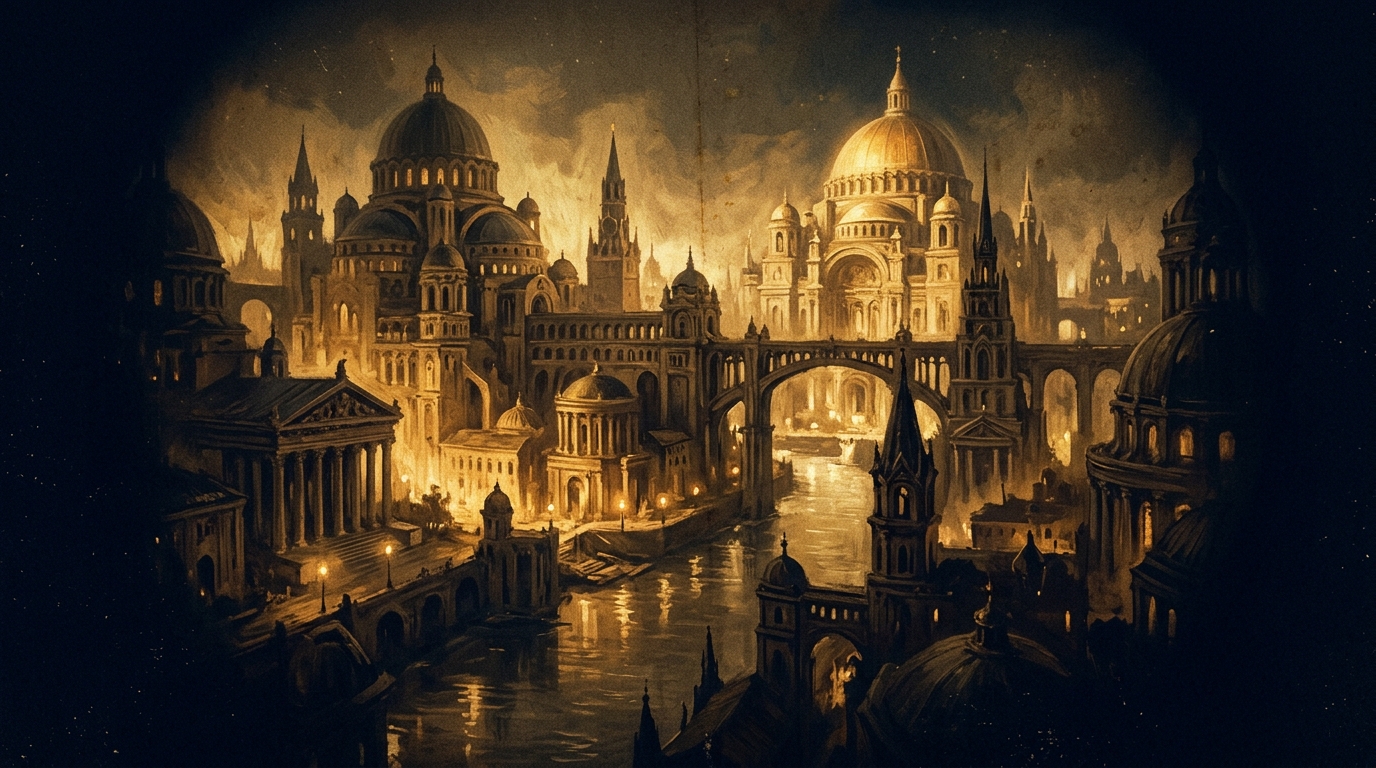
 Codex Illustration
Tartaria
A sprawling internet-born theory proposes that an advanced global civilization called the 'Tartarian Empire' was deliberately erased from history, its monumental architecture repurposed or destroyed, and its memory suppressed — a claim that collapses under historical scrutiny but illuminates genuine anxieties about institutional power, the reliability of the historical record, and the human need for a hidden past.
Overview
The name 'Tartaria' is not an invention of the internet age. Historical maps and early modern European texts — from the cartography of Abraham Ortelius in the sixteenth century to the diplomatic dispatches of seventeenth-century Jesuit missionaries — routinely labeled a vast, loosely defined region of Central Asia as 'Tartary' or 'Grand Tartary.' This geographic term, derived from the Tatar peoples who dominated the Eurasian steppe following the Mongol expansion, appears in the work of scholars such as John Bell, whose 1763 account of travels to China traversed what he called 'Great Tartary,' and in the encyclopedic geographic traditions of the early Royal Society. The region was real, the peoples were real, and the cartographic label persisted in European usage well into the eighteenth century before gradually being replaced by more precise national and regional designations. There is no scholarly mystery here: 'Tartary' was a geographic convention, not an empire with a capital, a dynasty, or a unified state apparatus.
The contemporary 'Tartarian Empire' theory, which appears to have crystallized on platforms such as Reddit, YouTube, and Telegram approximately between 2017 and 2020, reinterprets this historical cartographic convention as evidence of a suppressed advanced civilization. Proponents — the theory has no single founder, though certain YouTube channels and Telegram communities amplified it significantly — argue that nineteenth-century buildings exhibiting ornate Beaux-Arts, Second Empire, or neo-Gothic architecture were not constructed by the societies that claimed them, but are remnants of a technologically sophisticated pre-reset civilization. World's Fairs, particularly the 1893 World's Columbian Exposition in Chicago and the 1900 Paris Exposition Universelle, are presented as anomalous: the theory contends that temporary exhibition structures of such scale and grandeur could not have been built so rapidly by known Victorian-era labor and technology, and must therefore be remnants of prior, more advanced construction. This argument disregards the well-documented — and extensively photographed and reported — construction of these fairs, the thousands of laborers employed, the detailed architectural contracts, and the contemporary journalism covering every phase of their building.
A related and partially overlapping framework known as the 'Mud Flood' theory holds that a catastrophic event — variously described as a deluge of mud, an atmospheric cataclysm, or a deliberately induced disaster — buried the lower stories of Tartarian buildings worldwide, explaining why many older structures appear to have partially subterranean ground floors. Proponents cite photographs of buildings with ground-floor windows at or near street level as evidence of buried lower stories, and point to the repurposing of old European and American civic buildings as schools, prisons, and asylums as evidence of colonization by a conquering reset civilization. Architectural historians and urban geographers note, however, that the appearance of semi-subterranean ground floors is well explained by centuries of street-level accumulation, deliberate raising of road grades for drainage, and the adaptation of older buildings to changing urban contexts — all processes documented in municipal records across European and American cities. The theory additionally relies on selective photographic reading and frequently misidentifies building dates or architectural styles.
What makes the Tartaria phenomenon worthy of careful archival attention is not its historical claims — which do not survive contact with primary sources — but what it reveals about the epistemological climate of the early twenty-first century. The theory emerged alongside a broader crisis of institutional trust, a flourishing of alternative history content on algorithmically driven platforms, and a genuine (if often misdirected) public interest in the possibility that mainstream history conceals uncomfortable truths. Some scholars of conspiracy culture, including those working in the tradition of Michael Barkun's research on stigmatized knowledge and conspiracy belief, have noted that the Tartaria narrative functions less as a historical argument and more as a mythological system: it provides a coherent villain (elites who reset civilization), a lost golden age (Tartarian grandeur), and a community of enlightened discoverers. Its relationship to demonstrable historical evidence is, at best, incidental.
Key Claims
Timeline
Evidence
Multiple Perspectives
Biblical Lens
Scripture Threads
Sources & Further Study
Questions to Explore
Go Deeper Path
Follow the Thread
Continue the Investigation
You’ve reached the Full Archive portion of this Case File.
Ask the Archivist
about this fileSign in to ask the Archivist
Create a free account to ask the Archivist 1 grounded question each day, cited straight from the CODEX case files.
Discussion
0Share findings, questions, and evidence with fellow Seekers. Be respectful and cite sources where you can.
No comments yet. Be the first to open this thread.