
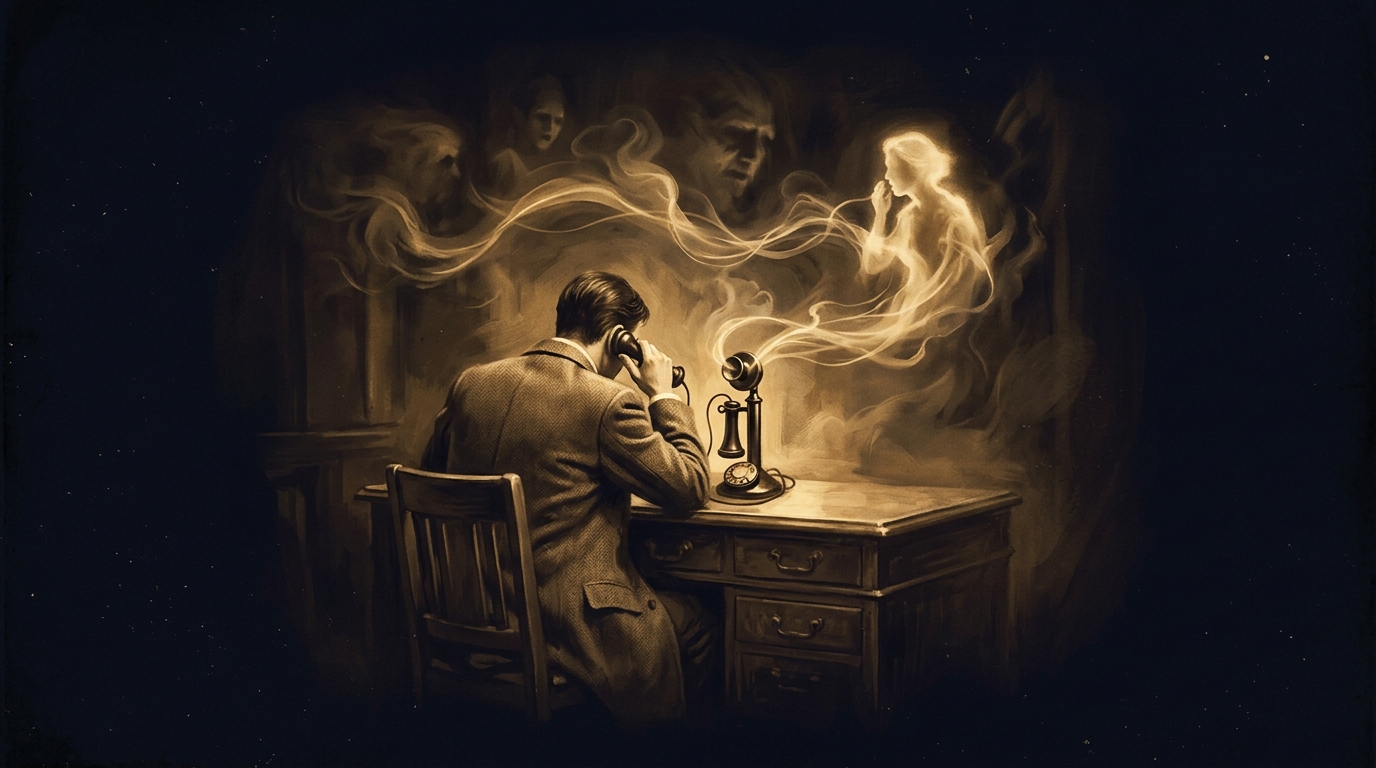
 Codex Illustration
Telephone Calls from the Dead
Across decades of documented eyewitness accounts, individuals have reported receiving telephone calls — and later, voicemails and digital messages — from people who were, at the time of contact, already deceased. Whether these accounts represent grief-induced hallucination, genuine anomaly, or something stranger still, they constitute one of the more persistent and quietly unsettling categories of reported paranormal experience.
Overview
The phenomenon broadly categorized as 'telephone calls from the dead' sits at an unusual crossroads between bereavement psychology, parapsychology, and folklore. The reports are remarkably consistent in their structure: a bereaved individual receives a call from a deceased relative or friend, often within hours or days of a death, sometimes before news of the death has been received. The voice is described as recognizable but faint, often accompanied by static or interference, and the call typically ends abruptly before the recipient can fully process what is happening. In a smaller subset of reports, the calls allegedly arrive days, weeks, or even years after a death — and in some accounts, the caller appears to convey information the living recipient could not otherwise have known.
The earliest serious academic attention to this phenomenon came through parapsychological researchers working within the broader framework of Electronic Voice Phenomena (EVP) in the mid-twentieth century. The work of Latvian psychologist Konstantīns Raudive and Swedish painter Friedrich Jürgenson in the 1960s and 1970s — both of whom reported capturing anomalous voices on magnetic tape — laid conceptual groundwork for later researchers interested in electronic contact with the deceased. The specific category of telephone contact was later gathered and analyzed by parapsychologists D. Scott Rogo and Raymond Bayless, whose 1979 book *Phone Calls from the Dead* (Prentice-Hall) remains the foundational text in this niche. Rogo and Bayless catalogued and classified hundreds of firsthand accounts, noting recurring patterns that they argued exceeded mere coincidence or grief projection.
The psychological literature offers more cautious interpretations. Grief researchers have long documented auditory and visual hallucinations as relatively common features of acute bereavement — studies cited in journals such as *Omega: Journal of Death and Dying* suggest that a substantial minority of bereaved individuals report some form of sensory experience of the deceased. From this perspective, a telephone call from the dead may represent a particularly vivid and technologically mediated form of grief hallucination, shaped by the cultural ubiquity of the phone as an intimate communication device. The brain, under extreme stress and longing, may generate extraordinarily realistic perceptual experiences that feel externally sourced. This explanation is scientifically parsimonious and widely accepted in clinical psychology, though it does not easily account for all reported features — particularly accounts in which call logs, voicemail recordings, or corroborating witnesses appear to support the experience having occurred.
In the contemporary digital era, the phenomenon has evolved in intriguing and complicating directions. Reports now include voicemails, text messages, and even social media notifications purportedly originating from deceased individuals — sometimes from accounts or devices that, by all ordinary measures, should no longer be active. A small number of these have been documented with preserved recordings or screenshots, though authentication of such evidence is persistently difficult. Researchers such as Gary Schwartz at the University of Arizona's Human Energy Systems Laboratory have explored adjacent questions about the survival of consciousness and mediated contact, though such work remains on the periphery of mainstream science. The phenomenon refuses neat resolution: too consistent in its reported features to dismiss wholesale, too dependent on unverifiable testimony to confirm.
Key Claims
Timeline
Evidence
Multiple Perspectives
Biblical Lens
Scripture Threads
Sources & Further Study
Questions to Explore
Go Deeper Path
Follow the Thread
Continue the Investigation
You’ve reached the Full Archive portion of this Case File.
Ask the Archivist
about this fileSign in to ask the Archivist
Create a free account to ask the Archivist 1 grounded question each day, cited straight from the CODEX case files.
Discussion
0Share findings, questions, and evidence with fellow Seekers. Be respectful and cite sources where you can.
No comments yet. Be the first to open this thread.