
 Codex Illustration
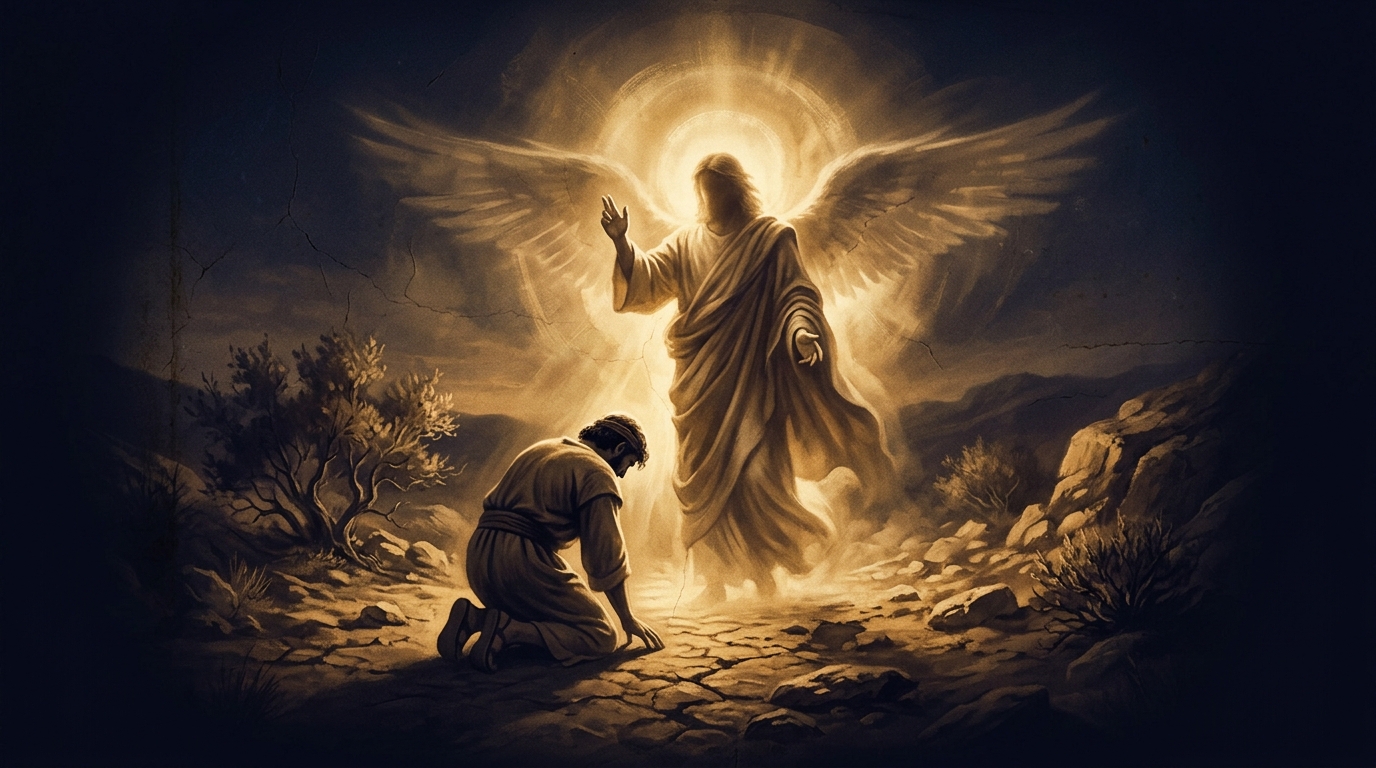
The Angel of the LORD
Throughout the Hebrew Bible, a figure identified as both a distinct messenger and Yahweh himself appears at pivotal moments in Israel's history — speaking in the first person as God, receiving worship, and bearing the divine Name, yet also described in terms that suggest a being sent from God rather than identical to him.
Overview
Few figures in the biblical corpus generate as much theological inquiry as the malʾak YHWH — the Angel of the LORD. Unlike the broad class of heavenly messengers (malʾakim) who populate biblical narrative as envoys and intermediaries, this particular figure operates in a category that consistently blurs the boundary between divine identity and divine agency. In Genesis 16, the Angel of the LORD encounters Hagar in the wilderness, addresses her with intimate knowledge of her circumstances, and she responds by naming the well 'Beer-lahai-roi' and identifying her interlocutor with the LORD himself — asking, 'Have I really seen God and remained alive?' In Genesis 22, the same figure interrupts the binding of Isaac, speaking from heaven in Yahweh's own voice: 'By myself I have sworn, declares the LORD.' The pattern repeats with Jacob in Genesis 32 and 48, where wrestling with a 'man' (ish) who blesses Jacob and refuses to disclose his name is later interpreted by Jacob and the narrator alike as an encounter with God or a divine figure of the highest order (cf. Hosea 12:4, which identifies this figure as a malʾak). The textual evidence for this figure is, in strictly documentary terms, unambiguous: the texts as they stand describe a being who is simultaneously sent and sender, identified and distinct.
The key passages cluster around moments of divine commissioning and covenant. At the burning bush in Exodus 3, the text opens by saying 'the Angel of the LORD appeared to him in a flame of fire out of the midst of a bush' (Exodus 3:2, ESV), yet by verse 4 it is plainly 'God' who calls to Moses, and by verse 6 the speaker declares: 'I am the God of your father, the God of Abraham, the God of Isaac, and the God of Jacob.' This grammatical oscillation between the Angel and Yahweh is not textual confusion or a seam between sources — it appears in contexts where a single coherent narrative is operative. In Joshua 5:13–15, a 'commander of the army of the LORD' appears to Joshua before Jericho, demands that Joshua remove his sandals because the ground is holy, and echoes almost precisely the theophany at the burning bush — a detail ancient readers would not have missed. The accounts in Judges 6 (Gideon) and Judges 13 (Manoah and his wife) further amplify the paradox: in each case the recipient of the visitation fears death because they have 'seen the Angel of the LORD face to face,' a fear that only makes sense if the figure bore full divine presence, not merely delegated authority.
Three major interpretive traditions have emerged in response to this textual phenomenon. The first, common in rabbinic and some Christian theological frameworks, holds that the figure is a created angelic being who speaks with delegated divine authority — the first-person divine speech being a form of the ancient Near Eastern 'messenger formula' in which the envoy speaks directly in the voice of the sender. This reading preserves strict monotheistic categories but struggles to explain why recipients fear death, why the figure forgives sin (Exodus 23:21), and why its Name is said to be within it in a way unique among heavenly beings. The second interpretation, extensively documented in Second Temple Jewish literature and analyzed academically by Alan Segal in his landmark study Two Powers in Heaven (Harvard University Press, 1977), identifies this figure as a 'second Yahweh' — a divine being of the highest heavenly council who shares the divine Name and divine authority in a manner that troubled later rabbinic authorities enough to declare the 'two powers' reading a heresy. Michael Heiser, drawing on Segal and on Ugaritic divine council texts, argues in The Unseen Realm (Lexham Press, 2015) that the biblical authors themselves operated within a divine-council framework in which a second divine figure — bearing the Name, identified with the divine glory, and functioning as the visible face of the invisible God — was a coherent theological category, not a later Christian imposition. The third interpretation, standard in classical Christian theology from Justin Martyr onward, reads these appearances as pre-incarnate manifestations of the Son — Christophanies — wherein the second person of the Trinity is the agent through whom the invisible Father is made visible and present in covenant history.
These three interpretations are not merely academic distinctions; they illuminate how communities of faith have understood the relationship between divine unity and divine differentiation across millennia. The theological stakes are high: how one reads the malʾak YHWH influences how one interprets the trajectory of Israelite monotheism, the coherence of Second Temple Jewish theology, the development of Trinitarian doctrine, and ultimately how the Johannine prologue ('In the beginning was the Word') and the Pauline Christ-hymns (Colossians 1:15–17; Philippians 2:6–11) ought to be situated within their biblical-theological heritage. The texts themselves are ancient and documented; the identity they describe remains one of Scripture's most generative and carefully contested mysteries.
Key Claims
Timeline
Evidence
Multiple Perspectives
Biblical Lens
Scripture Threads
Sources & Further Study
Questions to Explore
Go Deeper Path
Follow the Thread
Continue the Investigation
You’ve reached the Full Archive portion of this Case File.
Ask the Archivist
about this fileSign in to ask the Archivist
Create a free account to ask the Archivist 1 grounded question each day, cited straight from the CODEX case files.
Discussion
0Share findings, questions, and evidence with fellow Seekers. Be respectful and cite sources where you can.
No comments yet. Be the first to open this thread.