
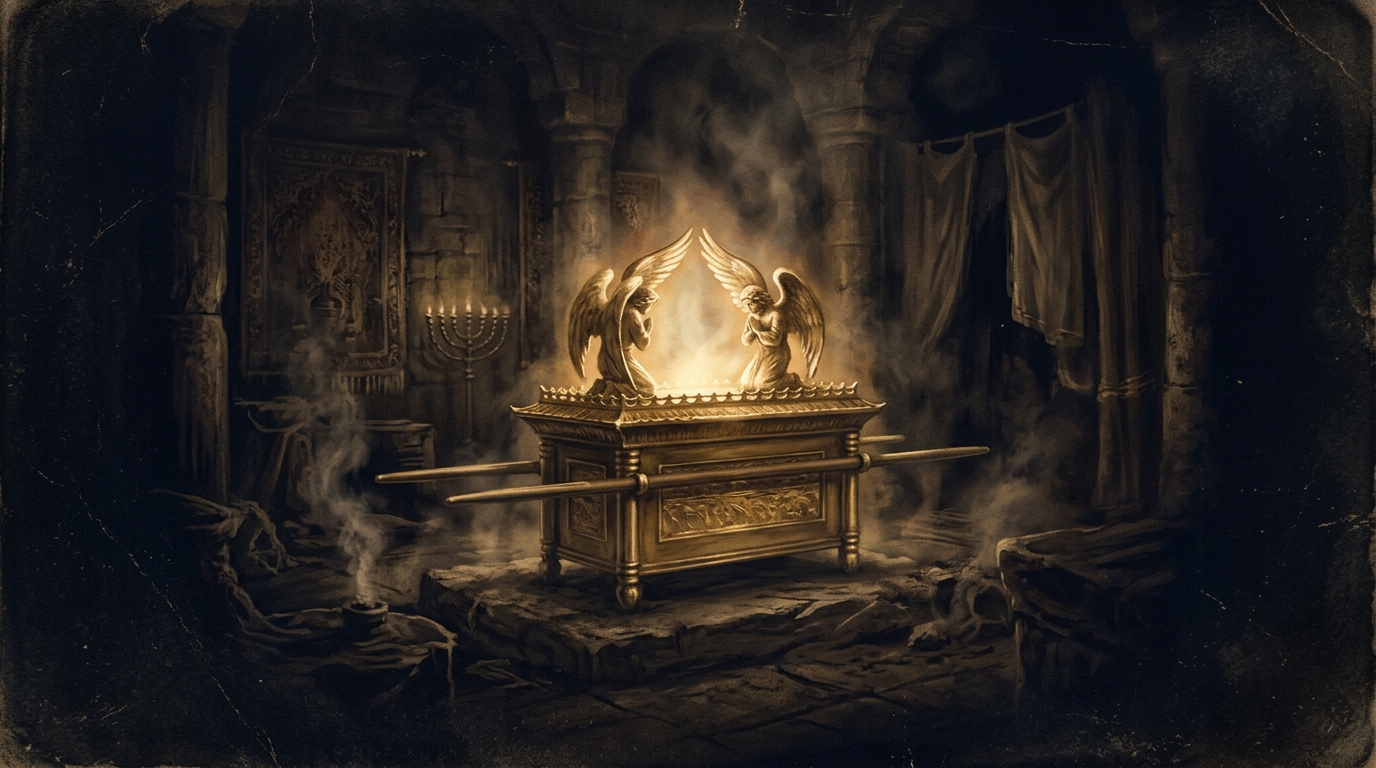
 Codex Illustration
The Ark of the Covenant
The Ark of the Covenant — a gilded acacia-wood chest housing the tablets of the Decalogue — stands as the most numinous object in the Hebrew Bible, the locus of divine presence, the instrument of judgment, and, after its disappearance from the historical record sometime before or during the Babylonian period, one of antiquity's most enduring unsolved mysteries.
Overview
In the Pentateuchal narrative, the Ark was constructed in the Sinai wilderness according to precise divine specifications delivered to Moses (Exodus 25:10–22), serving simultaneously as a mobile throne-footstool for Israel's God, a container for the covenant tablets, and the sole authorized site of atonement within the tabernacle system. Its dimensions — two and a half cubits long, one and a half cubits wide and tall — and its gold-covered mercy seat flanked by two cherubim are described with an architectural precision unusual even within the broader tabernacle prescriptions. Scholars working in the tradition of the ancient Near East, including scholars such as Menahem Haran and John Monson, have noted extensive comparative material from Egyptian and Canaanite portable shrine traditions, suggesting that the Ark's basic form belonged to a recognizable category of sacred regalia in the late Bronze Age Levant, even if its theological function was distinctive.
The Ark's career in the biblical narrative spans roughly four centuries: from the wilderness period through the conquest of Canaan, during which it is depicted as both military palladium and divine weapon (Joshua 3–6; Numbers 10:35–36), to its turbulent tenure among the Israelite tribes, its catastrophic capture by the Philistines and subsequent return (1 Samuel 4–6), its eventual installation in Jerusalem under David and later in Solomon's Temple (2 Samuel 6; 1 Kings 8). This arc of the narrative is given strong coherence by the biblical theology of divine presence: the Ark is not merely an object of veneration but the designated site where Israel's God chose to 'meet' with the covenant community. The deaths of Uzzah (2 Samuel 6:6–7) and the earlier Bethshemeshites (1 Samuel 6:19) — episodes that modern readers often find troubling — are consistently interpreted within the text as consequences of breaching the holiness protocols surrounding the object, a concern Michael Heiser and others have situated within the broader biblical logic of sacred space and the danger of unmediated divine encounter.
The Ark's last unambiguous biblical appearance is in 2 Chronicles 35:3, a passage in which King Josiah orders the Levites to restore it to the Temple during his seventh-century reforms — a reference which itself implies the Ark had been removed at some earlier point, possibly during the syncretistic reigns of Manasseh. After this, the Hebrew Bible offers no account of the Ark's fate during the Babylonian destruction of Jerusalem in 586 BC, a silence that is itself historically significant. The prophet Jeremiah (3:16) anticipates a future in which the Ark will be neither missed nor remade, a statement that has been read as suggesting the object had already become eschatologically secondary, and the deuterocanonical 2 Maccabees 2:4–8 preserves an ancient tradition that Jeremiah himself hid the Ark in a cave on Mount Nebo before the Babylonian invasion — a tradition that, while unverifiable, indicates that Second Temple Jews considered the Ark's whereabouts a live and serious question.
Since late antiquity, the search for the Ark has generated a vast literature ranging from rigorous archaeological inquiry to popular speculation. The Ethiopian Orthodox Church maintains, through an unbroken living tradition, that the Ark resides in the St. Mary of Zion church complex in Axum, Ethiopia — brought there, according to the Kebra Nagast, by Menelik I, son of Solomon and the Queen of Sheba. Mainstream archaeologists and historians regard this claim as historically unverifiable and most likely legendary, though the tradition itself is ancient and culturally serious. Other proposals have located the Ark beneath the Temple Mount in Jerusalem (a site inaccessible to systematic archaeology due to political and religious sensitivities), in the caves of Qumran, at Elephantine in Egypt, in Jordan, or in a range of European locations connected to Knights Templar lore. None of these hypotheses has produced credible physical evidence. What remains undisputed is the Ark's extraordinary theological and cultural weight: no other artifact in the Abrahamic tradition has generated comparable eschatological expectation, scholarly debate, and popular imagination.
Key Claims
Timeline
Evidence
Multiple Perspectives
Biblical Lens
Scripture Threads
Sources & Further Study
Questions to Explore
Go Deeper Path
Follow the Thread
Continue the Investigation
You’ve reached the Full Archive portion of this Case File.
Ask the Archivist
about this fileSign in to ask the Archivist
Create a free account to ask the Archivist 1 grounded question each day, cited straight from the CODEX case files.
Discussion
0Share findings, questions, and evidence with fellow Seekers. Be respectful and cite sources where you can.
No comments yet. Be the first to open this thread.