
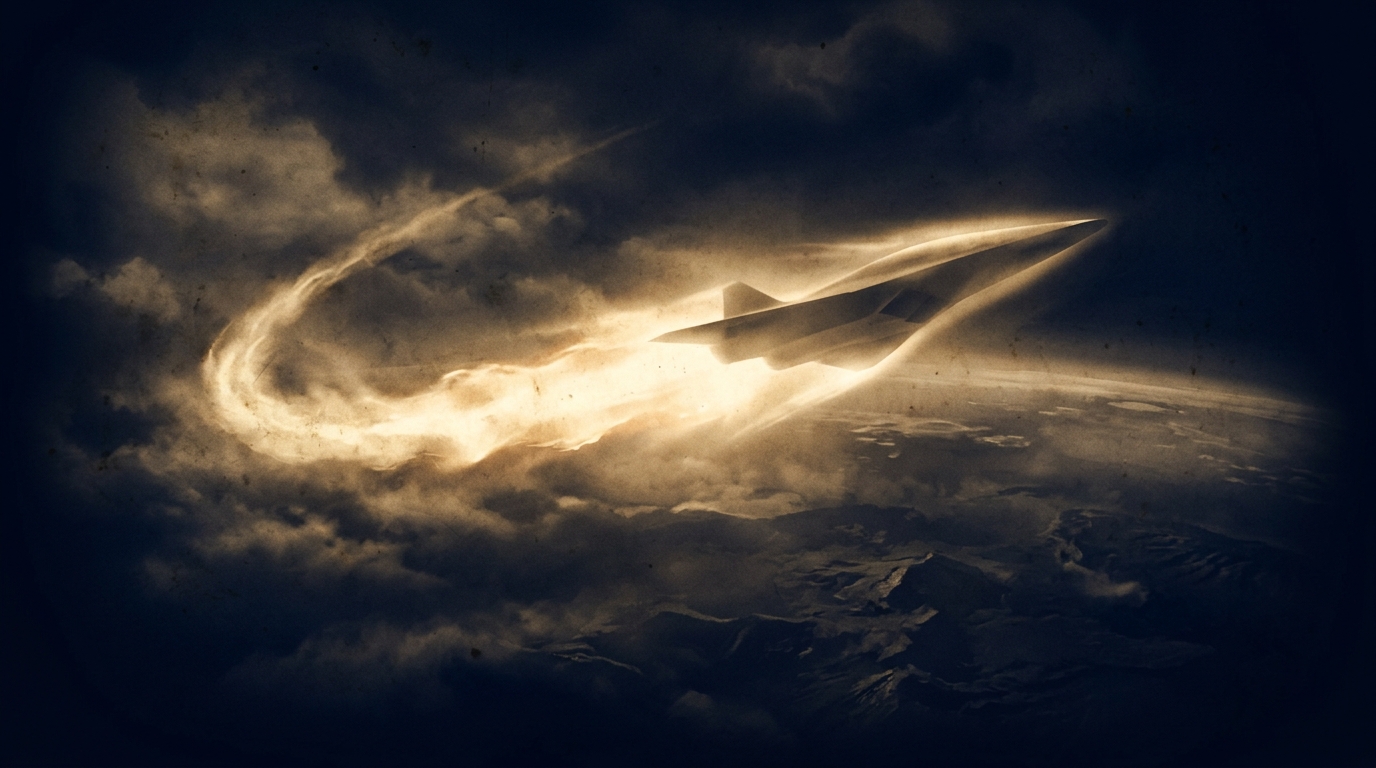
 Codex Illustration
The Aurora Aircraft Legend
Since the late 1980s, persistent rumors have circulated that the United States operates a hypersonic reconnaissance aircraft codenamed Aurora — a craft so advanced it has never been officially acknowledged, yet whose alleged sonic signatures, contrail patterns, and budget anomalies have drawn serious attention from aviation journalists and aerospace researchers.
Overview
The Aurora legend takes root in a specific, documented moment: the 1985 publication of the U.S. Defense Department's budget request, in which the line item for the SR-71 Blackbird's successor program was redacted and a funding category labeled 'Aurora' appeared alongside it. This was not conspiracy theory — it was a clerical or classification failure that placed a classified program name into an unclassified document. The Pentagon swiftly corrected the record, but the name had escaped. What followed was two decades of aviation journalism, eyewitness accounts from the high desert of California and Scotland, and a protracted silence from official quarters that has never been fully resolved. The existence of a successor to the SR-71, capable of Mach 6 or beyond, is not inherently implausible; the aerodynamics, thermodynamic challenges, and propulsion physics of hypersonic flight were already being actively researched in that era. Whether 'Aurora' was the name of such a program, a cancelled concept study, or a deliberate misdirection remains genuinely unknown.
The most forensically interesting evidence consists not of leaked documents or whistleblower testimony but of anomalous acoustic phenomena. Beginning in the early 1990s, residents of communities near Edwards Air Force Base in California and later near the Machrihanish NATO air base on the Kintyre peninsula in Scotland reported a distinctive, repetitive 'skyquake' — a rhythmic, rumbling pulse unlike the familiar double boom of conventional supersonic aircraft. Aviation journalist Bill Sweetman, writing for Jane's International Defense Review and later in his own books, documented these reports methodically and argued that they were consistent with the acoustic signature of a pulse-detonation engine or an exotic propulsion system operating at extreme altitude and velocity. Sweetman's analysis represents the most serious sustained journalistic investigation of the Aurora claim and is regularly cited even by skeptics as a benchmark for how fringe aviation claims should be evaluated.
Seismic monitoring data added another dimension. Researchers analyzing records from the U.S. Geological Survey and analogous networks noted a pattern of small, unexplained seismic events tracking in linear paths across parts of the American Southwest — paths consistent, some argued, with a fast-moving aircraft producing repeated atmospheric shock waves that registered as ground vibrations. This evidence is indirect, circumstantial, and disputed by mainstream seismologists who attribute the signals to other causes; nonetheless, the correlation was specific enough to attract attention from researchers at institutions including the California Institute of Technology. On the eyewitness side, several credentialed observers — including former RAF personnel at Machrihanish and civilian pilots — reported visual and acoustic encounters with objects moving at velocities inconsistent with any acknowledged platform. These accounts are individually anecdotal but collectively form a pattern that is difficult to dismiss entirely.
The Aurora legend operates within a well-documented ecosystem of American black aviation. The existence of the U-2, the SR-71, the F-117 Nighthawk, and the B-2 Spirit — all programs that were operational for years before official acknowledgment — establishes beyond reasonable doubt that the United States maintains a deep-black aviation development infrastructure capable of producing radical aircraft and concealing them from the public, Congress, and sometimes allied governments. The question is not whether such programs exist in principle; they demonstrably do. The question is whether 'Aurora' specifically names an operational hypersonic aircraft, a cancelled prototype, a cover name for another platform, or simply a funding line that was misread by an eager press. No declassified document, no verifiable photograph, and no confirmed government source has settled this question. The legend persists precisely because the institutional culture that would produce such a craft is itself real and thoroughly documented.
Key Claims
Timeline
Evidence
Multiple Perspectives
Biblical Lens
Scripture Threads
Sources & Further Study
Questions to Explore
Go Deeper Path
Follow the Thread
Continue the Investigation
You’ve reached the Full Archive portion of this Case File.
Ask the Archivist
about this fileSign in to ask the Archivist
Create a free account to ask the Archivist 1 grounded question each day, cited straight from the CODEX case files.
Discussion
0Share findings, questions, and evidence with fellow Seekers. Be respectful and cite sources where you can.
No comments yet. Be the first to open this thread.