
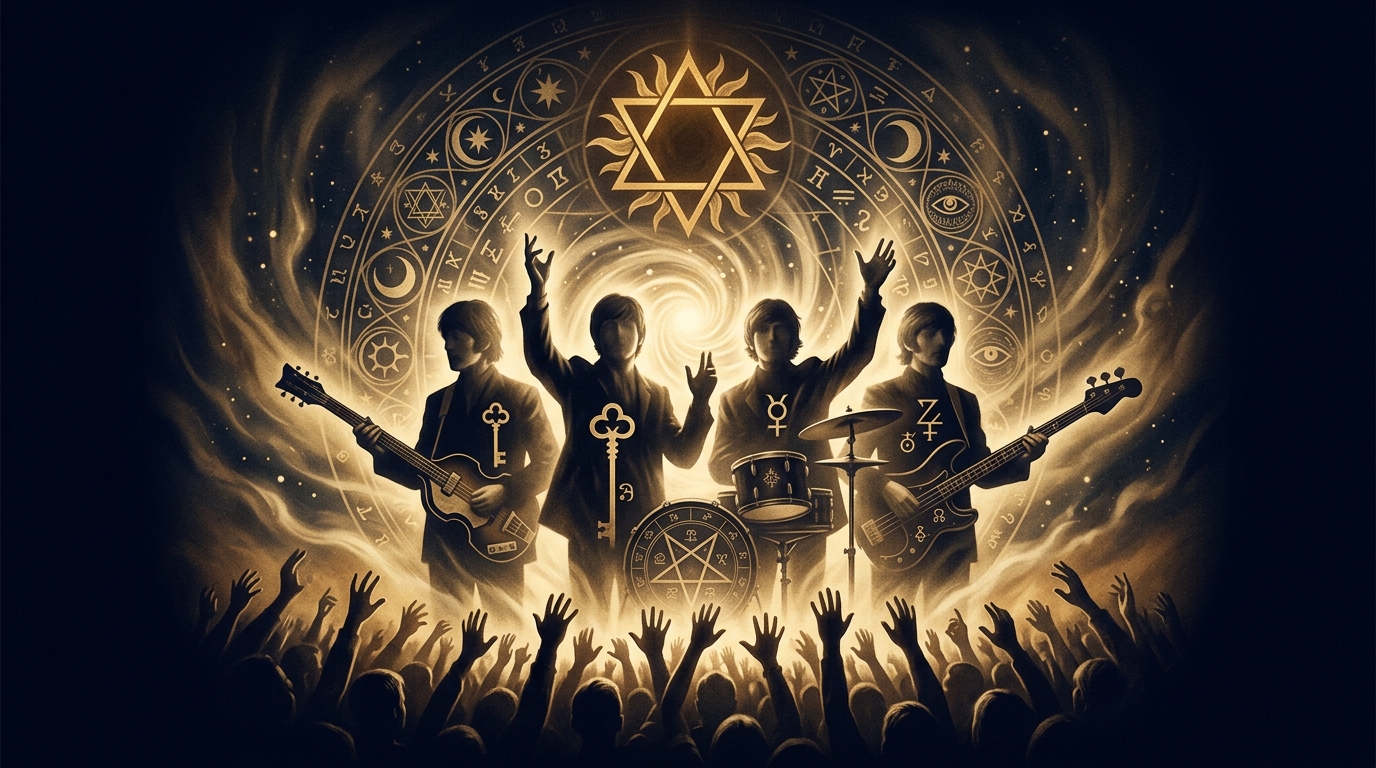
 Codex Illustration
The Beatles
The Beatles reshaped Western culture with an influence so vast and sudden that commentators across the ideological spectrum — from theologians to conspiracy theorists — have asked whether forces beyond mere musical talent were at work. Separating their documented cultural and spiritual footprint from decades of accumulated legend requires considerable care.
Overview
Few cultural phenomena of the twentieth century rival the Beatles in scope or longevity of influence. John Lennon, Paul McCartney, George Harrison, and Ringo Starr emerged from Liverpool in the early 1960s and within a decade had helped catalyze the sexual revolution, the turn toward Eastern spirituality in the West, the widespread experimentation with psychedelic substances, and a new aesthetic vocabulary for popular music. These are documented historical facts, affirmed by sociologists, musicologists, and cultural historians across a half-century of scholarship. What is considerably more contested is the nature and origin of that influence — whether the quartet were innocent conduits of generational change, willing or unwitting ambassadors of countercultural agendas, or, in the most expansive readings, instruments of deliberate social engineering.
Several specific cultural and esoteric flashpoints have attracted sustained attention. The 1967 Sgt. Pepper's Lonely Hearts Club Band album cover, designed by Peter Blake and Jann Haworth under the direction of the band, included among its gallery of admired figures the occultist Aleister Crowley — a documented fact, though the band's precise intention in including him remains a matter of interpretation. George Harrison's deep and sincere engagement with Vedantic Hinduism and the Maharishi Mahesh Yogi's Transcendental Meditation program brought Eastern religious categories into mainstream Western consciousness; this is well-documented and was the subject of Harrison's own extensive commentary. John Lennon's 1966 remark to journalist Maureen Cleave — that the Beatles were 'more popular than Jesus' — ignited a cultural firestorm, particularly in the American South, and raised genuine questions about celebrity, idolatry, and the displacement of religious authority by popular culture. These are historically substantiated episodes, whatever one's interpretation of their significance.
At a further remove from the documented record lie the claims that have accumulated in conspiracy and occult circles. The 'Paul is Dead' rumor — the assertion that McCartney died in 1966 and was replaced by a lookalike — is a well-studied example of urban legend formation, traceable to specific radio broadcasts in the United States in 1969. Claims of deliberate backmasking, most famously the alleged phrase 'turn me on, dead man' when 'Revolution 9' is played in reverse, represent a genuine acoustic phenomenon (reversed audio can produce pareidolic speech perception) but no credible evidence exists that such messages were intentionally embedded. Most expansive of all is the Tavistock Institute mind-control hypothesis, which asserts that the Beatles were manufactured instruments of social manipulation by British intelligence and social engineering institutions — a claim that circulates widely in conspiratorial literature but rests on no credible primary documentation and is firmly rejected by mainstream historians.
A thoughtful engagement with the Beatles' cultural legacy must hold these layers in careful tension. The band's genuine and documented engagements with occult iconography, Eastern mysticism, and psychedelic experience were real and consequential — they shaped millions of spiritual trajectories in an era of rapid deinstitutionalization of religion. Whether this constitutes evidence of orchestrated occult influence or reflects the sincere, if sometimes reckless, spiritual searching of four working-class men suddenly given global reach is a question the evidence does not definitively resolve. What is certain is that the Beatles provide an unusually rich case study for exploring how art, altered consciousness, spiritual hunger, and cultural power interact — and for asking, carefully, what discernment looks like in the presence of pervasive and beautiful influence.
Key Claims
Timeline
Evidence
Multiple Perspectives
Biblical Lens
Scripture Threads
Sources & Further Study
Questions to Explore
Go Deeper Path
Follow the Thread
Continue the Investigation
You’ve reached the Full Archive portion of this Case File.
Ask the Archivist
about this fileSign in to ask the Archivist
Create a free account to ask the Archivist 1 grounded question each day, cited straight from the CODEX case files.
Discussion
0Share findings, questions, and evidence with fellow Seekers. Be respectful and cite sources where you can.
No comments yet. Be the first to open this thread.