
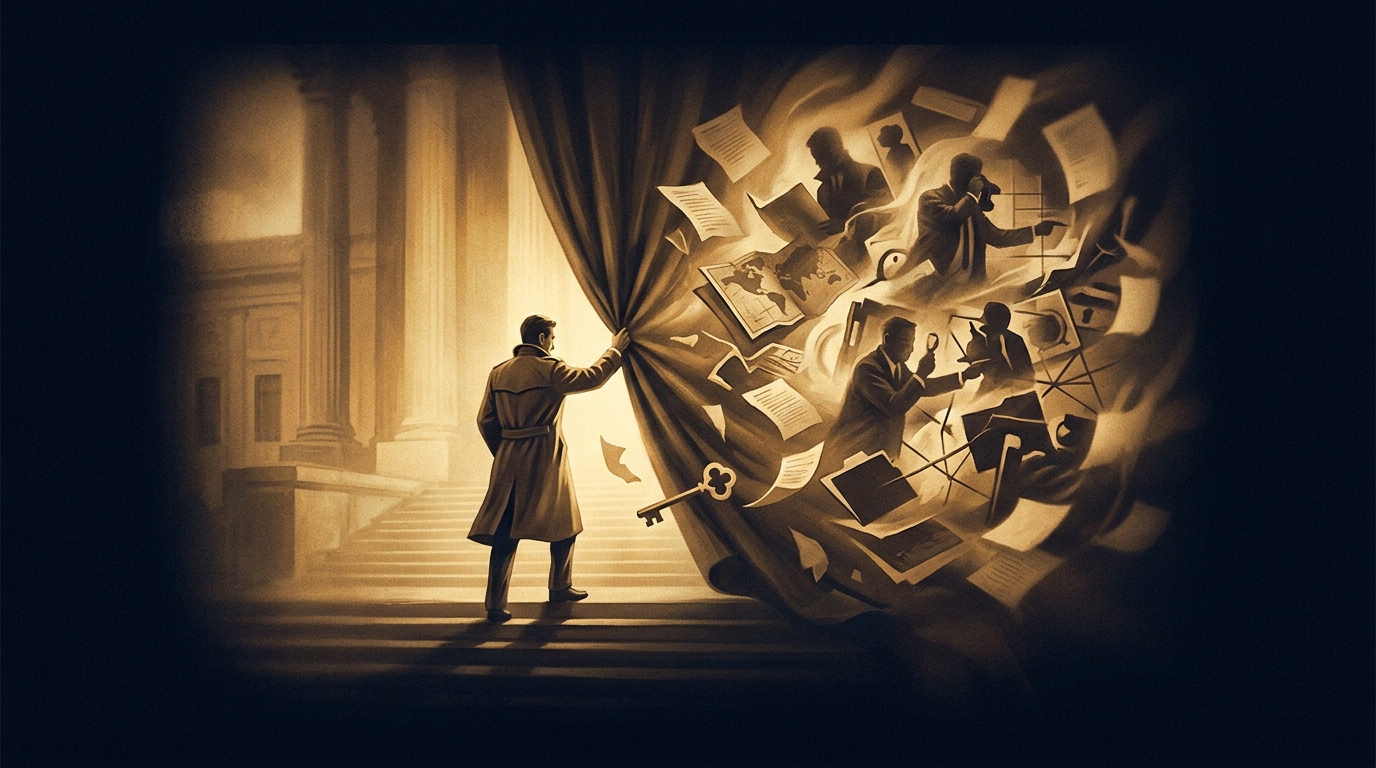
 Codex Illustration
The Church Committee
In 1975, a Senate select committee chaired by Frank Church pulled back the curtain on decades of covert American intelligence operations — revealing assassination plots, mass surveillance, and domestic manipulation programs that had operated entirely outside public or legislative knowledge.
Overview
In the aftermath of Watergate and a cascade of investigative journalism — most notably Seymour Hersh's December 1974 New York Times reporting on CIA domestic surveillance — the United States Senate convened the Select Committee to Study Governmental Operations with Respect to Intelligence Activities. Chaired by Idaho Senator Frank Church, the committee conducted what remains the most exhaustive congressional investigation into American intelligence agencies ever undertaken. Between 1975 and 1976, it interviewed hundreds of witnesses, reviewed thousands of classified documents, and produced a fourteen-volume final report that exposed the systematic abuse of state power across multiple administrations, both Democratic and Republican. The investigation was not a fringe exercise: it was a formal constitutional mechanism of oversight, and its findings were not disputed in their broad contours by the agencies themselves.
The committee's disclosures were of a scope that staggered even seasoned Washington observers. Among the documented revelations: the FBI's COINTELPRO program had systematically infiltrated, disrupted, and in some cases helped destroy lawful civil rights organizations, antiwar groups, and political activists — including a campaign to pressure Martin Luther King Jr. into suicide. The CIA had operated a mail-opening program (HTLINGUAL) for two decades without legal authorization. NSA had monitored the international communications of American citizens through arrangements with telecommunications carriers. And the CIA had participated in or facilitated assassination plots against foreign leaders including Patrice Lumumba, Fidel Castro, Rafael Trujillo, and Chilean General René Schneider. The word 'assassination' had been euphemized in internal documents as 'executive action,' lending the record a bureaucratic coldness that amplified rather than diminished its gravity.
Beyond specific programs, the Church Committee illuminated a structural problem: the so-called 'imperial presidency' and the intelligence community had evolved in tandem since World War II into a largely unaccountable apparatus that operated on its own institutional logic, insulated from democratic oversight by classification, compartmentalization, and the silencing effect of national security claims. Senator Church himself famously described the NSA as a potential 'apparatus that could enable a tyranny in America' — a remark that would be quoted repeatedly in the wake of the 2013 Snowden revelations, nearly four decades later. The committee's work directly produced the Foreign Intelligence Surveillance Act (FISA) of 1978, the establishment of permanent Senate and House intelligence oversight committees, and Executive Order 11905, which formally banned U.S.-sanctioned assassinations of foreign leaders.
The Church Committee's legacy is genuinely contested in the scholarly literature. Critics — including former intelligence officials and some national security historians — have argued that the public exposure of methods and programs degraded American intelligence capabilities during a dangerous period of Cold War competition, a claim sometimes called the 'intelligence gap' theory. Defenders, including most civil liberties scholars and many historians of American democracy, argue the opposite: that a surveillance state operating without accountability is itself a profound security threat to constitutional government. What is not seriously disputed is the factual record the committee established. Its volumes remain publicly available, its findings have been corroborated by subsequent declassification, and the programs it exposed were real. The Church Committee stands as a documented case study in the tension between state power and democratic accountability — and as evidence that, at least occasionally, the light can be forced on.
Key Claims
Timeline
Evidence
Multiple Perspectives
Biblical Lens
Scripture Threads
Sources & Further Study
Questions to Explore
Go Deeper Path
Follow the Thread
Continue the Investigation
You’ve reached the Full Archive portion of this Case File.
Ask the Archivist
about this fileSign in to ask the Archivist
Create a free account to ask the Archivist 1 grounded question each day, cited straight from the CODEX case files.
Discussion
0Share findings, questions, and evidence with fellow Seekers. Be respectful and cite sources where you can.
No comments yet. Be the first to open this thread.