
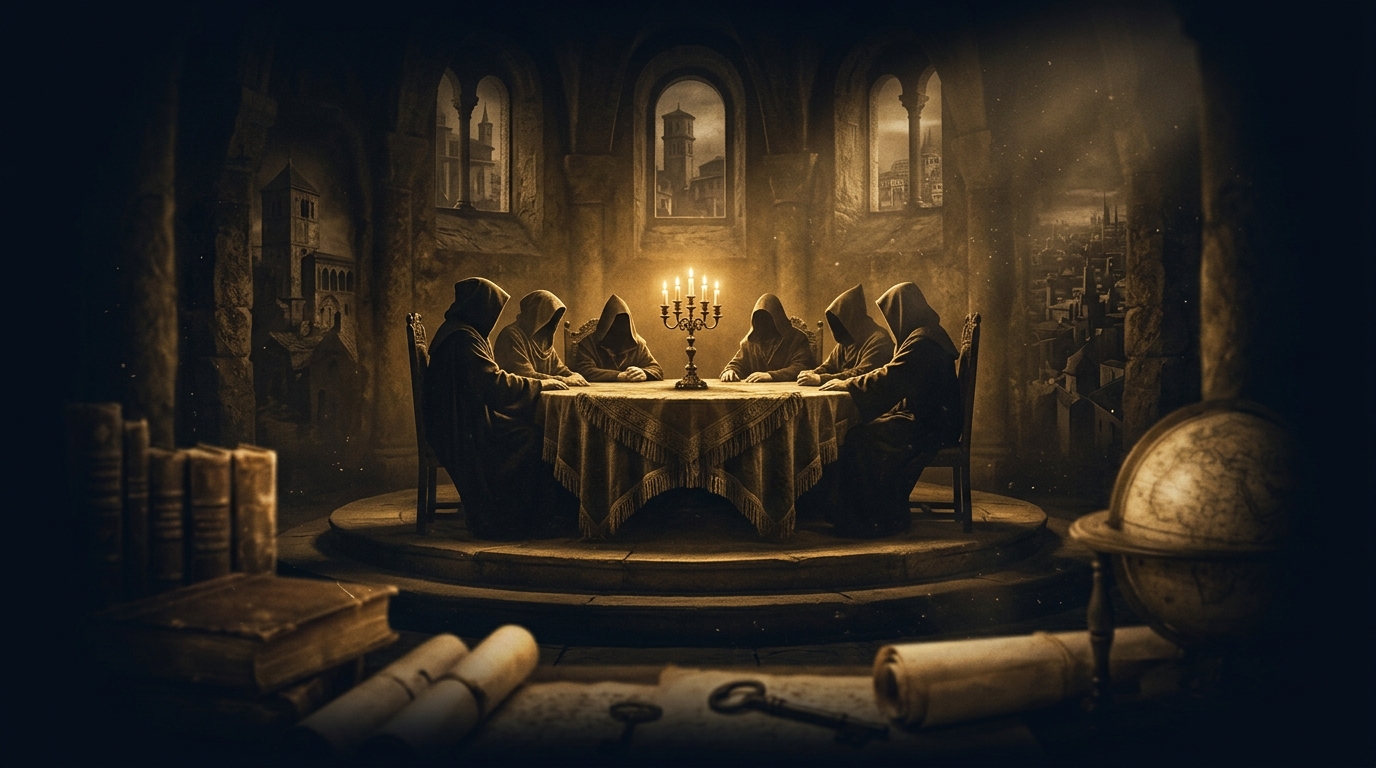
 Codex Illustration
The Committee of 300
The Committee of 300 is alleged to be a supreme, centuries-old cabal coordinating global banks, intelligence agencies, royal houses, and corporations toward a hidden world order — a claim popularized almost entirely by one author, John Coleman, and for which no credible documentary evidence has ever been produced.
Overview
In 1992, a former British intelligence officer writing under the name John Coleman self-published a book titled *Conspirators' Hierarchy: The Story of the Committee of 300*, asserting that a covert governing body of three hundred individuals — drawn from European aristocracy, central banking dynasties, elite think tanks, and major corporations — had directed global affairs for over two centuries from behind institutions such as the Club of Rome, the Bilderberg Group, the Tavistock Institute, and the Royal Institute of International Affairs. Coleman claimed this body was the apex predator of a nested hierarchy of secret societies, with Freemasonry, the Illuminati, and Skull and Bones as merely its subordinate instruments. The appeal was immediate in certain circles: the claim offered a totalizing architecture for otherwise bewildering geopolitical complexity, naming familiar and genuinely powerful real-world institutions as confirmed nodes in the network. The theory spread through shortwave radio broadcasts, photocopied pamphlets, and later the early internet, finding receptive audiences among those already skeptical of establishment power.
The factual foundation for the claim is, on examination, extremely thin. Coleman offered no documentary evidence — no membership rolls, no meeting minutes, no corroborating testimony from credible insiders, and no archival record from any intelligence service or investigative journalist that could independently establish the body's existence. Scholars and journalists who have examined his work note that his credentials are disputed: his claimed background as an MI6 officer has never been independently verified, and his citation practices do not meet academic or journalistic standards. The core methodology of the Committee of 300 narrative — and of the broader genre it belongs to — is one of pattern-matching and aggregation: real institutions with documented power and real figures with documented influence are woven into an assumed master-narrative whose organizing claim (the Committee itself) is never separately evidenced. This renders the theory structurally unfalsifiable: any absence of evidence becomes evidence of concealment.
Historically, the impulse to imagine a supreme hidden directorate coordinating visible power is ancient and has appeared in many cultural contexts. Enlightenment-era fears of the Bavarian Illuminati, nineteenth-century anxieties about Jewish banking conspiracies, Cold War fears of communist infiltration, and post-9/11 suspicions of a permanent deep state all share a common cognitive architecture: a belief that observed disorder and suffering must have a hidden author, that institutions presenting as independent are secretly unified, and that one is among a discerning minority who can perceive the hidden truth. Sociologists and psychologists of belief — including Rob Brotherton (*Suspicious Minds*, 2015) and Michael Barkun (*A Culture of Conspiracy*, 2003) — have described this as a form of proportionality bias and agency detection: the human mind resists the idea that large events have dispersed, banal, or accidental causes, and prefers the explanatory economy of a single malevolent intelligence. The Committee of 300 narrative is perhaps the most architecturally ambitious expression of this impulse in modern conspiracy literature.
There is a legitimate and important distinction that careful inquiry must maintain: the existence of genuine elite networks — the World Economic Forum, the Council on Foreign Relations, the Bilderberg meetings, documented intelligence community overreach — is not in dispute and is a proper subject of democratic scrutiny. What Coleman's framework does, and what makes it epistemically dangerous, is to absorb these verifiable institutions into an unfalsifiable meta-claim, thereby immunizing itself against normal evidential challenge while also potentially discrediting legitimate critique of actual concentrated power. The archive records this entry not as documented history but as a significant example of how conspiracy literature is constructed, propagated, and psychologically maintained — and as a reminder that honest inquiry demands the same evidentiary standards whether investigating a government program or a populist theory.
Key Claims
Timeline
Evidence
Multiple Perspectives
Biblical Lens
Scripture Threads
Sources & Further Study
Questions to Explore
Go Deeper Path
Follow the Thread
Continue the Investigation
You’ve reached the Full Archive portion of this Case File.
Ask the Archivist
about this fileSign in to ask the Archivist
Create a free account to ask the Archivist 1 grounded question each day, cited straight from the CODEX case files.
Discussion
0Share findings, questions, and evidence with fellow Seekers. Be respectful and cite sources where you can.
No comments yet. Be the first to open this thread.