
 Codex Illustration
The Fetch
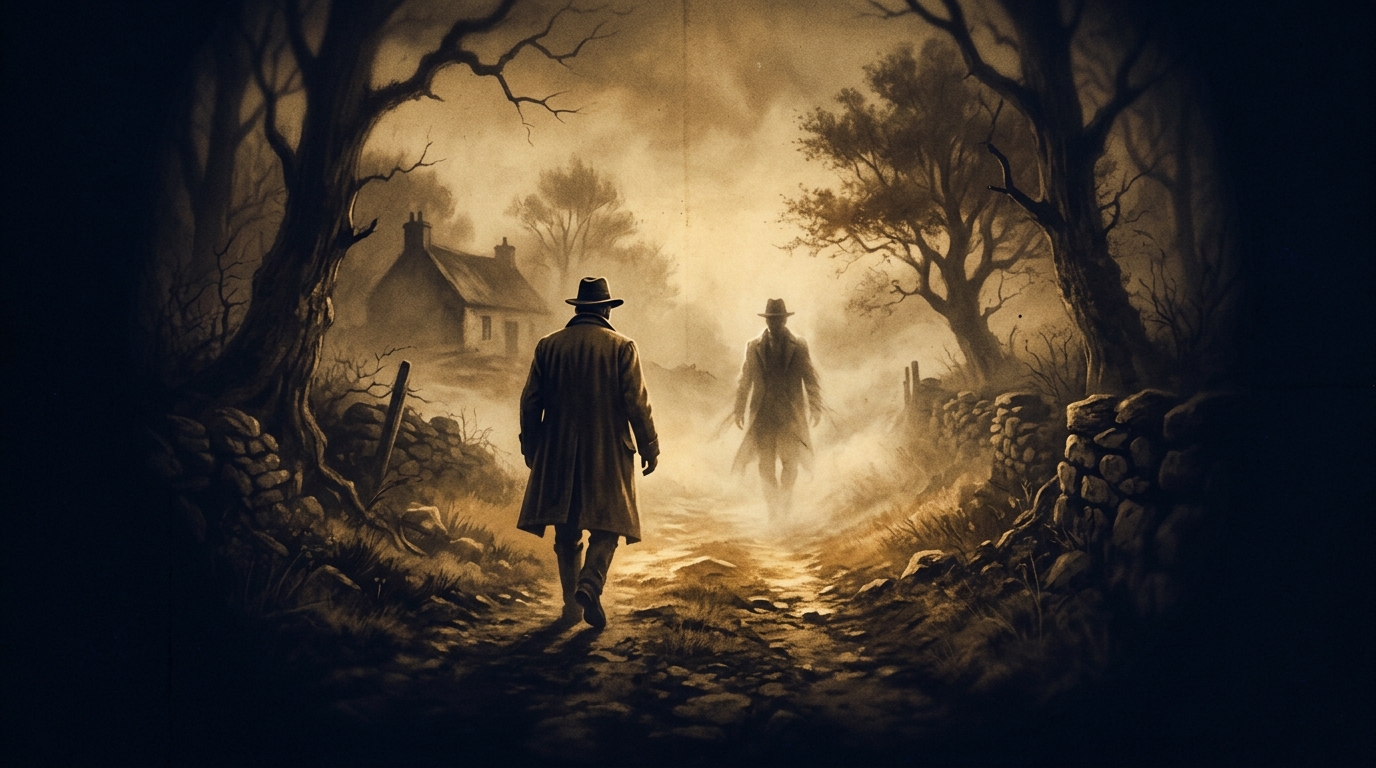
In the folklore of Ireland, Scotland, and their Appalachian diaspora, the Fetch is the spectral double of a living person — an apparition whose appearance is widely understood as an omen of imminent death, raising enduring questions about the permeable boundary between the living and the dead.
Overview
The Fetch occupies a distinctive and unsettling niche in the folklore of the British Isles and the communities that carried that tradition across the Atlantic. Unlike the German doppelgänger — which appears ambiguously as a harbinger of misfortune or a psychological double — the Irish and Scottish Fetch is culturally specific in its meaning: it is the wraith-like projection of a living person, seen by witnesses other than that person themselves, and its appearance is understood as a portent of death. The term 'fetch' appears in Irish usage at least as far back as the eighteenth century, and scholars of Celtic folklore, including Lady Wilde (Jane Francesca Elgee) and the folklorist Katharine Briggs, have catalogued numerous accounts in which a neighbor, family member, or passerby reports seeing someone who turns out to be nowhere near the location of the sighting — often followed within days or weeks by the death of the person whose form was seen. The tradition is well-documented as a folk belief; the reality of the phenomenon itself remains entirely unverified.
The Scots-Irish migration of the eighteenth and nineteenth centuries carried the Fetch tradition into the Appalachian highlands of the American South and Mid-Atlantic, where it merged with indigenous Scots-Irish superstition, Protestant folk Christianity, and the broader Appalachian culture of signs and omens. In this context, the Fetch became part of a larger constellation of death-warning beliefs — including the sound of a death knock, the sight of a will-o'-the-wisp over a graveyard, and the crying of a banshee — all of which were taken seriously as practical warnings rather than merely literary conceits. Folklorists such as Richard Chase and later scholars working in the traditions documented by the Foxfire series have noted the persistence of such beliefs in isolated mountain communities well into the twentieth century. The Fetch in Appalachian usage was sometimes called the 'forerunner' or the 'token,' emphasizing its function as a warning sign rather than a supernatural entity in its own right.
The conceptual structure of the Fetch raises philosophically serious questions about the nature of personal identity, the relationship between soul and body, and the possibility of presences that exist at the edge of perception. Some scholars of comparative folklore, including Alan Gailey writing on Irish folk tradition, have noted structural parallels between the Fetch and the Scottish 'co-walker' or 'co-walker wraith' — a double that is believed in some traditions to accompany the living person through life and to separate at the moment of death. This overlaps partially with the Norse concept of the fylgja, a spirit-double or attendant spirit that takes the form of the person it accompanies, and whose appearance to the individual themselves can signal approaching death. These cross-cultural resonances suggest a deep and widespread human intuition that selfhood has some kind of projection or shadow in the unseen order — a notion that intersects with theological categories of soul and spirit without being reducible to any single tradition's framework.
In the contemporary period, the Fetch survives less as a living folk belief than as a literary and cultural memory, appearing in Irish fiction and poetry, in Appalachian gothic literature, and occasionally in discussions of parapsychology and crisis apparitions. The Society for Psychical Research (SPR), founded in 1882 in London, collected numerous accounts in the late Victorian era of 'veridical apparitions' — that is, apparitions of living persons seen at a distance, often at the moment of a severe crisis or death. Some of these accounts bear structural resemblance to traditional Fetch lore, though the SPR approached them as potential evidence for telepathy or some form of psychic projection rather than as supernatural portents. Whether understood through the lens of cultural psychology, parapsychological hypothesis, neurological explanation, or traditional folk cosmology, the Fetch remains a striking and persistent feature of human experience — one that refuses easy dismissal and equally resists confident verification.
Key Claims
Timeline
Evidence
Multiple Perspectives
Biblical Lens
Scripture Threads
Sources & Further Study
Questions to Explore
Go Deeper Path
Follow the Thread
Continue the Investigation
You’ve reached the Full Archive portion of this Case File.
Ask the Archivist
about this fileSign in to ask the Archivist
Create a free account to ask the Archivist 1 grounded question each day, cited straight from the CODEX case files.
Discussion
0Share findings, questions, and evidence with fellow Seekers. Be respectful and cite sources where you can.
No comments yet. Be the first to open this thread.