
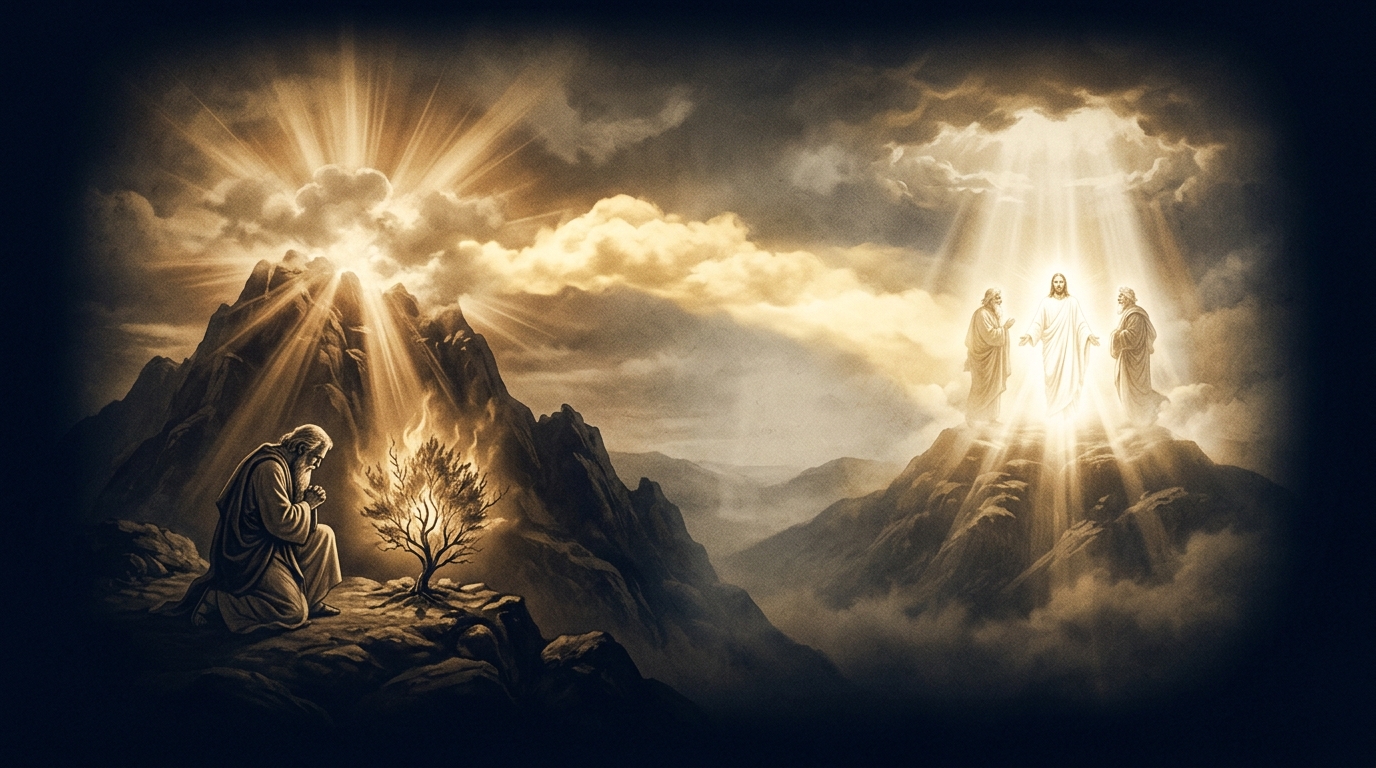
 Codex Illustration
The Glory Moses Saw: Sinai and the Transfiguration
On two separate mountains, separated by more than a thousand years, Moses encountered radiant divine glory — and a remarkable thread of biblical theology asks whether both encounters are, in some profound sense, with the same Person.
Overview
The request Moses makes in Exodus 33:18 — 'Please show me your glory' — is one of the most audacious prayers in Scripture. Having already spoken with the LORD 'face to face, as a man speaks with his friend' (33:11), Moses now seeks something more: direct sight of the divine kabod, the weighty, luminous presence that had led Israel through the wilderness as pillar and cloud. The answer is carefully calibrated. The LORD promises that His goodness will pass before Moses, that He will proclaim the divine Name, but that the face cannot be seen, 'for man shall not see me and live' (33:20). Moses is placed in a cleft of the rock, shielded by the divine hand as the glory passes, and is permitted to see only the LORD's 'back' — an anthropomorphic expression nearly all commentators read as indicating an indirect or mediated glimpse, a veiled disclosure that is nonetheless real. When Moses descends from Sinai afterward, his own face radiates light (Exodus 34:29-35) — a reflected or borrowed luminescence so unsettling that the Israelites ask him to veil it. The pattern is established: glory encountered from behind a barrier, mediated, partial, and yet transforming.
The Transfiguration narratives (Matthew 17:1-8; Mark 9:2-8; Luke 9:28-36) constitute a deliberate and densely layered recapitulation of the Sinai theophany — but with a decisive inversion. Jesus ascends a mountain with three disciples, and His face shines 'like the sun' while His garments become radiant white. The gospel writers are careful about the direction of the light: at Sinai, Moses's face reflected borrowed glory; on Tabor, the glory radiates outward from Jesus Himself. A bright cloud overshadows the scene — evoking the Sinai cloud — and a voice speaks from it, echoing the divine proclamation at Sinai yet now identifying Jesus as the beloved Son. Most remarkable of all, Moses appears on the mountain in glory, alongside Elijah. Luke's account adds a precise detail of enormous theological weight: Moses and Elijah speak with Jesus about His 'departure' (Greek: exodon, 9:31) — a word that is almost certainly a deliberate echo of the Exodus Moses himself led. The figure who could only glimpse divine glory from behind now stands in its presence unveiled.
The parallel structure between the two events has been recognized and elaborated across two millennia of Christian interpretation. Several threads are particularly striking. Paul, writing in 2 Corinthians 3:7-18, draws the contrast explicitly: the glory on Moses's face was real but fading, and Moses veiled it; but the glory of Christ, beheld with 'unveiled face,' is transformative and permanent. Paul's argument implies that Moses's glory was always anticipatory — a shadow or earnest of a fuller light yet to come. Separately, Paul's statement in 1 Corinthians 10:4 — that 'the rock was Christ' — opens a typological door: the cleft of the rock in which Moses was hidden during the divine passage may be read as a figure of sheltering in Christ, the one who mediates between divine fullness and human fragility. These Pauline threads, widely treated as established doctrine in classical Christian exegesis, provide the exegetical skeleton on which more speculative interpretations are later built.
Three distinct interpretive traditions have developed around this material, and they must be held clearly apart. The first — broadly attested in patristic, medieval, and Reformation commentary — is a fulfillment reading: what Moses glimpsed partially at Sinai is fully unveiled at Tabor, so that Moses's presence at the Transfiguration represents the answering of his ancient request. This is a longstanding, widely-held theological interpretation, not a fringe claim, though it remains interpretation rather than explicit biblical statement. The second tradition, associated in modern scholarship with Michael Heiser's synthesis of the 'two powers in heaven' material (drawing on Jarl Fossum, Alan Segal, and Second Temple Jewish sources), identifies the figure Moses encountered at Sinai — the 'Yahweh' who bears the divine Name and acts with full divine authority — as the pre-incarnate Son, the figure who in later Christian theology becomes Jesus of Nazareth. On this reading, Moses was already encountering a veiled form of Christ's glory at Sinai; the Transfiguration is not merely fulfillment but revelation of identity. This reading is serious, grounded in ancient Jewish texts about a 'second power' in heaven, and widely discussed in academic biblical studies, but it remains a theological interpretation debated across traditions. The third tradition — that in the divine eternal 'now,' the Sinai theophany and the Transfiguration are participations in a single, timeless act of divine self-disclosure — is a mystical hypothesis, evocative and not without philosophical coherence, but properly understood as contemplative speculation rather than established doctrine.
Key Claims
Timeline
Evidence
Multiple Perspectives
Biblical Lens
Scripture Threads
Sources & Further Study
Questions to Explore
Go Deeper Path
Follow the Thread
Continue the Investigation
You’ve reached the Full Archive portion of this Case File.
Ask the Archivist
about this fileSign in to ask the Archivist
Create a free account to ask the Archivist 1 grounded question each day, cited straight from the CODEX case files.
Discussion
0Share findings, questions, and evidence with fellow Seekers. Be respectful and cite sources where you can.
No comments yet. Be the first to open this thread.