
 Codex Illustration
The Hat Man
Across cultures and continents, a striking number of people report encountering the same figure during sleep paralysis or waking states: a tall, featureless silhouette wearing a wide-brimmed hat, radiating dread unlike any ordinary nightmare. Whether neurological artifact, cultural archetype, or something older and stranger, the Hat Man remains one of the most consistent and unexplained recurring figures in modern paranormal testimony.
Overview
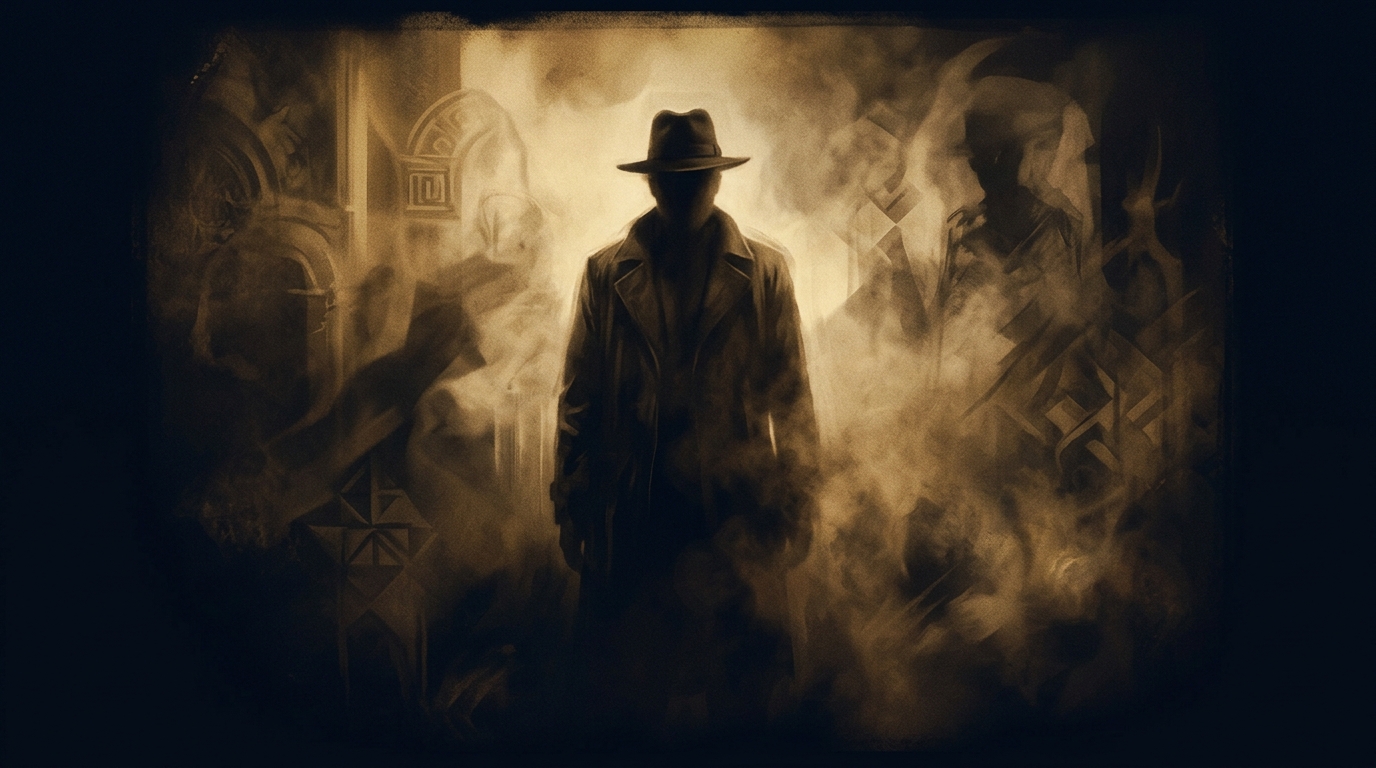
The Hat Man is a reported apparition — almost universally described as a solid or semi-transparent shadow figure of tall, masculine proportions, wearing a wide-brimmed fedora or top hat and sometimes a long coat or cloak. Unlike the diffuse, peripheral 'shadow people' reported in related accounts, witnesses consistently describe the Hat Man as possessing a distinct, deliberate presence: he does not flicker at the edge of vision but stands fully visible, often at the foot of a bed or in a doorway, seemingly watching. Witnesses frequently report an overwhelming sense of malevolent intelligence and intentionality, distinguishing the experience emotionally from ordinary fear responses. Thousands of independent accounts have been collected by researchers, paranormal investigators, and medical professionals alike, with notable cross-cultural consistency in the described silhouette, posture, and emotional atmosphere.
The phenomenon came to wider public attention in the early 2000s, primarily through online paranormal forums and the work of researcher Heidi Hollis, whose 2001 book 'The Secret War' and subsequent 2014 book 'The Hat Man: The True Story of Evil Encounters' compiled hundreds of testimonies and proposed the figure as a genuinely malevolent non-human entity. Television programs such as 'A Haunting' and documentary segments on paranormal television further amplified public awareness. What makes the Hat Man culturally notable is not merely the volume of reports but their cross-cultural and cross-generational distribution: accounts surface from North America, Europe, Latin America, and parts of Asia, predating the internet era and appearing in historical records of folklore relating to oppressive nocturnal presences. The specificity of the hat — an anachronistic but culturally resonant garment — is among the most discussed and unexplained details, as the silhouette is described consistently by children who have no cultural priming for it.
From a neuroscientific and psychological standpoint, the majority of Hat Man encounters occur during hypnagogic or hypnopompic states — the threshold between sleep and wakefulness — or during clinically recognized sleep paralysis episodes. Sleep paralysis is a well-documented neurological phenomenon affecting an estimated 8 percent of the general population, during which voluntary muscle control is suppressed while partial wakefulness returns, frequently accompanied by vivid hallucinations and intense feelings of a threatening presence. Researchers such as J. Allan Cheyne (University of Waterloo) have studied the 'intruder' hallucination type extensively, noting that the human brain, under the particular stress of sleep paralysis, reliably generates a sense of a looming, threatening humanoid figure. The neuroscientific framework offers a robust and parsimonious explanation for much of the Hat Man phenomenon — but it does not fully account for the specificity of the brimmed hat, shared by witnesses who had never encountered each other or been exposed to the archetype, nor for the subset of accounts that occur in fully waking, non-paralytic states.
Theoretical interpretations range from the purely neurological to the deeply metaphysical. Psychologists have proposed that the Hat Man is a culturally acquired archetype transmitted through folklore channels, akin to the 'Old Hag' of sleep paralysis traditions across cultures. Jungian analysts might frame the figure as a shadow archetype — an autonomous complex projecting from the unconscious in a form shaped by collective cultural imagery of menace and authority. At the more speculative end, some researchers in the paranormal field propose that the Hat Man is an autonomous non-human intelligence, a demonic or inter-dimensional entity, or a tulpa-like thought-form that has achieved a degree of ontological independence through sustained collective attention and belief. The convergence of similar accounts in remote-viewing research periphery and anomalous zones like Skinwalker Ranch, where similar shadow entities have reportedly been observed, invites at least cautious notice from researchers willing to entertain non-ordinary hypotheses.
Key Claims
Timeline
Evidence
Multiple Perspectives
Biblical Lens
Scripture Threads
Sources & Further Study
Questions to Explore
Go Deeper Path
Follow the Thread
Continue the Investigation
You’ve reached the Full Archive portion of this Case File.
Ask the Archivist
about this fileSign in to ask the Archivist
Create a free account to ask the Archivist 1 grounded question each day, cited straight from the CODEX case files.
Discussion
0Share findings, questions, and evidence with fellow Seekers. Be respectful and cite sources where you can.
No comments yet. Be the first to open this thread.