
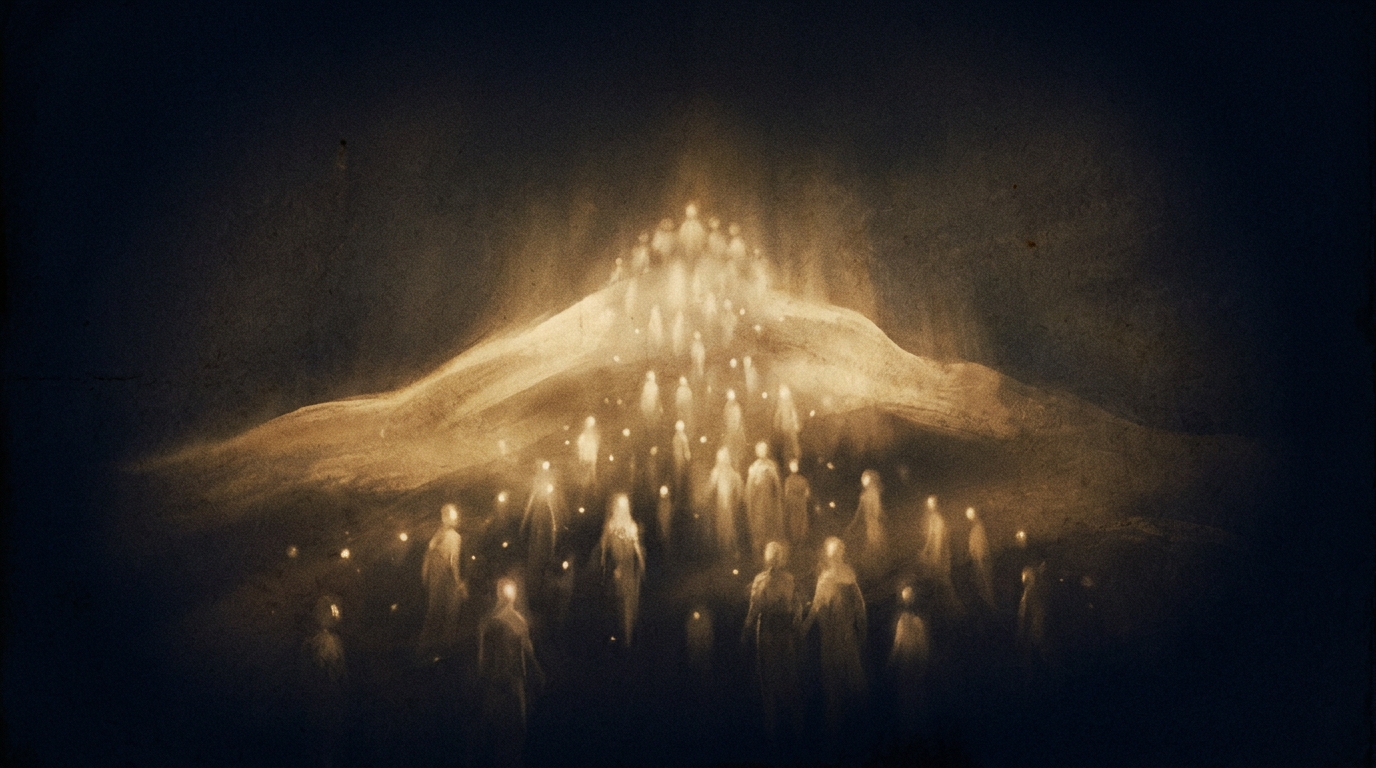
 Codex Illustration
The Hill
Through spelling and letterboard communication, a growing number of nonspeaking autistic individuals have independently described a shared spiritual location they call 'the Hill' — a place where, they claim, they gather together in some non-physical sense and encounter the presence of Jesus. The phenomenon, brought to wide public attention by the podcast 'The Telepathy Tapes,' sits at a contested crossroads of disability advocacy, scientific skepticism, theological discernment, and what some are calling the most provocative spiritual testimony of the twenty-first century.
Overview
Beginning roughly in the mid-2010s and accelerating through the early 2020s, parents, therapists, and researchers working with nonspeaking autistic individuals began documenting a pattern of unsolicited, convergent accounts: separate children — many of whom had never met, living in different households, cities, and countries — described spontaneous awareness of one another, visits to a luminous place on a hill, and encounters with a figure they identified as Jesus. The accounts surfaced primarily through Spelling to Communicate (S2C) and related augmentative and alternative communication (AAC) methods, in which a trained communication partner holds or stabilizes a letterboard while the nonspeaking individual points to letters. The 2024 podcast 'The Telepathy Tapes,' hosted by investigative journalist Ky Dickens, brought these testimonies to a global audience of millions and ignited fierce debate in disability science, theology, and popular culture simultaneously.
The claims are extraordinary on multiple levels. Proponents note that many of the children described the same location with specific, convergent imagery before anyone had coordinated their accounts. Some reportedly named other nonspeaking children they had supposedly 'met on the Hill' who were later confirmed to exist and who, when subsequently interviewed, corroborated the encounter — without prior contact between their families. A number of accounts include descriptions of spiritual instruction, prophetic-sounding statements, or sensory details about the Hill itself: light, warmth, the sense of being fully known and understood, and a relief from the isolation that marks so much of the nonspeaking experience. Parents and facilitators have described these sessions with a mixture of wonder, caution, and grief — grief because, as several have noted, many of these individuals struggle to communicate even basic needs in daily life, yet appear to speak with striking fluency about the unseen.
The scientific controversy attached to these accounts is substantial and cannot be responsibly minimized. The ideomotor effect — in which unconscious muscular movements guide a pointer without the mover's awareness — is a well-documented phenomenon (Ray Hyman, Nicholas Spanos, and others have written extensively on this in the context of facilitated communication). Facilitated Communication (FC), a precursor and relative of S2C, was formally repudiated by the American Psychological Association, American Academy of Pediatrics, and numerous other bodies after controlled studies consistently demonstrated that the facilitator, not the nonspeaking individual, was the source of the messages. Defenders of S2C argue it is a distinct method with evolving evidence, and some studies — including work by Edlyn Vallecillo Peña, Howard Shane, and others — remain actively contested. The scientific community has not reached consensus on S2C's validity, and the question of whether the children's Hill accounts originate with the children themselves or reflect the unconscious expectations of facilitators remains unanswered by controlled experimental evidence.
Biblically and theologically, the Hill accounts present a genuine discernment challenge. The content of the testimonies — a shared encounter with Jesus, a luminous gathering place, the sense of being spiritually known — resonates with themes of divine presence, vision, and the worth of every image-bearer that run throughout the Christian scriptures. The apostle John's instruction to 'test the spirits' (1 John 4:1) is cited by thoughtful Christian commentators on both sides: some see the convergent, Christ-centered content as evidence that passes theological scrutiny; others warn that extraordinary spiritual claims, particularly those mediated through contested communication methods, require extraordinary caution. No denominational body or mainstream theological institution has formally evaluated the Hill accounts. What persists, for those willing to sit with the uncertainty, is a question that will not easily resolve: if even a fraction of these testimonies reflects genuine spiritual experience inaccessible to standard scientific measurement, what does that say about consciousness, disability, the unseen realm, and the nature of divine communication?
Key Claims
Timeline
Evidence
Multiple Perspectives
Biblical Lens
Scripture Threads
Sources & Further Study
Questions to Explore
Go Deeper Path
Follow the Thread
Continue the Investigation
You’ve reached the Full Archive portion of this Case File.
Ask the Archivist
about this fileSign in to ask the Archivist
Create a free account to ask the Archivist 1 grounded question each day, cited straight from the CODEX case files.
Discussion
0Share findings, questions, and evidence with fellow Seekers. Be respectful and cite sources where you can.
No comments yet. Be the first to open this thread.