
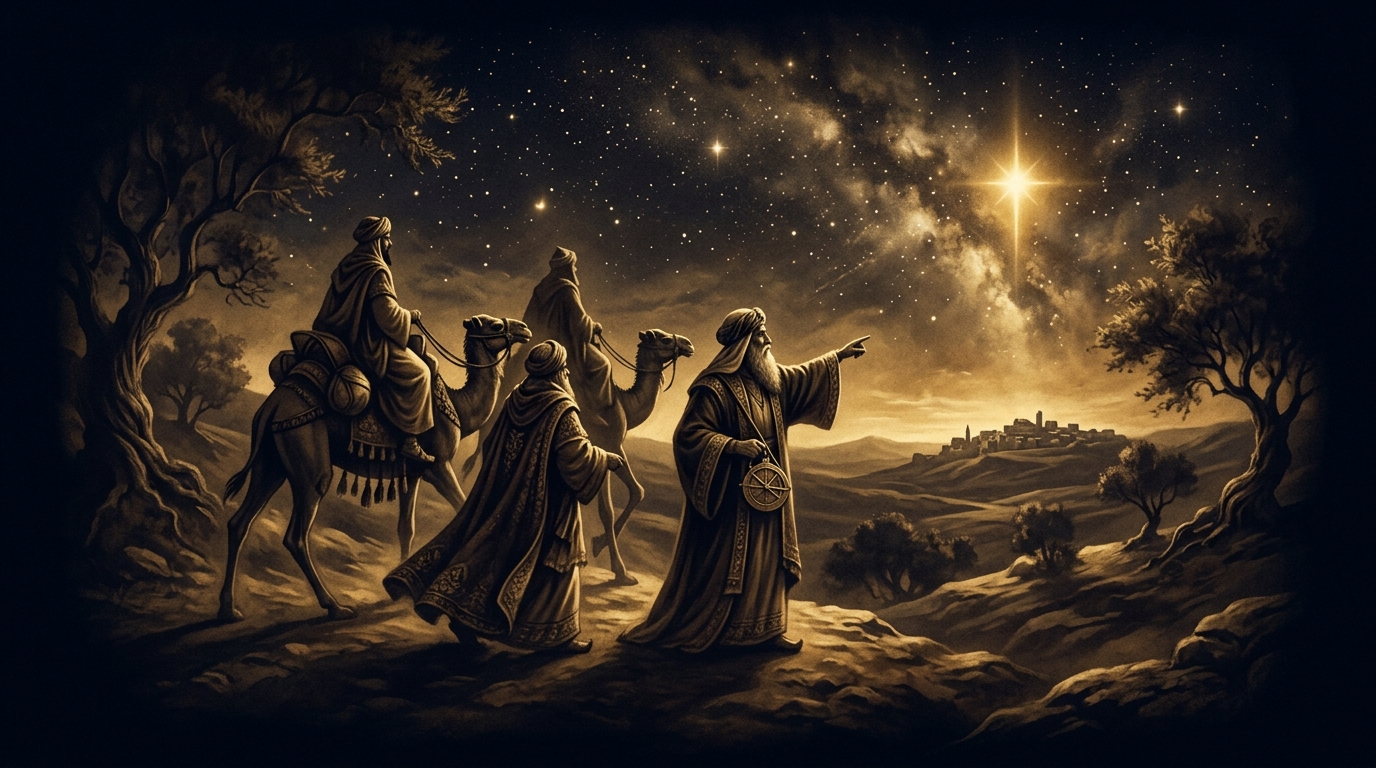
 Codex Illustration
The Magi
Mysterious figures from the East who followed a celestial sign to the birthplace of Jesus, the Magi stand at the intersection of ancient astronomy, Persian priestly tradition, Jewish diaspora scholarship, and theological fulfillment — their identity, number, and route remaining genuinely contested across two millennia of scholarship.
Overview
The Magi appear in a single Gospel account — Matthew 2:1–12 — described only as wise men (Greek: magoi) who came from 'the East,' observed a rising star, sought the newborn 'King of the Jews,' and presented gifts of gold, frankincense, and myrrh before being warned in a dream not to return to Herod. Matthew provides no number, no names, no precise origin, and no description of their qualifications. What he does provide is theologically deliberate: gentiles from beyond Israel's borders, guided by both celestial observation and prophetic text, arriving to worship the one the scribes in Jerusalem could locate in scripture but chose not to seek. The gap between what the text says and what later tradition has elaborated is enormous, and a sober reading of the Magi requires holding both the simplicity of the biblical account and the extraordinary weight of scholarly, astronomical, and theological inquiry that has accumulated around it.
The Greek term magoi had a wide semantic range in the ancient world. In its earliest Persian usage, magi referred to a priestly caste of the Medes associated with Zoroastrian religious practice, dream interpretation, and astronomical observation. By the Hellenistic period, the word had broadened to encompass astrologers, diviners, court advisors, and in some pejorative contexts, sorcerers — a usage evident in Acts 8:9–11 and Acts 13:6–8. The most historically plausible identification connects Matthew's Magi to the Babylonian and Persian scholarly tradition, particularly the priestly astronomers who maintained detailed records of celestial events for centuries. A significant minority of scholars, most notably Edwin Yamauchi in his study of Persia and the Bible, have emphasized the Zoroastrian priestly connection. Others, including scholars attentive to the Jewish diaspora, suggest that communities descended from the Babylonian exile may have preserved messianic expectation and shared it with local astronomical elites, providing a plausible channel through which Jewish prophetic texts — especially Numbers 24:17 and Daniel — could have reached non-Jewish observers.
The astronomical dimension of the Magi account has attracted sustained scholarly and scientific attention. What was the 'star'? Proposed candidates include a conjunction of Jupiter and Saturn in Pisces (7 BC, calculated by Johannes Kepler and subsequently refined by modern astronomers), a triple conjunction of the same planets visible across several months, a nova or supernova, a comet, the planet Jupiter alone as it underwent retrograde motion appearing to 'stop' over a location, and the Babylonian astronomical record known as the 'Jupiter tablet' discovered among cuneiform sources. No single candidate commands consensus, partly because the phenomenological description in Matthew — a star that 'went before them' and 'stood over' a specific location — may be as much theological and symbolic as observational. The Septuagint rendering of Numbers 24:17 ('a star shall rise out of Jacob') almost certainly informed Matthew's narrative framing, and ancient readers would have recognized the messianic register of stellar imagery without requiring a literal astronomical event. This does not necessarily mean the event was invented; it means the ancient authors wrote within a symbolic idiom that modern literalist and dismissive readings alike can misrepresent.
Church tradition moved quickly to fill the silence of Matthew's text. By the third century, Origen noted three gifts and inferred three givers — a logical but textually unwarranted deduction. By the sixth century, the Syriac tradition had supplied names: Hormizd, Yazdegerd, and Perozadh. Western tradition eventually settled on Caspar, Melchior, and Balthasar, first appearing by name in a sixth-century Greek manuscript. The claim that their relics were preserved in Cologne Cathedral — the Shrine of the Three Kings, one of the most visited medieval pilgrimage sites — belongs to devotional history rather than recoverable archaeology. What is theologically significant in all of this is Matthew's purpose: the arrival of gentile wisdom-seekers to honor Israel's Messiah functions as an early fulfillment of the prophetic vision of nations streaming toward the light of Zion (Isaiah 60:1–6), a theme the evangelist weaves with deliberate care throughout his infancy narrative.
Key Claims
Timeline
Evidence
Multiple Perspectives
Biblical Lens
Scripture Threads
Sources & Further Study
Questions to Explore
Go Deeper Path
Follow the Thread
Continue the Investigation
You’ve reached the Full Archive portion of this Case File.
Ask the Archivist
about this fileSign in to ask the Archivist
Create a free account to ask the Archivist 1 grounded question each day, cited straight from the CODEX case files.
Discussion
0Share findings, questions, and evidence with fellow Seekers. Be respectful and cite sources where you can.
No comments yet. Be the first to open this thread.