
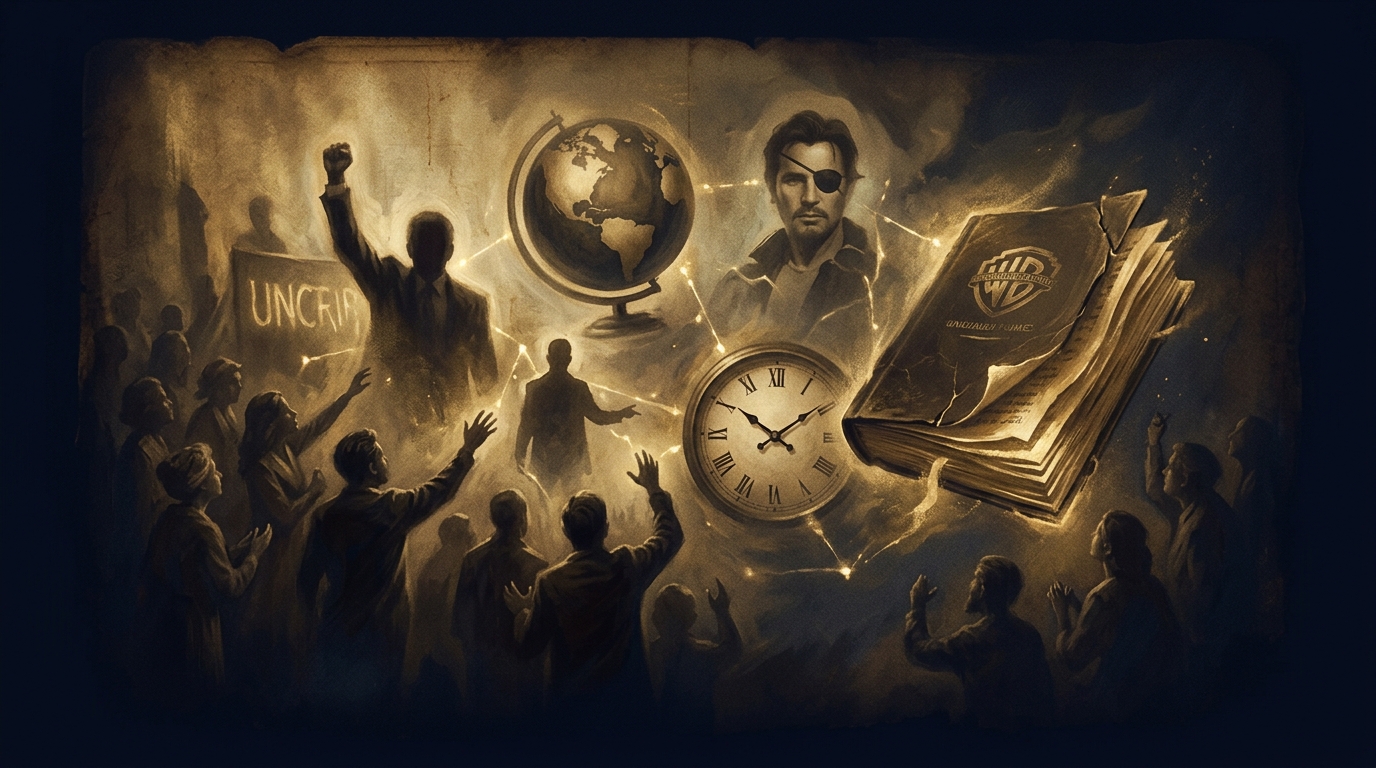
 Codex Illustration
The Mandela Effect
The Mandela Effect describes the curious phenomenon in which large groups of people share identical false memories — recollections of events, logos, or cultural details that demonstrably never occurred as remembered — raising unsettling questions about the reliability of human memory, the nature of shared cognition, and, in more speculative quarters, the stability of reality itself.
Overview
In 2009, paranormal researcher and blogger Fiona Broome publicly coined the phrase 'Mandela Effect' after discovering that she and a surprising number of others shared a vivid but historically inaccurate memory: the conviction that South African anti-apartheid leader Nelson Mandela had died in prison during the 1980s. Mandela, of course, was released from Robben Island in 1990 and lived until December 2013. What made Broome's observation culturally resonant was not merely that people had misremembered — human memory being notoriously fallible — but that the false memories were often uncannily specific, consistent across strangers, and accompanied by genuine emotional conviction. The phenomenon rapidly became an internet-era touchstone, gathering momentum through forums, social media, and YouTube communities, transforming from a casual observation into a full-blown cultural mythology.
The most frequently cited examples of the Mandela Effect include: the widespread belief that the Berenstain Bears children's book series was originally spelled 'Berenstein'; confident recollections that the cartoon character Pikachu possesses a black-tipped tail (it does not); memories of a 1990s film called 'Shazaam' starring comedian Sinbad as a genie (no such film exists, though a similarly themed film, 'Kazaam,' starred Shaquille O'Neal); the persistence of the phrase 'mirror, mirror on the wall' from Snow White (the original Disney film uses 'magic mirror on the wall'); and debates over whether the Monopoly mascot 'Rich Uncle Pennybags' wears a monocle (he does not, and apparently never did). Each of these examples, taken individually, might be unremarkable. Taken collectively, they form a pattern that has attracted serious attention from cognitive psychologists, who recognize in them a potent illustration of how memory actually functions.
Mainstream cognitive science offers a robust and well-evidenced explanation. Memory is not a recording device but a reconstructive process — each act of remembering is also an act of partial reconstruction, vulnerable to contamination by subsequent information, social influence, schema-driven expectation, and simple familiarity. Elizabeth Loftus, whose decades of peer-reviewed research on false memory and eyewitness testimony stands as some of the most cited work in cognitive psychology, demonstrated that entirely false memories can be implanted and held with great confidence. The 'misinformation effect,' the 'DRM paradigm' (Deese-Roediger-McDermott), and related experimental frameworks demonstrate that collective false memories are a predictable, reproducible product of normal human cognition — not an anomaly requiring exotic explanation. The internet, far from merely revealing these shared errors, may actively amplify and synchronize them: when millions of people read the same incorrect claim, the false version can become more cognitively accessible than the correct one.
Nevertheless, the Mandela Effect has attracted a parallel universe of alternative interpretation. A significant online subculture — drawing loosely on the many-worlds interpretation of quantum mechanics, speculative theories about CERN's Large Hadron Collider altering timelines, and broader simulation theory frameworks — proposes that the shared discrepancies are evidence of genuine timeline shifts, dimensional bleed-through, or glitches in a simulated reality. These interpretations are not supported by peer-reviewed physics or cognitive science, and physicists working in quantum mechanics have consistently noted that the many-worlds interpretation, even if valid, would produce no perceptible or navigable 'shifts' at the macroscopic human level. What remains genuinely interesting to scholars, however, is the sociological and epistemological question the phenomenon surfaces: in an age of digitally mediated culture, how do communities construct, share, and defend collective memories — and what does the widespread appeal of these alternative explanations reveal about contemporary anxieties regarding truth, reality, and institutional trustworthiness?
Key Claims
Timeline
Evidence
Multiple Perspectives
Biblical Lens
Scripture Threads
Sources & Further Study
Questions to Explore
Go Deeper Path
Follow the Thread
Continue the Investigation
You’ve reached the Full Archive portion of this Case File.
Ask the Archivist
about this fileSign in to ask the Archivist
Create a free account to ask the Archivist 1 grounded question each day, cited straight from the CODEX case files.
Discussion
0Share findings, questions, and evidence with fellow Seekers. Be respectful and cite sources where you can.
No comments yet. Be the first to open this thread.