
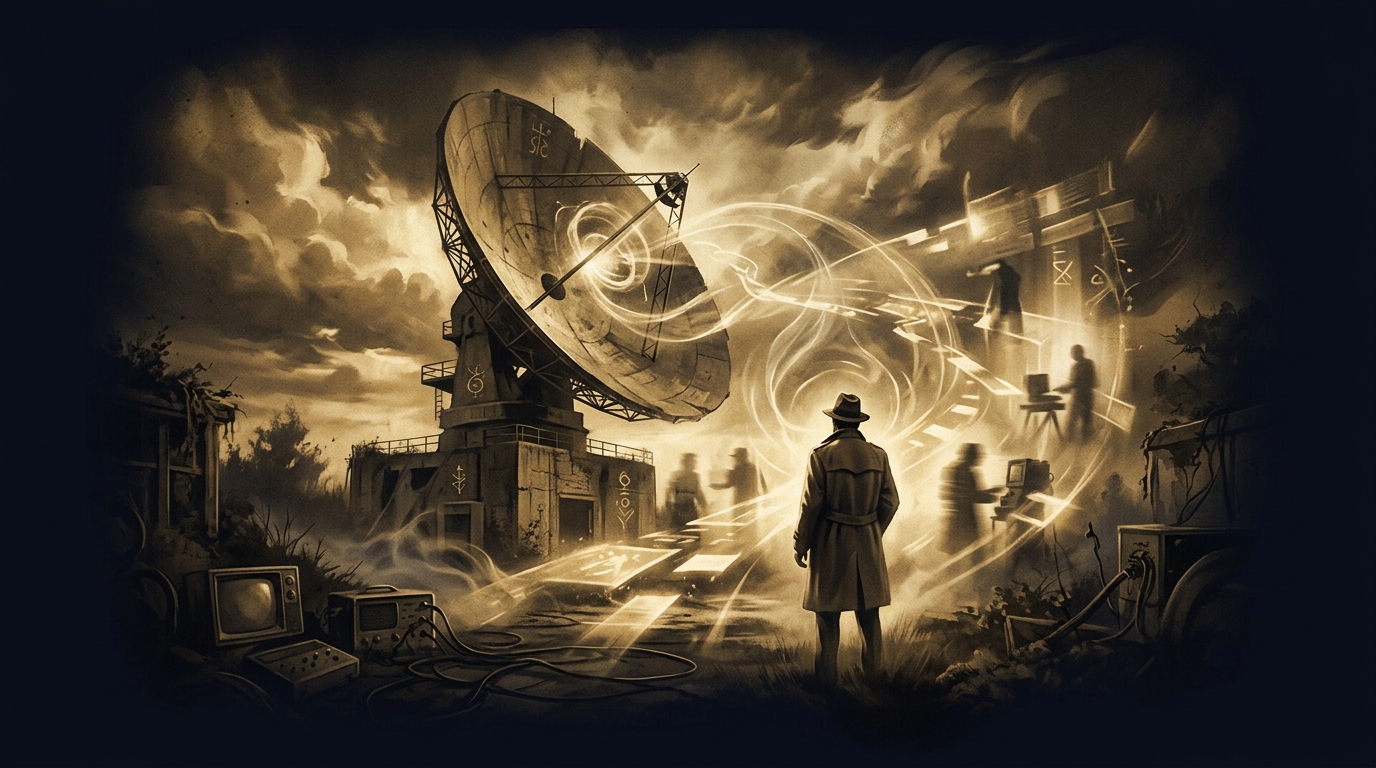
 Codex Illustration
The Montauk Project
Emerging from the wreckage of Cold War paranoia and the shadow of documented mind-control programs, the Montauk Project is a sprawling set of claims alleging that covert experiments in time travel, mind control, and interdimensional exploration were conducted beneath a decommissioned Air Force radar station at Montauk Point, New York — allegations that have never been substantiated by credible evidence, yet continue to exert a powerful grip on the fringe imagination.
Overview
The Montauk Project entered public consciousness principally through a series of books published beginning in 1992 by Preston Nichols and Peter Moon, collectively known as 'The Montauk Project: Experiments in Time.' Nichols, who claimed to have recovered repressed memories of his participation in secret experiments, alleged that Camp Hero — a decommissioned U.S. Army and Air Force installation at Montauk Point on Long Island — served as the operational site for a classified government program that extended the work of the Philadelphia Experiment into the realms of psychotronics, teleportation, and temporal manipulation. The narrative presents a hidden continuity between wartime naval research and postwar black programs, framing Camp Hero's distinctive AN/FPS-35 radar tower as the antenna for a machine capable of generating and shaping a 'time vortex.' These claims arrived with no documentation, no corroborating witnesses beyond the authors' own circle, and no physical evidence beyond the admittedly atmospheric ruins of the base itself.
The documented history of Camp Hero is considerably more prosaic, though genuinely interesting in its own right. The site began as a coastal artillery battery during World War II, was later converted to Air Force radar operations during the Cold War, and was formally decommissioned in 1984. It is now a New York State park. The large radar tower that features so prominently in Montauk mythology is a real structure — an AN/FPS-35 long-range radar dish — but its existence is entirely consistent with the base's openly documented Cold War surveillance mission. Investigators and journalists who have examined the physical site have found sealed underground bunkers consistent with standard military construction of the era, not the elaborate subterranean laboratory complex described in Nichols and Moon's accounts. The New York State Office of Parks, Recreation and Historic Preservation has conducted assessments of the facility and found nothing inconsistent with its known history.
The Montauk Project narrative draws heavily, and often explicitly, from two documented but unrelated sources of genuine historical strangeness: Project MKUltra, the CIA's real program of covert psychological and pharmacological experimentation on unwitting subjects (confirmed through declassified documents released after the 1973 destruction of records and the 1977 Senate hearings), and the Philadelphia Experiment legend, which itself derives from the peculiar annotations of Carlos Allende in a copy of Morris Jessup's 'The Case for the UFO.' MKUltra provides the Montauk narrative its most compelling gravitational pull — because a real government program of that moral character existed, the imaginative leap to something even more extreme feels, to many readers, like a small one. Scholars of conspiracy culture, including Michael Barkun in 'A Culture of Conspiracy: Apocalyptic Visions in Contemporary America,' have analyzed how documented government wrongdoing functions as a credibility anchor for far more expansive and unsubstantiated claims.
The Montauk Project has achieved an unusual second life in popular culture, most visibly as a significant acknowledged inspiration for the Netflix series 'Stranger Things,' whose fictional Hawkins Laboratory shares numerous structural elements with the Montauk narrative. This cultural diffusion has paradoxically both amplified awareness of the original claims and further blurred the already uncertain boundary between documented history, folk legend, and deliberate fiction. Among researchers of the fringe, Montauk functions less as a falsifiable historical claim than as a mythology — a narrative complex through which anxieties about government secrecy, the weaponization of consciousness, and the fragility of perceived reality are given vivid, if entirely speculative, symbolic form.
Key Claims
Timeline
Evidence
Multiple Perspectives
Biblical Lens
Scripture Threads
Sources & Further Study
Questions to Explore
Go Deeper Path
Follow the Thread
Continue the Investigation
You’ve reached the Full Archive portion of this Case File.
Ask the Archivist
about this fileSign in to ask the Archivist
Create a free account to ask the Archivist 1 grounded question each day, cited straight from the CODEX case files.
Discussion
0Share findings, questions, and evidence with fellow Seekers. Be respectful and cite sources where you can.
No comments yet. Be the first to open this thread.