
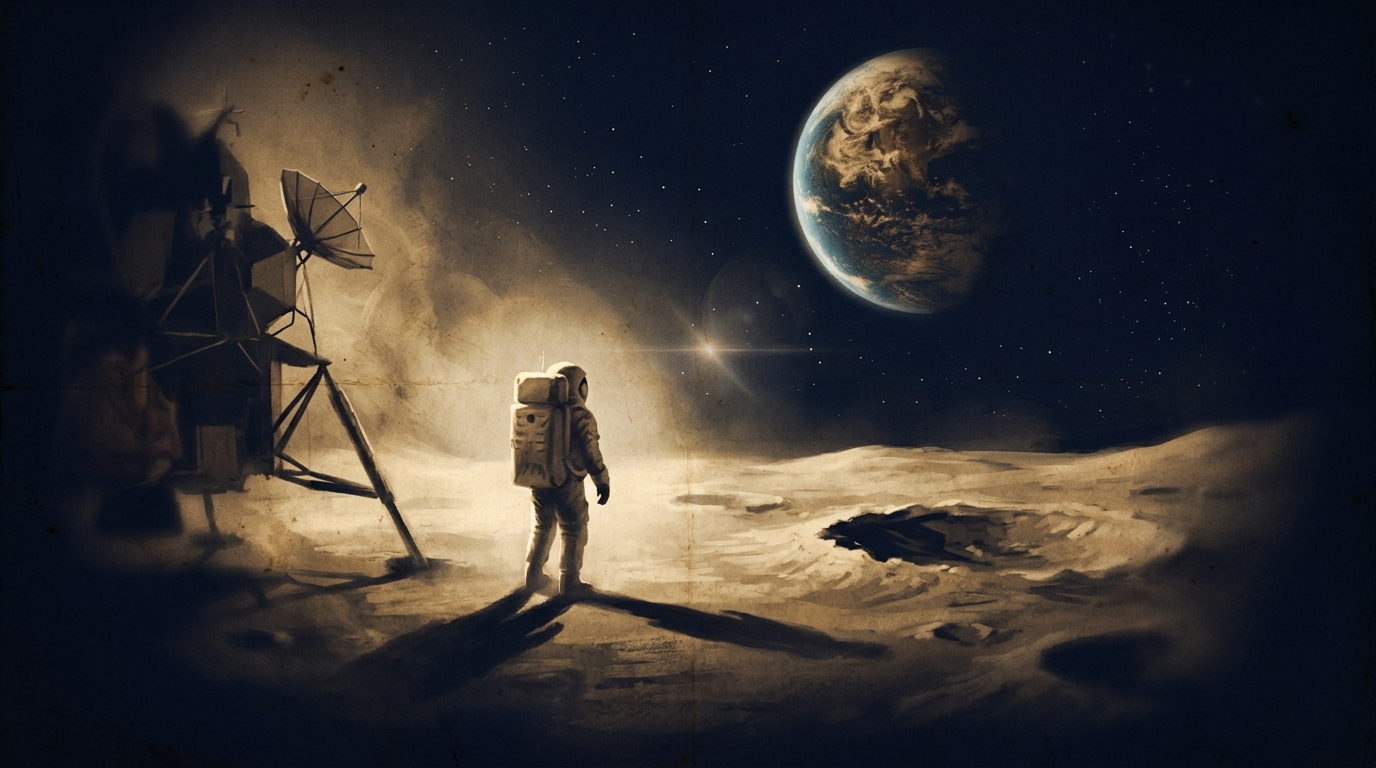
 Codex Illustration
The Moon Landing
On July 20, 1969, two human beings stepped onto the surface of another world — an event so extraordinary that, for some, its very audacity became the seed of doubt. The Apollo program stands as one of the most thoroughly documented achievements in human history, yet a persistent conspiracy tradition insists the footage was fabricated, raising enduring questions not about the moon, but about the nature of evidence, trust, and the psychology of disbelief.
Overview
The Apollo 11 mission, culminating in Neil Armstrong's first steps on the lunar surface at 20:17 UTC on July 20, 1969, represents a landmark in the history of human exploration. The mission was the product of an eight-year national effort initiated by President John F. Kennedy's 1961 address to Congress, involving an estimated 400,000 engineers, scientists, and technicians across NASA and its contractors. Five subsequent missions landed on the moon between 1969 and 1972, collecting 842 pounds of lunar samples, deploying scientific instrument packages that continued transmitting data for years, and leaving retroreflector arrays that independent observatories around the world — including Soviet tracking stations — continue to use to this day to measure the precise Earth-Moon distance by bouncing laser pulses off them. The documentary record of the Apollo program is vast, public, and cross-referenced across multiple independent national archives.
Despite this mountain of corroborating evidence, the 'moon-hoax' theory began circulating almost immediately, gaining its most systematic early expression in Bill Kaysing's self-published 1974 pamphlet We Never Went to the Moon: America's Thirty Billion Dollar Swindle. Kaysing, a former Rocketdyne technical writer with no engineering credentials, argued that NASA lacked the technical capability and that the footage was staged — an idea later dramatized in Peter Hyams's 1977 thriller Capricorn One, which depicted a faked Mars mission. The theory found renewed cultural traction in the late 1990s and 2000s with the addition of the claim that Stanley Kubrick, director of 2001: A Space Odyssey, was recruited to produce the fabricated footage — a claim documented nowhere in Kubrick's extensive personal archive and explicitly denied by his family and colleagues. These claims are specific, checkable, and have been methodically addressed by NASA, independent scientists, and photographic analysts.
The most commonly cited 'anomalies' in the Apollo photographs and footage include: the apparently waving flag, shadows that seem to converge at non-parallel angles, the absence of stars in lunar surface photographs, and the claim that the Van Allen radiation belts would have delivered lethal doses to the crew. Each of these has a well-established scientific explanation rooted in basic physics. The flag was designed with a horizontal rod sewn into its upper edge precisely to keep it extended in the vacuum; residual motion from planting caused oscillation that, without air resistance, continued briefly. Non-parallel shadows on an uneven surface photographed with a wide-angle lens are a predictable optical outcome. Stars are invisible in photographs of sunlit lunar surfaces because the correct exposure for a brightly lit foreground necessarily underexposes the faint stellar background — exactly as on Earth. The Van Allen belt radiation dose, while significant, was calculated by mission planners; the transit trajectory was optimized to minimize exposure time, and dosimetry data from the crew confirmed doses well within survivable ranges, a finding corroborated by independent radiation physicists including those at Rice University and the Langley Research Center.
The deeper question the moon-hoax tradition raises is not technical but epistemological: how do communities of evidence work, and how does distrust in institutions — sometimes earned — migrate into rejection of well-attested facts? The same Cold War rivalry that conspiracy theorists claim provided motive for a hoax also provided the most powerful real-world verification mechanism: the Soviet Union, with every strategic incentive to expose a fabrication, tracked the Apollo missions in real time and never disputed their authenticity. Independent amateur radio operators around the world monitored the transmissions. Retroreflectors deployed by Apollo astronauts are experimentally confirmed by dozens of independent observatories annually. The lunar samples — distributed to researchers in dozens of countries — have petrological signatures, isotopic ratios, and micrometeorite impact characteristics physically impossible to replicate on Earth. The Apollo missions happened. What endures as a genuine historical mystery is not whether the moon was reached, but why the belief that it was not has proven so remarkably durable.
Key Claims
Timeline
Evidence
Multiple Perspectives
Biblical Lens
Scripture Threads
Sources & Further Study
Questions to Explore
Go Deeper Path
Follow the Thread
Continue the Investigation
You’ve reached the Full Archive portion of this Case File.
Ask the Archivist
about this fileSign in to ask the Archivist
Create a free account to ask the Archivist 1 grounded question each day, cited straight from the CODEX case files.
Discussion
0Share findings, questions, and evidence with fellow Seekers. Be respectful and cite sources where you can.
No comments yet. Be the first to open this thread.