
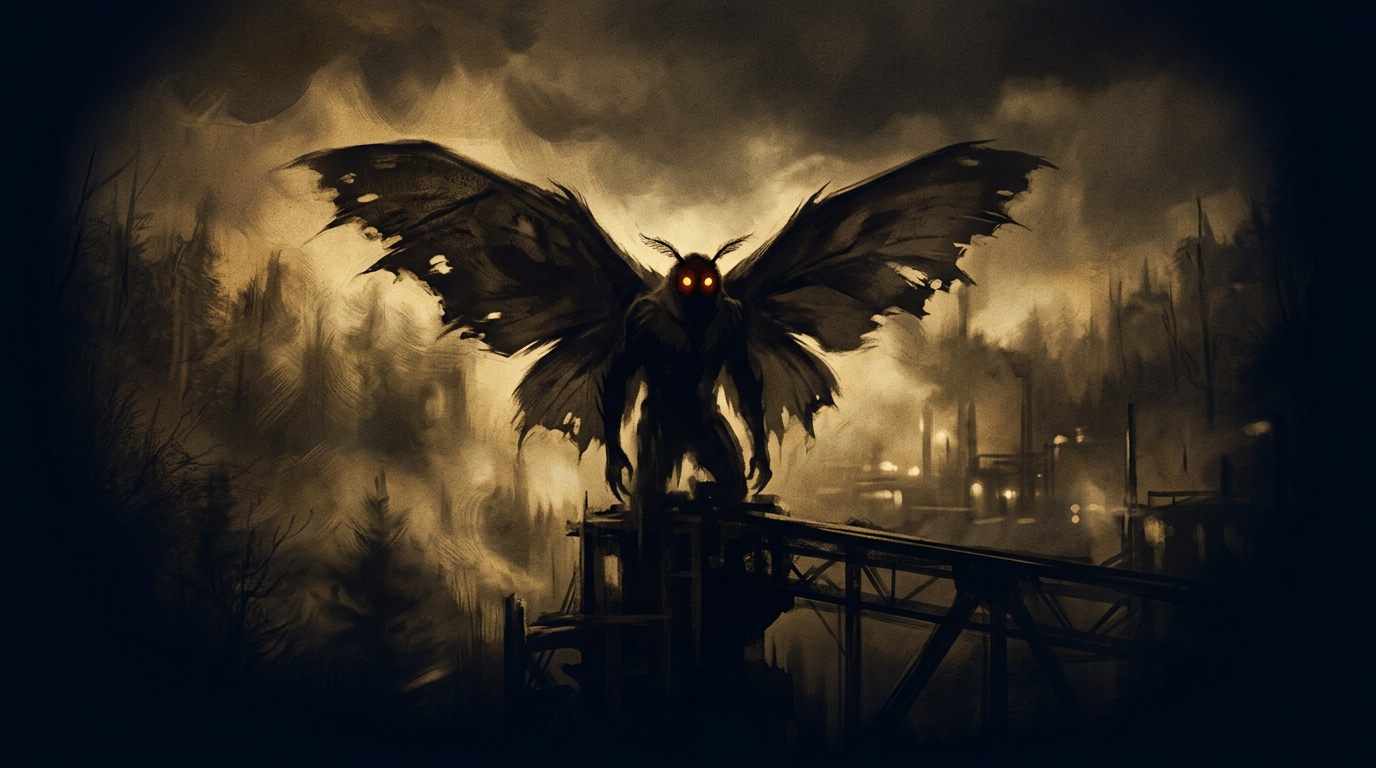
 Codex Illustration
The Mothman
Between November 1966 and December 1967, the small West Virginia town of Point Pleasant became the epicenter of one of America's most enduring and disturbing cryptid legends — a large, winged, red-eyed figure whose appearances were reportedly intertwined with UFO sightings, strange phone calls, and culminated, in the minds of many witnesses, with the catastrophic collapse of the Silver Bridge. Whether the Mothman represents a misidentified animal, a mass psychological event, a genuine anomalous entity, or something stranger still remains, decades later, an open and genuinely puzzling question.
Overview
The Mothman encounters began on November 12, 1966, when five gravediggers in Clendenin, West Virginia, reported seeing a large, man-shaped figure lift from the trees and fly overhead. Two nights later, two young couples — Roger and Linda Scarberry, and Steve and Mary Mallette — reported a terrifying encounter near an abandoned TNT munitions plant outside Point Pleasant. They described a gray, humanoid creature standing six to seven feet tall, with enormous wings folded against its back and two large, glowing red eyes set not in a distinct head but apparently in the upper torso. The creature allegedly pursued their vehicle at speeds reportedly exceeding one hundred miles per hour along Route 62. Their report was taken seriously enough to make local and then national newspapers within days, and within weeks, dozens of additional witnesses had come forward with strikingly similar descriptions. The area around the former World War II-era West Virginia Ordnance Works — locally called the TNT Area — became the focal geography of the sightings, a detail some researchers have connected to the site's documented history of chemical contamination and industrial abandonment.
The encounters did not occur in isolation. Investigative journalist John Keel arrived in Point Pleasant in late 1966 and spent considerable time interviewing witnesses, logging not only Mothman sightings but a dense cluster of UFO reports, Men in Black visitations, poltergeist activity, and anomalous telephone interference. Keel's methodology was journalistic rather than strictly scientific, but his field notes and published accounts remain the most comprehensive primary record of the Point Pleasant wave. Keel developed the theory that the Mothman, Men in Black, and UFO phenomena were not separate events but manifestations of a single ultraterrestrial phenomenon — entities he believed were not extraterrestrial but interdimensional, or perhaps inherent features of human consciousness and the electromagnetic environment. This theoretical framework has remained influential in Fortean research but is rejected by mainstream science and skeptical investigators alike, who regard it as unfalsifiable speculation.
The Mothman legend acquired its darkest and most culturally durable dimension on December 15, 1967, when the Silver Bridge — a 1928 eyebar-chain suspension bridge spanning the Ohio River between Point Pleasant and Gallipolis, Ohio — collapsed during rush-hour traffic, killing forty-six people. The proximity of the bridge collapse to the preceding thirteen months of anomalous activity led many residents and outside observers to retrospectively connect the two phenomena, a linkage that Keel would later formalize in his 1975 book The Mothman Prophecies. Whether this connection represents genuine precognitive warning, confirmation bias applied to tragedy, or narrative storytelling pattern-matching is a matter of serious ongoing debate. The National Transportation Safety Board's official investigation attributed the collapse to a stress-corrosion crack in a single eyebar link — a documented structural failure with no paranormal dimension — but the cultural fusion of creature and catastrophe proved more powerful than engineering reports.
The Mothman has since become a significant piece of American folklore and popular culture, spawning a 2002 film adaptation of Keel's book, an annual festival in Point Pleasant, a bronze statue erected in the town center, and countless documentary treatments. Researchers such as Loren Coleman and Jerome Clark have situated the Mothman within a broader tradition of crisis apparitions — entities or phenomena that appear to communities in advance of or during periods of collective trauma — while skeptical investigators including Joe Nickell have proposed that the original sightings are most plausibly explained by misidentification of a large bird, most likely the sandhill crane or barn owl, whose eyes reflect brightly in artificial light. The honest accounting of the Mothman must hold these competing explanations in tension: the eyewitness testimony is voluminous and sincere, the cultural elaboration is extensive, the structural explanations are plausible but not fully satisfying to all parties, and the phenomenon itself remains, by any rigorous evidentiary standard, unresolved.
Key Claims
Timeline
Evidence
Multiple Perspectives
Biblical Lens
Scripture Threads
Sources & Further Study
Questions to Explore
Go Deeper Path
Carry the Investigation
Field gear inspired by this Codex case file.
Follow the Thread
Continue the Investigation
You’ve reached the Full Archive portion of this Case File.
Ask the Archivist
about this fileSign in to ask the Archivist
Create a free account to ask the Archivist 1 grounded question each day, cited straight from the CODEX case files.
Discussion
0Share findings, questions, and evidence with fellow Seekers. Be respectful and cite sources where you can.
No comments yet. Be the first to open this thread.