
 Codex Illustration
The Number Nine
Across an extraordinary range of unconnected civilizations, the number nine has occupied a position of singular symbolic weight — standing at the boundary of completion, transformation, and the divine — yet the mechanisms by which this convergence arose remain genuinely contested.
Overview
The number nine sits at an unusual intersection of arithmetic fact and cultural mythology. As the last single-digit integer and the square of three — itself universally treated as a number of completeness — nine carries properties that are mathematically distinctive as well as symbolically charged. Its most celebrated arithmetic feature is the 'digital root' property: the digits of any multiple of nine, when summed repeatedly, return to nine itself (e.g., 9 × 7 = 63; 6 + 3 = 9). This is a provable consequence of base-ten positional notation, not mystical resonance, and mathematicians have understood it in formal terms since at least the medieval period. Yet the sheer consistency with which pre-modern cultures — who lacked formal algebra — noticed this property and wove it into cosmological and theological frameworks is itself a legitimate subject of cultural-historical inquiry.
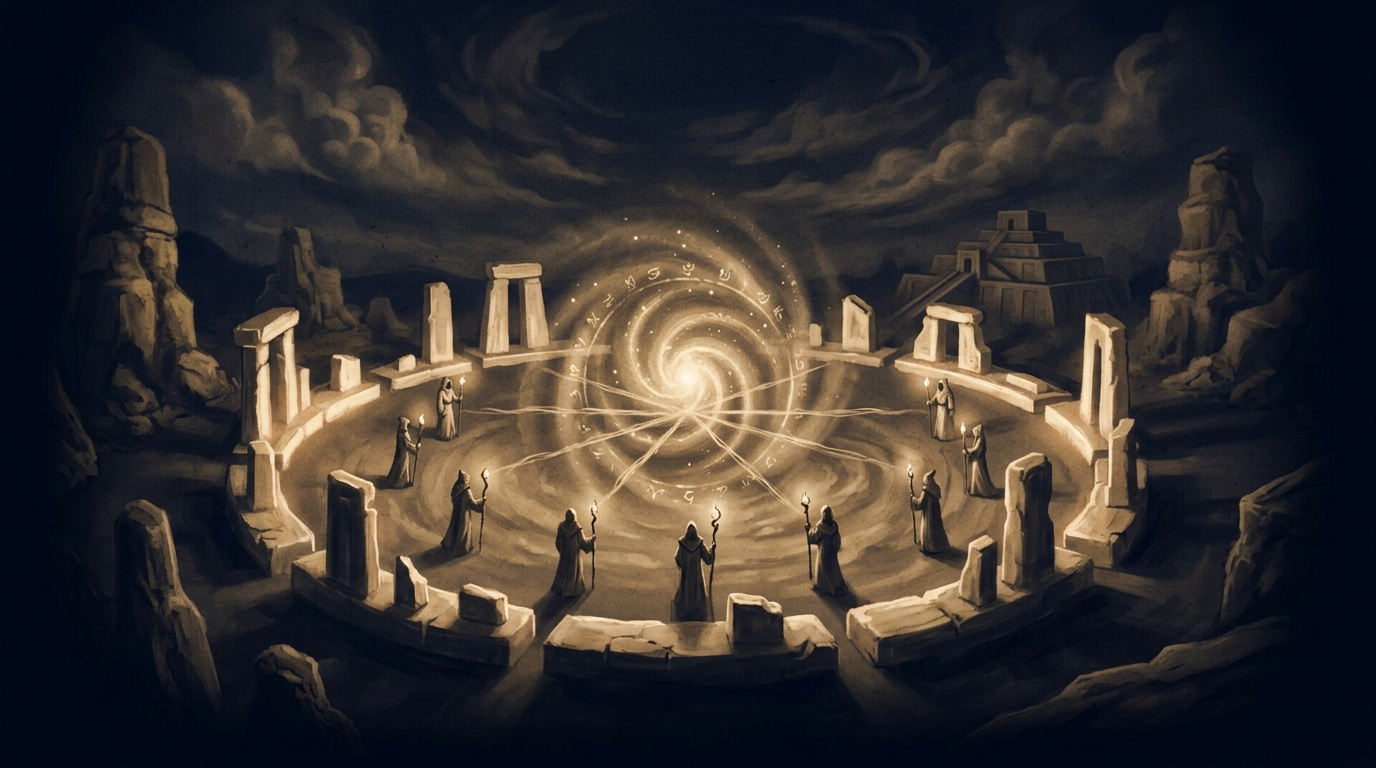
In Norse cosmology, nine worlds are organized upon the cosmic tree Yggdrasil, and Odin hangs upon it for nine nights to win the runes — a sacrificial pattern that scholars including Hilda Ellis Davidson (in 'Gods and Myths of Northern Europe') have examined as a shamanic initiation archetype. In Chinese tradition, nine was the supreme yang number and was institutionally embedded in imperial architecture: the Forbidden City's gates are said to be studded with 81 (9×9) nails in their rows and columns. Ancient Egyptian cosmology recognized the Ennead of Heliopolis, nine principal deities whose interactions structured creation. In Mesoamerican traditions, the Mayan underworld was divided into nine levels ruled by nine lords of the night, a structure with partial parallels in central Mexican cosmology as well. The Vedic and later Hindu traditions assign nine to Navagrahas — the nine celestial influences — and the Bahá'í Faith employs nine as the number of its universal House of Worship design. Whether this breadth of usage represents independent convergence driven by arithmetic perception or reflects ancient diffusion remains a genuinely open scholarly question.
In the Abrahamic traditions, the symbolic weight of nine is more muted than numbers such as seven, twelve, or forty, but it is not absent. In the Hebrew Bible, the ninth hour (3 p.m.) carries narrative significance in several texts; in the New Testament, the death of Jesus is recorded as occurring at the ninth hour (Matthew 27:46), and the Epistle to the Galatians (5:22–23) enumerates nine fruits of the Spirit — a list that generated considerable patristic and later theological commentary. Jewish mysticism, particularly Kabbalah, situates nine within the structure of the Sefirot: the ninth Sefirah, Yesod, functions as a channel or foundation through which divine energy flows into the manifest world, a concept developed extensively in the Zohar and in the writings of Isaac Luria. Medieval Christian numerologists, drawing on Augustine's distinction between numbers that convey spiritual meaning and those that are merely quantitative, assigned nine to angelic orders and to the threefold Trinity squared.
Contemporary popular culture has generated a secondary layer of nine-mythology that blends legitimate historical observations with internet-amplified numerological claims. The assertion that '9 is the number of the universe' — popularized through viral videos and numerology websites — typically conflates the digital root property with metaphysical significance, presenting an arithmetic inevitability as though it were a discovered cosmic secret. More serious investigators in the history of mathematics — including scholars associated with journals such as Historia Mathematica — treat the cultural history of number symbolism as a legitimate subdiscipline, while carefully distinguishing between documented historical usage, cross-cultural pattern recognition, and unwarranted causal inference. The number nine is thus a genuine case study in how mathematical properties, when filtered through human pattern-seeking cognition, generate symbolic systems of remarkable durability and reach.
Key Claims
Timeline
Evidence
Multiple Perspectives
Biblical Lens
Scripture Threads
Sources & Further Study
Questions to Explore
Go Deeper Path
Follow the Thread
Continue the Investigation
You’ve reached the Full Archive portion of this Case File.
Ask the Archivist
about this fileSign in to ask the Archivist
Create a free account to ask the Archivist 1 grounded question each day, cited straight from the CODEX case files.
Discussion
0Share findings, questions, and evidence with fellow Seekers. Be respectful and cite sources where you can.
No comments yet. Be the first to open this thread.