
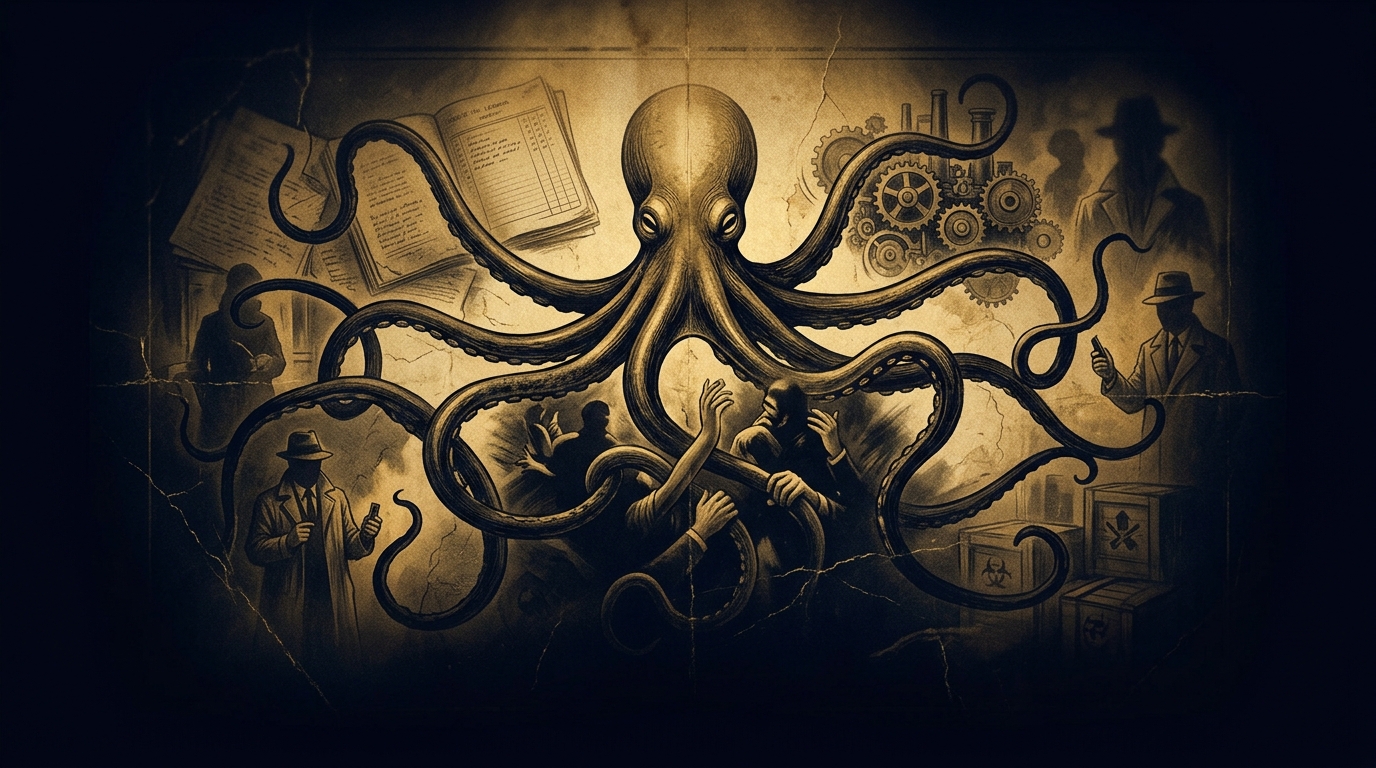
 Codex Illustration
The Octopus Conspiracy
In the late 1980s and early 1990s, a cluster of investigative journalists, whistleblowers, and federal informants alleged the existence of a vast, interconnected criminal network — involving arms trafficking, drug smuggling, financial fraud, and covert intelligence operations — that reached into the highest levels of the American government. The story's most haunting detail may be that several of those who pursued it died before their findings could be fully published.
Overview
The term 'Octopus' was coined, or at least popularized, by freelance journalist Danny Casolaro, who used it as a metaphor for what he believed was a single, tentacled criminal enterprise linking seemingly disparate scandals of the late Cold War era: the October Surprise allegations (claims that Reagan campaign operatives negotiated with Iran to delay the release of American hostages in 1980), the BCCI banking scandal, the Inslaw affair (involving stolen software called PROMIS), Iran-Contra, and land fraud cases in the American Southwest. Casolaro's working thesis, gathered across hundreds of interviews and thousands of pages of notes, was that these were not separate events but coordinated operations managed by a loose, partially privatized intelligence network operating outside congressional oversight. In August 1991, he was found dead in a Martinsburg, West Virginia hotel room, his wrists slashed. The official ruling was suicide, though his family and colleagues disputed this, noting that his research materials — a briefcase of documents he had told associates would 'blow the whole thing open' — were missing from the room.
The PROMIS software affair forms one of the most substantiated threads of the larger tapestry. PROMIS (Prosecutor's Management Information System) was developed by the Inslaw company, led by Bill Hamilton, under a contract with the U.S. Department of Justice. Hamilton alleged that DOJ officials conspired to steal the software without compensation. Subsequent investigations — including a formal report by the House Judiciary Committee in 1992 — found credible evidence of government misconduct in the Inslaw case, though the full scope of what was done with PROMIS remained disputed. Some credible sources, including former Justice Department official Elliot Richardson (who represented Inslaw), and investigative journalist Seymour Hersh in passing references, treated the case as genuine government malfeasance. The more extraordinary allegation — that PROMIS was modified with a backdoor and sold to foreign intelligence services, law enforcement agencies, and financial institutions as a surveillance tool — remains unconfirmed but was reported seriously by journalists at outlets including the Village Voice and Wired.
The human toll attached to this story is itself the subject of legitimate historical inquiry. Casolaro's death in 1991 was the most prominent, but researchers and journalists have documented a broader list of individuals connected to Iran-Contra, BCCI, and related investigations who died under disputed or unusual circumstances in this period — among them Alan Standorf, a National Security Agency employee who was found murdered in January 1991 and who had reportedly been a Casolaro source. Whether these deaths constitute a pattern of suppression, a tragic coincidence amplified by confirmation bias, or something in between remains genuinely unresolved. Congressional investigations touched the edges of several related scandals — the Kerry Committee Report on BCCI (1992) and the Tower Commission on Iran-Contra (1987) both documented significant institutional wrongdoing — without ever substantiating the overarching unified-network thesis.
What makes 'The Octopus' a uniquely difficult subject for archival treatment is that it exists at the precise intersection of documented institutional crime and speculative grand unified theory. Several of its component scandals are thoroughly documented historical events: Iran-Contra is established fact; BCCI's collapse involved proven criminal fraud across dozens of countries; the October Surprise allegation remains officially unresolved but was the subject of serious Senate investigation. What remains unverified — and may be unverifiable — is whether these events were coordinated by a single covert network, or whether Casolaro's synthesis was a pattern-seeking construction imposed on genuinely related but ultimately separate scandals. The archive records the question without resolving it.
Key Claims
Timeline
Evidence
Multiple Perspectives
Biblical Lens
Scripture Threads
Sources & Further Study
Questions to Explore
Go Deeper Path
Follow the Thread
Continue the Investigation
You’ve reached the Full Archive portion of this Case File.
Ask the Archivist
about this fileSign in to ask the Archivist
Create a free account to ask the Archivist 1 grounded question each day, cited straight from the CODEX case files.
Discussion
0Share findings, questions, and evidence with fellow Seekers. Be respectful and cite sources where you can.
No comments yet. Be the first to open this thread.