
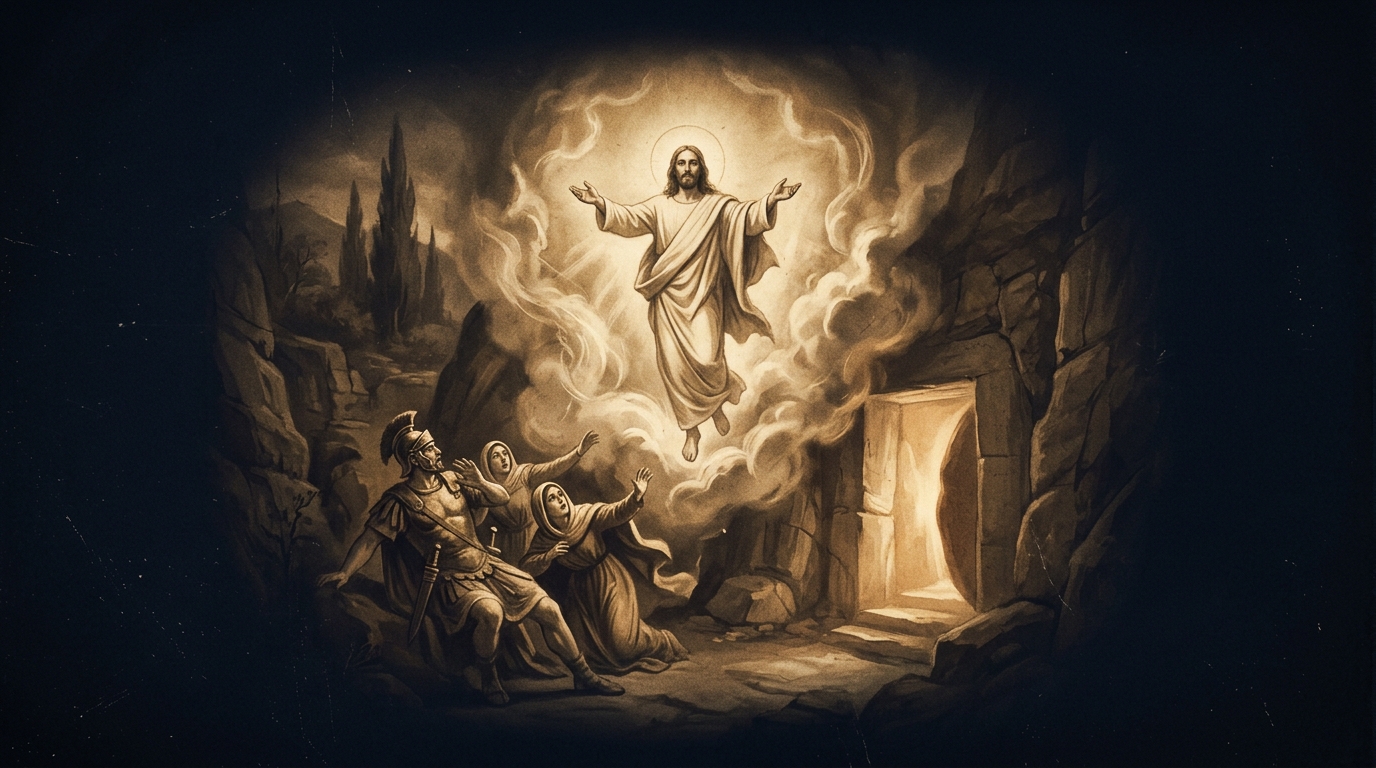
 Codex Illustration
The Resurrection of Jesus Christ
The central and most contested claim of Christianity — that Jesus of Nazareth, executed by Roman crucifixion under Pontius Pilate circa AD 30–33, rose bodily from the dead on the third day — stands as a hinge point between ancient history and living faith, drawing serious scholarly engagement from believers and skeptics alike.
Overview
In the first century of the Common Era, a Galilean teacher and healer named Jesus of Nazareth was crucified in Jerusalem under the authority of the Roman prefect Pontius Pilate. Within days of his death, his followers began making a claim so extraordinary that it fractured families, toppled careers, and ultimately reshaped the course of Western civilization: that he had risen bodily from the tomb. Four independent Gospel accounts — Matthew 28, Mark 16, Luke 24, and John 20–21 — each narrate the discovery of an empty tomb, the terror and confusion of the disciples, and a series of post-resurrection appearances. What is immediately striking to the historian is a detail that all four accounts share without apparent coordination: it is women, not men, who first encounter the risen Christ. In a first-century Jewish and Roman legal culture that routinely discounted the testimony of women, this feature would have been a liability in any fabricated account. The 'criterion of embarrassment' — a standard tool in historical criticism — suggests that the detail survived precisely because it was remembered as true.
The most significant historical datum bearing on the resurrection may not be the Gospel narratives themselves but an earlier document embedded within Paul's first letter to the Corinthians, written around AD 53–55. In 1 Corinthians 15:3–7, Paul transmits a structured creed — using the technical Jewish terminology for received tradition ('I delivered to you what I also received') — that critical scholars across the theological spectrum date to within a few years of the crucifixion itself, possibly as early as AD 30–35. The creed lists named witnesses: Peter (Cephas), the Twelve, more than five hundred people at once (many of whom, Paul notes, were still living at the time of writing), James the brother of Jesus, and finally Paul himself. Paul is not here appealing to legend; he is appealing to living, checkable testimony. The earliness of this creed — predating any of the canonical Gospels — is among the most robustly argued points in New Testament scholarship, broadly accepted even by historians who dispute the resurrection itself.
Non-Christian historical sources provide a useful, if limited, corroboration. The Roman historian Tacitus, writing around AD 116 in his Annals (15.44), refers to 'Christus,' executed under Pilate during the reign of Tiberius, as the origin of the movement called Christianity. Most scholars accept this passage as authentic and entirely independent of Christian tradition. Josephus, writing in his Antiquities of the Jews (c. AD 93–94), offers two relevant references. The shorter passage in Antiquities 20.9.1, describing the execution of 'the brother of Jesus, who was called Christ, whose name was James,' is largely accepted by scholars as authentic and independently attests Jesus as a historical figure. The longer 'Testimonium Flavianum' (Antiquities 18.3.3) is considerably more contested: the surviving text contains phrases — including an apparent affirmation that Jesus was the Christ and had risen — that most scholars regard as later Christian interpolations into Josephus's originally neutral account. Some scholars believe a genuine, neutral reference to Jesus underlies the passage; others remain agnostic. In neither case does Josephus serve as an independent witness to the resurrection. These external sources establish, with reasonable historical confidence, that Jesus existed, that he was crucified, and that his followers made extraordinary claims about him — but they do not and cannot adjudicate the resurrection claim itself.
A further consideration, often given significant weight, concerns the fate of the witnesses themselves. The earliest proclaimers of the resurrection did not assert it from safety; several endured imprisonment, beatings, and execution rather than recant. Acts records the killing of James son of Zebedee (Acts 12:2); Josephus independently reports the execution of James the brother of Jesus around AD 62; and early tradition — including Clement of Rome (1 Clement, c. AD 96) — describes the martyrdoms of Peter and Paul. The evidential force of this deserves to be stated precisely. People die for beliefs they sincerely hold all the time, so martyrdom cannot by itself prove a belief true. What it does establish is that the witnesses genuinely believed what they proclaimed: unlike later converts who trusted a story, the original disciples were in a position to know whether they had actually seen the risen Jesus, and their willingness to suffer and die makes deliberate fraud — the theory that they knowingly invented a lie — extremely implausible. The live historical question, therefore, is not whether the disciples lied, but whether they could have been sincerely mistaken.
The scholarly debate over the resurrection is genuinely vigorous and deserves to be heard with care. The 'minimal facts' approach, developed by historians Gary Habermas and Michael Licona, builds its case from data that a significant cross-section of critical scholars — including non-Christian scholars — accept as historically secure: the crucifixion of Jesus, the sincere conviction of the disciples that they had seen him risen, the dramatic conversions of Paul (a persecutor of Christians) and James (a skeptical sibling of Jesus), and, for most scholars, the empty tomb. Habermas and Licona argue that bodily resurrection is the hypothesis that best accounts for this convergent evidence. Skeptical historians — including Bart Ehrman, Gerd Lüdemann, and Richard Carrier — accept many of these facts but propose alternative explanations: visionary or grief-induced hallucinatory experiences, the psychological dynamics of cognitive dissonance among a traumatized community, or simple agnosticism about what actually occurred. A crucial epistemological point must be stated plainly: historians, as historians, operate within a methodology that, by design, excludes supernatural intervention as an explanatory category. The question of whether a dead man was raised by God is therefore not a question that historical inquiry alone can settle. The surrounding historical data are strong and genuinely remarkable; the interpretation of those data as a bodily resurrection is a theological and philosophical conclusion that each reader must weigh for themselves.
Key Claims
Timeline
Evidence
Multiple Perspectives
Biblical Lens
Scripture Threads
Sources & Further Study
Questions to Explore
Go Deeper Path
Follow the Thread
Continue the Investigation
You’ve reached the Full Archive portion of this Case File.
Ask the Archivist
about this fileSign in to ask the Archivist
Create a free account to ask the Archivist 1 grounded question each day, cited straight from the CODEX case files.
Discussion
0Share findings, questions, and evidence with fellow Seekers. Be respectful and cite sources where you can.
No comments yet. Be the first to open this thread.