
 Codex Illustration
The Scent of Space
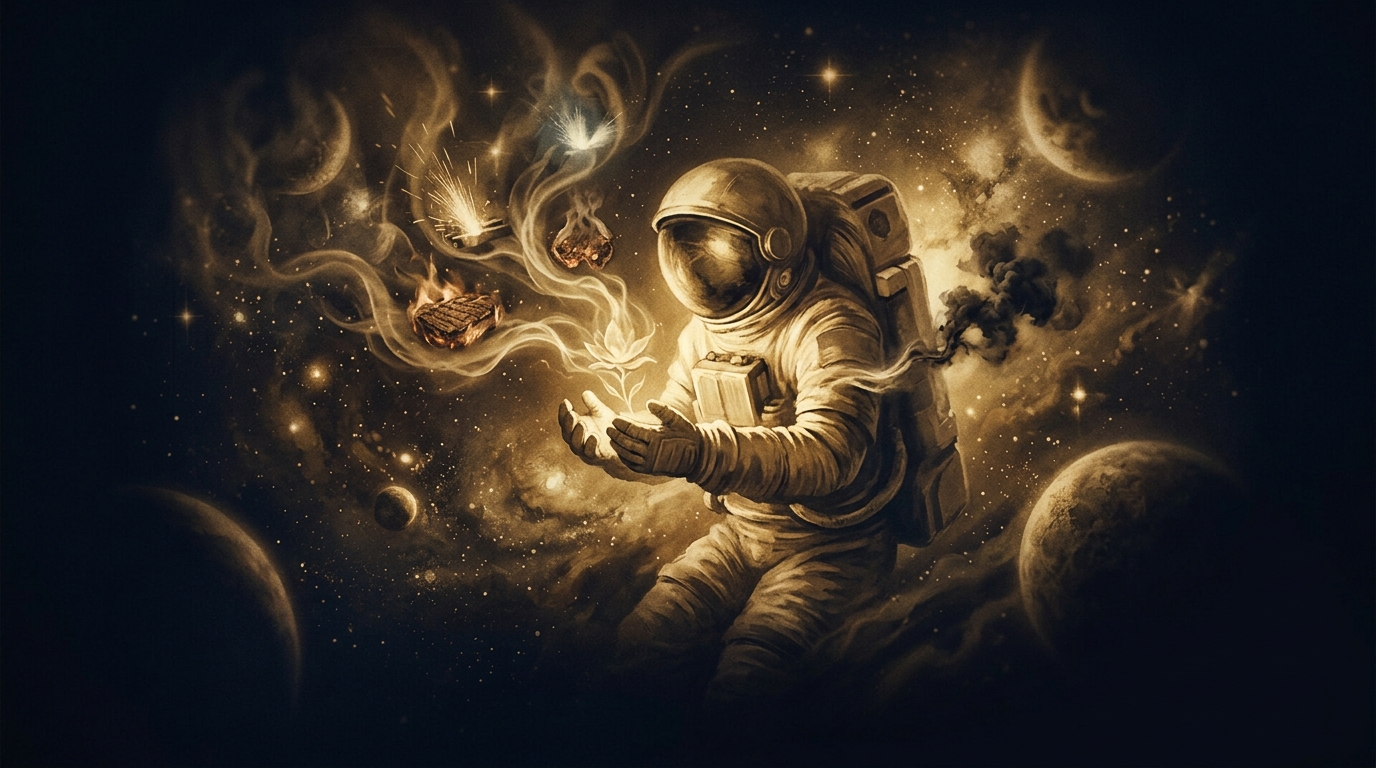
Returning astronauts have consistently reported that their spacesuits and equipment carry a distinctive odor after extravehicular activity — variously described as hot metal, seared steak, welding fumes, or burnt gunpowder — prompting chemists and astrobiologists to investigate the molecular sources of a smell that no living human has ever directly inhaled in the vacuum of space.
Overview
Since the early Apollo era, astronauts returning from spacewalks have noted a peculiar, persistent smell clinging to their suits and gear when they re-enter the pressurized cabin. Unlike the sterile expectations of a vacuum, the scent is vivid and chemically complex: astronaut Don Pettit, who spent months aboard the International Space Station, described it as 'a distinct odor of ozone, a faint acrid smell,' resembling burnt metal or the air after a lightning strike. Apollo-era astronauts made similar observations. Because no one can smell open space directly — the vacuum would be lethal before any olfactory experience were possible — these reports describe secondhand molecular residue deposited on surfaces and garments, then volatilized upon re-entry into a breathable atmosphere.
The scientific investigation of this phenomenon converges on several candidate molecular mechanisms. Polycyclic aromatic hydrocarbons (PAHs), which are among the most abundant organic molecules in the interstellar medium, are prime suspects; they are known to produce the characteristic burnt or smoky notes. Additionally, high-energy particle radiation and ultraviolet photons in the space environment can cleave chemical bonds on suit surfaces, generating reactive free radicals and ozone-like compounds. A 2021 study by Rachael Zammit and colleagues at the University of Leuven attempted to replicate space-like olfactory compounds by irradiating mixtures of known interstellar molecules. The field also connects to the broader chemistry of the interstellar medium (ISM), where molecular spectroscopy has confirmed the existence of ethanol, formaldehyde, acetaldehyde, and even the amino acid glycine in cometary and nebular environments.
Beyond the ISM, the scent question has practical implications for mission design and astronaut psychology. On long-duration missions to the Moon or Mars, olfactory stimuli will form part of the sensory environment in ways that mission planners cannot afford to ignore. NASA has funded limited research into replicating 'space smells' for training simulations, and perfumer Steve Pearce was commissioned in the early 2000s to develop a synthetic approximation for this purpose — a project that attracted considerable popular media attention. The chemistry of reactive oxygen species, nitrogen compounds, and radical intermediates in a near-vacuum environment remains an area of active study in astrochemistry and materials science.
The phenomenon also opens a window into the grand chemical richness of the cosmos. The Atacama Large Millimeter Array (ALMA) and its predecessors have catalogued hundreds of complex organic molecules in star-forming regions and molecular clouds, including compounds associated with familiar terrestrial smells. The Sagittarius B2 molecular cloud near the galactic center contains ethyl formate — a compound that contributes to the scent of raspberries and the flavor of rum — detected by radio astronomers in 2009. These findings do not imply that space 'smells like raspberries' in any accessible sense, but they underscore the remarkable chemical complexity of the universe and suggest that the molecular precursors of smell, flavor, and perhaps life itself are distributed across cosmic scales.
Key Claims
Timeline
Evidence
Multiple Perspectives
Biblical Lens
Scripture Threads
Sources & Further Study
Questions to Explore
Go Deeper Path
Follow the Thread
Continue the Investigation
You’ve reached the Full Archive portion of this Case File.
Ask the Archivist
about this fileSign in to ask the Archivist
Create a free account to ask the Archivist 1 grounded question each day, cited straight from the CODEX case files.
Discussion
0Share findings, questions, and evidence with fellow Seekers. Be respectful and cite sources where you can.
No comments yet. Be the first to open this thread.