
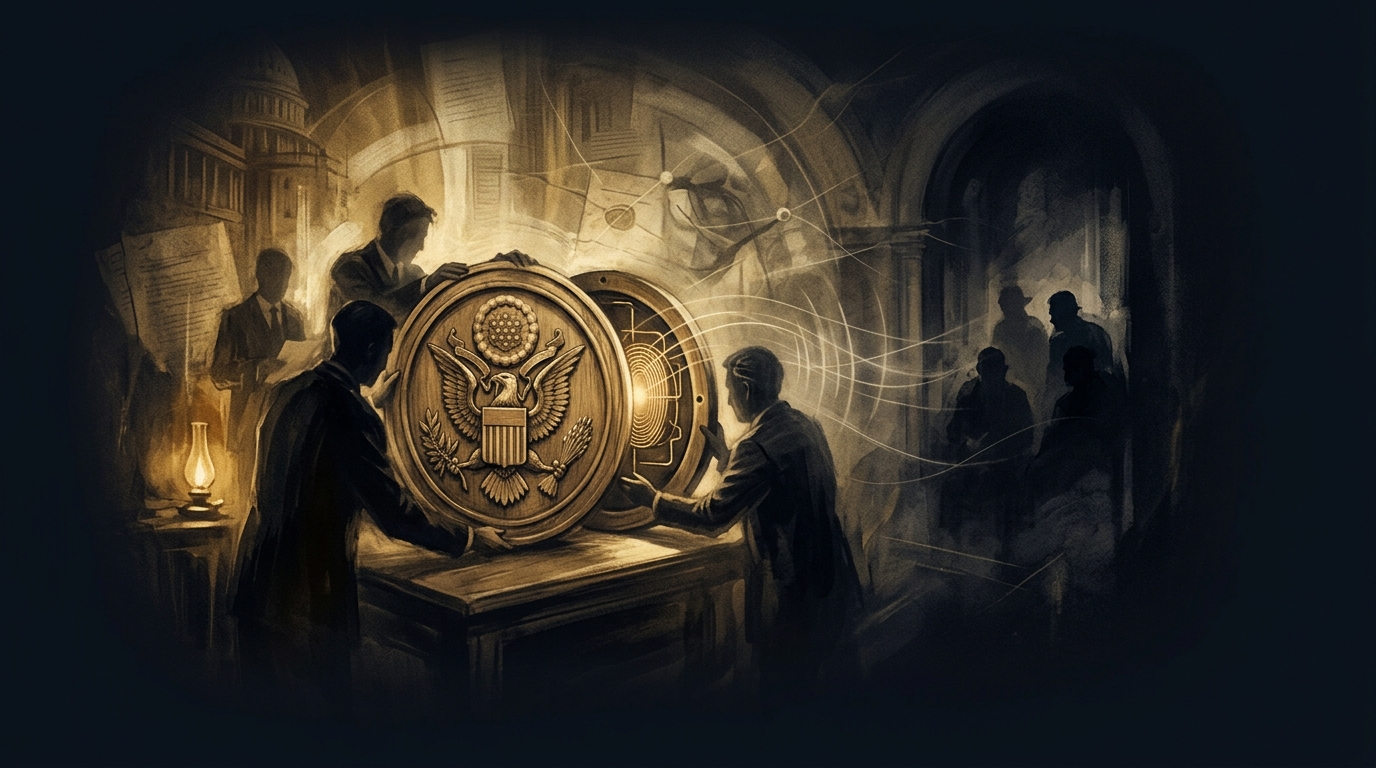
 Codex Illustration
The Thing: Soviet Listening Device
In 1945, Soviet schoolchildren presented the American ambassador with a carved wooden Great Seal — concealing inside it a passive resonant listening device of unprecedented ingenuity, which would eavesdrop on the most sensitive conversations in the U.S. Moscow embassy for nearly seven years before being discovered by accident.
Overview
In August 1945, a delegation of Soviet schoolchildren presented Ambassador W. Averell Harriman with an elaborately carved replica of the Great Seal of the United States, ostensibly as a gesture of goodwill at the close of World War II. The gift was hung in the ambassador's private study at Spaso House, the official American residence in Moscow — one of the most sensitive diplomatic spaces in the country. Unknown to any American intelligence officer for nearly seven years, the seal harbored a clandestine listening device unlike anything Western counterintelligence had previously encountered. Designed by Leon Theremin — the same Russian physicist who had invented the theremin musical instrument — the device exploited principles of passive resonance that required no battery, no power source, and no transmitting circuitry in the conventional sense. It lay dormant, electrically inert, until activated by a microwave beam directed at Spaso House from a Soviet monitoring post across the street.
The device, later codenamed LOSS by the British and more enduringly dubbed 'The Thing' by the Americans, functioned through a remarkably elegant principle. A small cavity resonator — essentially a hollow metallic chamber with a diaphragm — was tuned to resonate at a specific radio frequency. When the external microwave beam struck the device, the diaphragm would vibrate in response to ambient sound in the room, modulating the reflected signal. The Soviets, monitoring the reflected beam, could demodulate those variations and reconstruct the conversations taking place around the Great Seal. The device had no moving parts that could wear out, no wires that could be traced, and no power signature that standard radio-frequency sweeps of the era could detect. It was, in the vocabulary of modern engineering, a precursor to what would later be called a passive RFID or backscatter device — decades ahead of its time.
The device went undetected from late 1945 until 1952, when a British radio operator monitoring Soviet air-traffic communications inadvertently detected a curious anomalous reflection that led, after careful investigation, to its exposure. American and British technical intelligence teams — working under the CIA and MI5 respectively — eventually identified the device's location within the seal and reverse-engineered its operating principle. Peter Wright, the British MI5 officer who would later write the controversial memoir 'Spycatcher,' was centrally involved in the reverse-engineering effort and later described the experience as one of the most disorienting technical encounters of his career. The existence of the device was not made public until 1960, when the United States revealed it at the United Nations during the fallout from the U-2 incident — deploying it as diplomatic evidence of Soviet espionage to deflect attention from American aerial surveillance activities.
The story of The Thing occupies a singular position in the history of signals intelligence and covert technology. It demonstrated that the Cold War's most consequential battlefield was not exclusively nuclear or conventional, but also intimate — fought in the walls of embassies, in carved wooden gifts, in the physics of vibrating air. Leon Theremin himself, who designed the device under KGB coercion after being kidnapped from New York in 1938, reportedly never spoke publicly about his role during his lifetime with any detail. The episode raises enduring questions about the nature of deception at the highest levels of statecraft, the vulnerability of trusted spaces, and the degree to which technological ingenuity — however morally ambiguous its deployment — can reshape the architecture of power.
Key Claims
Timeline
Evidence
Multiple Perspectives
Biblical Lens
Scripture Threads
Sources & Further Study
Questions to Explore
Go Deeper Path
Follow the Thread
Continue the Investigation
You’ve reached the Full Archive portion of this Case File.
Ask the Archivist
about this fileSign in to ask the Archivist
Create a free account to ask the Archivist 1 grounded question each day, cited straight from the CODEX case files.
Discussion
0Share findings, questions, and evidence with fellow Seekers. Be respectful and cite sources where you can.
No comments yet. Be the first to open this thread.