
 Codex Illustration
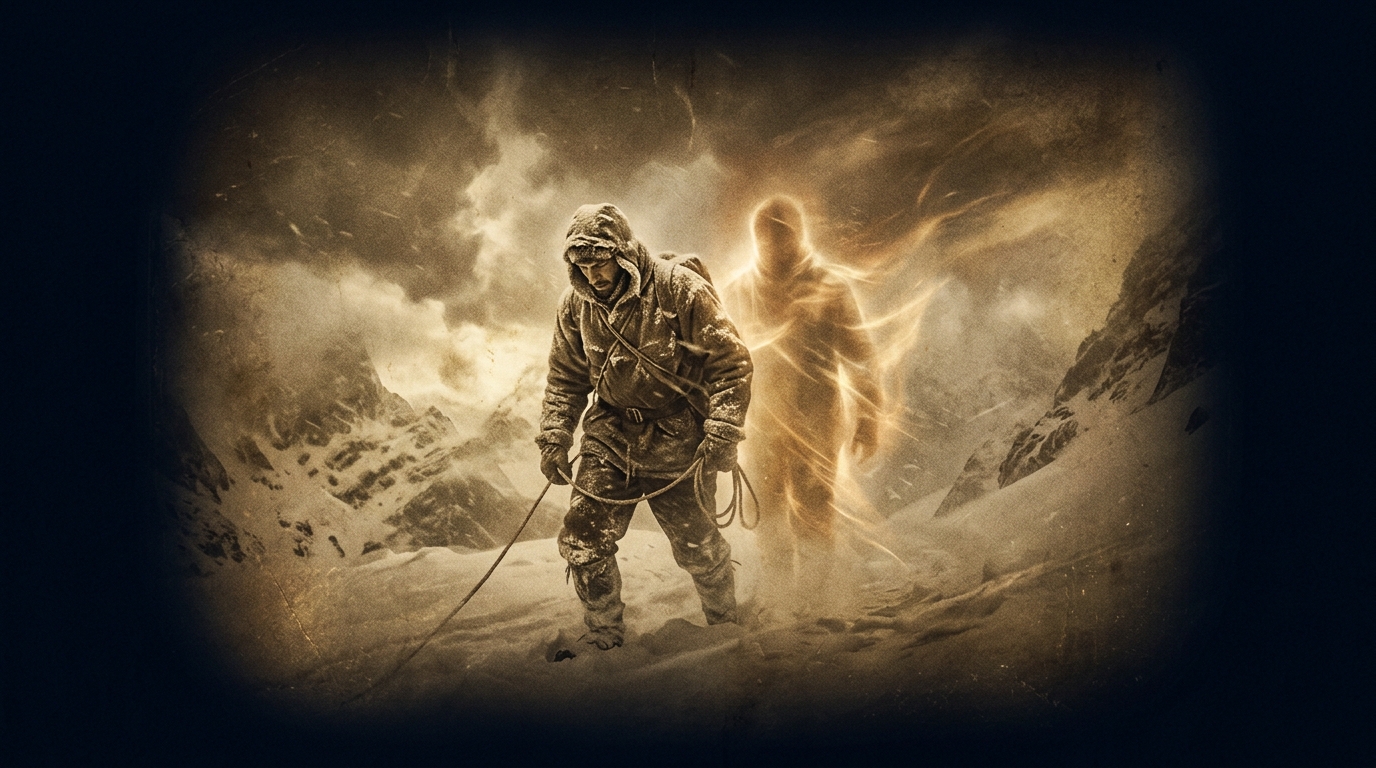
The Third Man Factor
In moments of extreme, life-threatening duress — polar crossings, mountain summits, shipwrecks, burning skyscrapers — survivors across centuries and cultures have independently reported the sensed presence of a benevolent, unseen companion that guided, comforted, or urged them to live. Whether this presence is a protective artifact of the stressed human brain, a guardian from beyond the material world, or something that resists clean categorization remains one of consciousness research's most quietly profound open questions.
Overview
The phenomenon takes its name from a navigational paradox: when Sir Ernest Shackleton, Frank Worsley, and Tom Crean completed their harrowing thirty-six-hour crossing of South Georgia Island in 1916 — an uncharted glacial traverse undertaken after their ship Endurance was crushed in Antarctic pack ice — all three men independently reported the sustained impression that a fourth figure walked alongside them. Shackleton later wrote, with characteristic understatement, that 'it seemed to me often that we were four, not three,' and alluded to what he called a 'divine companion.' This account, recorded in his 1919 memoir South, was not offered as a mystical boast but as a quiet acknowledgment of something he could not explain. When T. S. Eliot read a lecture account of the experience, he wove it into The Waste Land (1922) — 'Who is the third who walks always beside you?' — embedding the phenomenon in literary consciousness even as its name became slightly misattributed: Shackleton's party experienced a fourth companion, not a third, but 'the Third Man' is now the settled scholarly term.
Author and journalist John Geiger undertook the first systematic survey of the phenomenon in his 2009 book The Third Man Factor: Surviving the Impossible, drawing on interviews, memoirs, and historical records to compile dozens of cases spanning more than a century. Among his subjects: aviator Charles Lindbergh, who described spectral presences during his solitary 1927 transatlantic crossing; British mountaineer Frank Smythe, who on a solo push toward Everest's summit in 1933 so strongly sensed a companion that he reflexively broke a piece of Kendal mint cake to share it; and Ron DiFrancesco, reportedly the last person to escape from the South Tower of the World Trade Center on September 11, 2001, who described a guiding presence — experienced as a person distinct from himself — that propelled him through smoke and flame when his own volition had nearly failed. Geiger's corpus also includes accounts from cave divers, solo sailors, and military personnel in extreme conditions, establishing that the experience appears cross-cultural, cross-era, and independent of prior religious belief, though its interpretation is invariably filtered through the experiencer's own framework.
Neuroscience and cognitive psychology have proposed several overlapping mechanisms, none of which fully accounts for every documented case. Research centered on the brain's temporoparietal junction — a region associated with bodily self-modeling and the sense of agency — suggests that under conditions of severe stress, sensory deprivation, hypoxia, hypothermia, dehydration, sleep deprivation, or monotony, the right cerebral hemisphere may generate a felt sense of an alien presence that the conscious left hemisphere then interprets as another person. Neurologist Michael Persinger conducted laboratory experiments using weak magnetic fields applied to the temporal lobes, claiming to induce a 'sensed presence,' though subsequent replication efforts yielded mixed results and the hypothesis remains contested in the peer-reviewed literature. Julian Jaynes's influential — and disputed — bicameral mind hypothesis offers another frame: that the sense of an external guiding voice is a vestige of an older cognitive architecture in which the two brain hemispheres communicated as if speaker and listener. These explanations are genuine scientific proposals, not settled science; none has achieved consensus, and critics note that laboratory analogues rarely replicate the full phenomenological richness of field accounts.
The theological and phenomenological dimensions of the Third Man Factor sit in genuine tension with the neurological hypotheses, and intellectual honesty requires holding both seriously. Survivors frequently report not a vague dissociative sensation but a purposeful, intelligent, linguistically competent presence that provides accurate information, issues specific directional commands, and generates a warmth described as unmistakably personal. Some accounts note that the presence vanishes precisely at the moment of safety — behavior difficult to explain purely as cognitive disintegration. Theologians, philosophers of mind, and phenomenologists have argued that the reductive neural account, even if partially correct as a mechanism, does not resolve the question of what — if anything — the mechanism responds to or mediates. The experience remains, as Geiger carefully frames it, genuinely ambiguous: a window that looks inward toward the brain's hidden architecture, or outward toward something that has been present in human extremity across every age and culture.
Key Claims
Timeline
Evidence
Multiple Perspectives
Biblical Lens
Scripture Threads
Sources & Further Study
Questions to Explore
Go Deeper Path
Follow the Thread
Continue the Investigation
You’ve reached the Full Archive portion of this Case File.
Ask the Archivist
about this fileSign in to ask the Archivist
Create a free account to ask the Archivist 1 grounded question each day, cited straight from the CODEX case files.
Discussion
0Share findings, questions, and evidence with fellow Seekers. Be respectful and cite sources where you can.
No comments yet. Be the first to open this thread.