
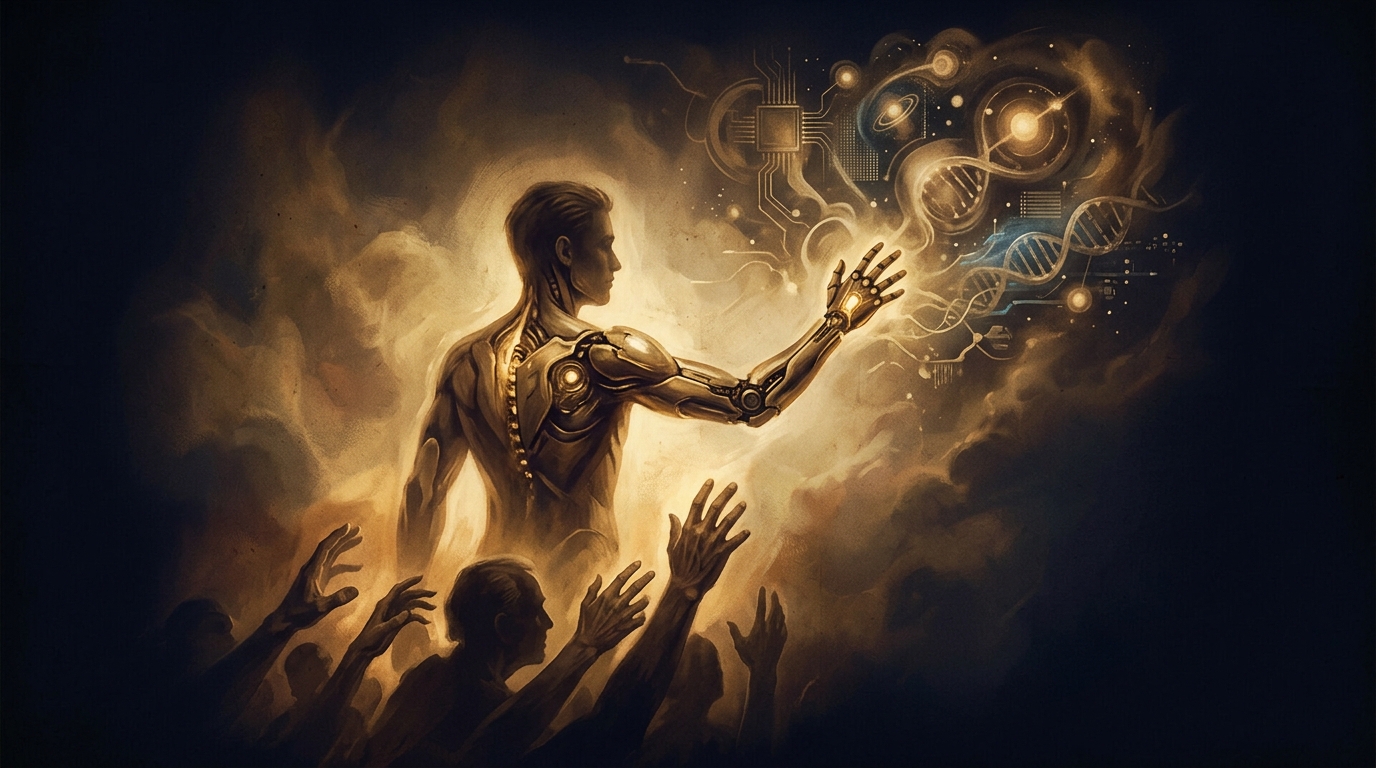
 Codex Illustration
Transhumanism
Transhumanism is an intellectual and cultural movement that holds that the human species can and should transcend its biological limitations through technology — raising ancient questions about the nature of humanity, the image of God, and the boundaries of what it means to be human.
Overview
Transhumanism as a formal movement emerged in the mid-twentieth century, drawing on Enlightenment rationalism, Darwinian evolutionary theory, and the accelerating capabilities of biotechnology, computing, and neuroscience. Julian Huxley coined the term in its modern sense in 1957, arguing that humanity could, if it wished, transcend itself — not just sporadically but in its entirety, through the transformation of inherited biological conditions. Since then, thinkers such as Hans Moravec, Ray Kurzweil, and Nick Bostrom have elaborated this vision into concrete programs: radical life extension, mind uploading, genetic enhancement, neural interfaces, and the eventual creation of posthuman intelligences. The movement is not monolithic; it includes libertarian technologists, academic philosophers, secular humanists, and, controversially, esoteric spiritualists who see in technology a path toward the divine.
The intellectual genealogy of transhumanism is longer than its recent branding suggests. Francis Bacon's vision of science as dominion over nature, Friedrich Nietzsche's Übermensch, and early eugenics movements all prefigure core transhumanist intuitions — that the human condition is a problem to be solved rather than a nature to be accepted. The twentieth century saw these ideas pursued through space programs, pharmaceutical enhancement, early cybernetics (Norbert Wiener), and cognitive science. By the 1980s and 1990s, organizations such as the Extropy Institute and World Transhumanist Association were formalizing the movement. The Singularity — the hypothetical moment when artificial intelligence surpasses human cognitive capacity, first rigorously described by Vernor Vinge and popularized by Kurzweil — became its eschatological horizon.
The relationship between transhumanism and theological traditions is deeply contested. Critics from within Christianity, Judaism, and Islam argue that the transhumanist project constitutes a fundamental assault on the doctrine of the imago Dei — the conviction that human beings bear the image of God in a way that confers inalienable dignity and sets limits on human self-modification. Bioethicists such as Michael Sandel and theologians such as C. Ben Mitchell have argued that the drive to perfect and transcend the human is a form of hubris that displaces God and commodifies personhood. Others, including Mormon transhumanist advocates and some process theologians, contend that technological development is itself participation in ongoing divine creativity.
From a broader cultural perspective, transhumanism intersects with ancient mythologies of self-deification, with Gnostic traditions that regard the material body as a prison to be escaped, and with contemporary anxieties about surveillance capitalism, genetic inequality, and the existential risks posed by unaligned artificial intelligence. Nick Bostrom's concept of existential risk and the work of the Future of Humanity Institute at Oxford University have brought transhumanist concerns into mainstream policy discourse. Whether transhumanism represents the fulfillment of humanity's highest aspirations or a sophisticated recapitulation of the oldest temptation — 'you will be like God' — remains one of the defining theological and philosophical questions of the twenty-first century.
Timeline
Evidence
Multiple Perspectives
Biblical Lens
Scripture Threads
Sources & Further Study
Questions to Explore
Follow the Thread
Continue the Investigation
You’ve reached the Full Archive portion of this Case File.
Ask the Archivist
about this fileSign in to ask the Archivist
Create a free account to ask the Archivist 1 grounded question each day, cited straight from the CODEX case files.
Discussion
0Share findings, questions, and evidence with fellow Seekers. Be respectful and cite sources where you can.
No comments yet. Be the first to open this thread.