
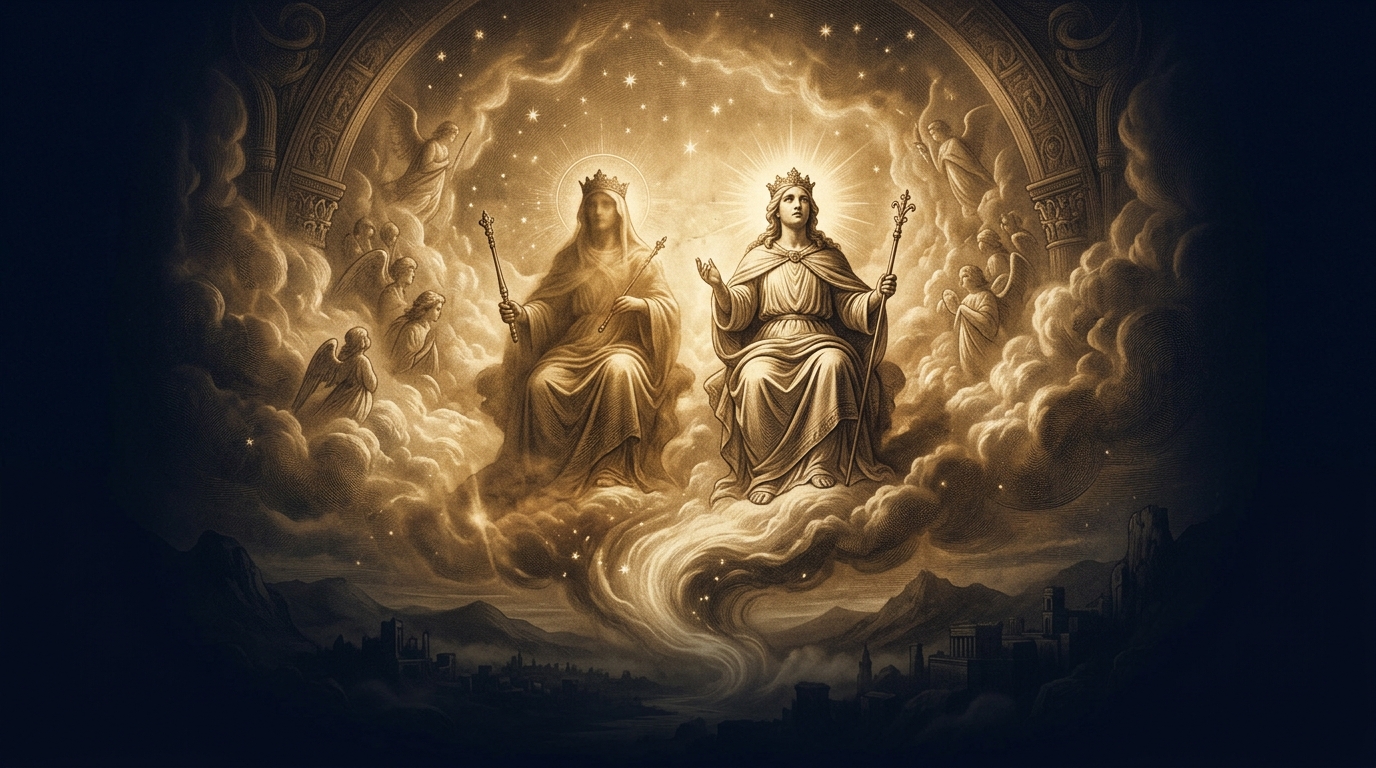
 Codex Illustration
Two Powers in Heaven
The 'Two Powers in Heaven' doctrine refers to an ancient Jewish theological tradition that posited a second, distinct divine figure alongside God—a tradition so widespread in Second Temple Judaism that early rabbinic authorities eventually condemned it as heresy, and which biblical scholars argue provides the most historically coherent backdrop for understanding early high Christology.
Overview
The phrase 'Two Powers in Heaven' (Hebrew: שתי רשויות בשמים, shtei reshuyot ba-shamayim) derives from rabbinic polemical literature—primarily the Mishnah, Talmud, and Midrashim—where it is invoked as a category of heresy to be refuted. Yet the very vigor of the rabbinic condemnation, documented by scholar Alan Segal in his foundational 1977 work, reveals that the idea was not marginal: it was a deeply rooted interpretive tradition within pre-Christian and early Jewish thought. The 'second power' was not conceived as a rival god but as a principal divine agent—variously identified with the Angel of the LORD, the Name, the Word (Logos), the Glory (Kavod), or the enthroned figure of Daniel 7:13—who shared in divine prerogatives such as judgment, creation, and worship without contradicting strict monotheism in its ancient, non-philosophical sense.
The textual roots of this tradition are numerous and well-documented. Passages such as Exodus 23:20–21, where YHWH warns Israel to obey the Angel whose 'Name is in him,' Genesis 18–19 (the appearance of three visitors, two of whom are addressed as 'YHWH'), Daniel 7:9–14 (two thrones set in the divine court, one occupied by the Ancient of Days and one by the Son of Man), and Proverbs 8 (Wisdom as a co-creator present at the foundation of the world) all contributed to a hermeneutical tradition in which a secondary divine figure was exegetically warranted. The Dead Sea Scrolls have dramatically expanded this picture, revealing texts such as 4Q491 and the Melchizedek scroll (11QMelchizedek) that present an exalted heavenly figure exercising divine judgment, further grounding the tradition in pre-Christian Jewish soil.
Michael Heiser, building on Segal and scholars like Larry Hurtado, John Collins, and Jarl Fossum, argues that the Two Powers tradition is indispensable for understanding how the earliest Jewish followers of Jesus—who were unambiguous monotheists—could simultaneously exalt Jesus to divine status without perceiving themselves as abandoning Jewish theology. In Heiser's framework, this is not eisegesis but recovery: the Divine Council worldview of the Hebrew Bible already contained a binatarian grammar in which YHWH could be distinguished into two manifestations or persons sharing a single divine identity. The incarnation, in this reading, was not the introduction of a foreign theological category but the identification of a long-anticipated heavenly figure with the human Jesus of Nazareth.
The significance of Two Powers extends beyond Christology into broader questions about the development of monotheism, the origins of Gnosticism (which arguably exploited the same exegetical tradition in heterodox directions), and the nature of early Jewish mysticism (Merkabah literature). The rabbinic condemnation—aimed variously at Christians, Jewish-Christians, Gnostics, and possibly certain apocalyptic sects—was itself a second-century and later development, suggesting that for much of the Second Temple period the tradition circulated without being perceived as problematic. Understanding this background transforms the reading of the New Testament's highest Christological passages from apparent innovations into recognizable claims within a living exegetical tradition.
Timeline
Evidence
Multiple Perspectives
Biblical Lens
Scripture Threads
Sources & Further Study
Questions to Explore
Follow the Thread
Continue the Investigation
You’ve reached the Full Archive portion of this Case File.
Ask the Archivist
about this fileSign in to ask the Archivist
Create a free account to ask the Archivist 1 grounded question each day, cited straight from the CODEX case files.
Discussion
0Share findings, questions, and evidence with fellow Seekers. Be respectful and cite sources where you can.
No comments yet. Be the first to open this thread.