
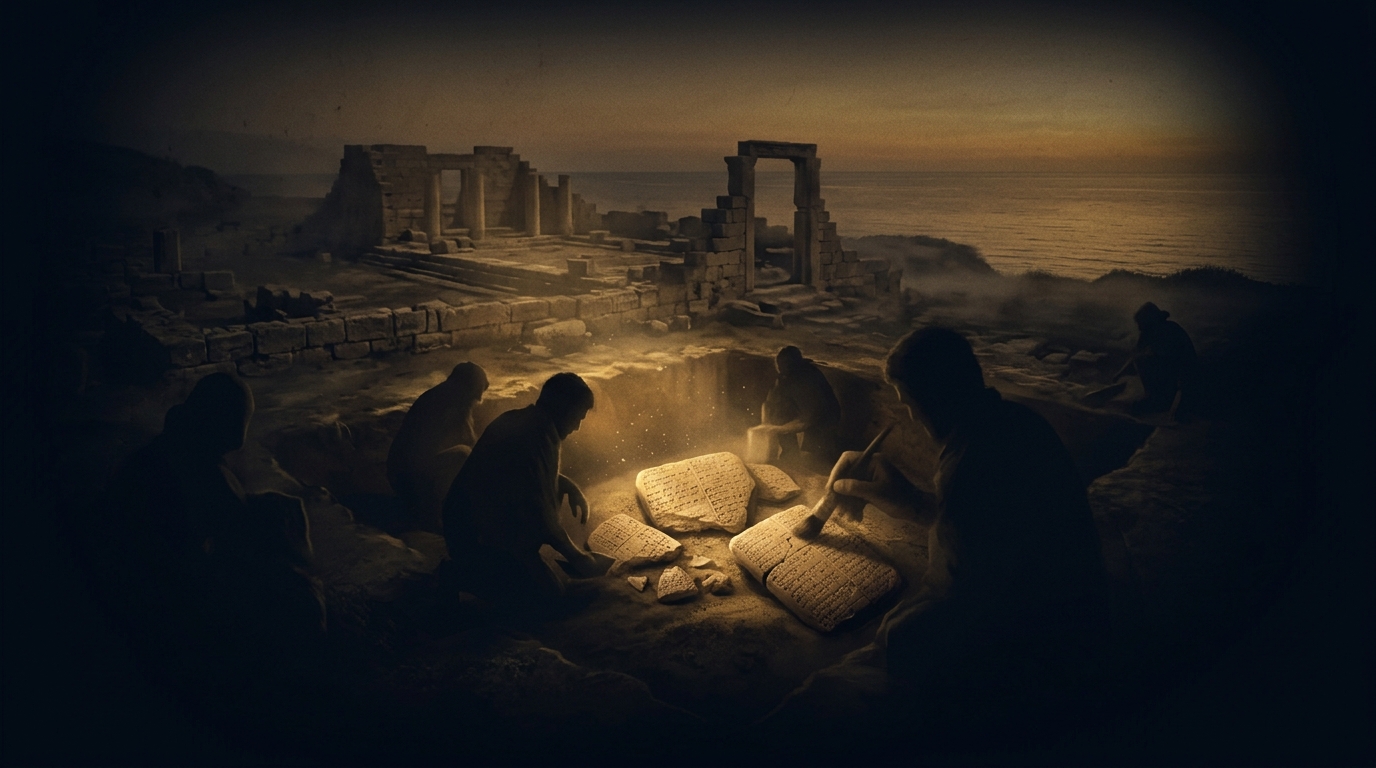
 Codex Illustration
Ugarit and the Ras Shamra Texts
Discovered in 1929 at Ras Shamra on the Syrian coast, the cuneiform tablets of ancient Ugarit have revolutionized our understanding of Canaanite religion, the Hebrew Bible, and the shared mythological world of the ancient Near East. These texts preserve the living literary context in which the Old Testament was written, revealing divine councils, storm gods, underworld figures, and cosmic conflicts that illuminate—and sometimes challenge—biblical interpretation.
Overview
In the spring of 1929, a Syrian farmer accidentally broke into an ancient tomb near the coastal mound of Ras Shamra, triggering an excavation that would become one of the most consequential archaeological discoveries of the twentieth century. The site proved to be ancient Ugarit, a prosperous Bronze Age city-state that flourished from roughly 1450 to 1185 BC before being destroyed, likely by the Sea Peoples. French archaeologist Claude Schaeffer led the initial excavations and quickly uncovered a scribal school, a palace library, and two temple archives containing hundreds of clay tablets inscribed in a previously unknown alphabetic cuneiform script. Within two years, scholars—most notably Hans Bauer and Édouard Dhorme—had deciphered the script, revealing a language now called Ugaritic, a Semitic tongue closely related to biblical Hebrew.
The tablets contain a rich literary corpus: the Baal Cycle, the Legend of Keret, the Aqhat Epic, administrative documents, ritual texts, and diplomatic correspondence. The Baal Cycle is the most theologically significant, narrating the conflicts between Baal, the storm god, and Yam (the sea) and Mot (death), presided over by the father-god El who sits enthroned in an assembly of divine beings called the 'council of El' or the 'assembly of the sons of El' (phr bn il). This language is strikingly parallel to Hebrew texts describing Yahweh's divine council, the 'sons of God' (bene Elohim), and cosmic battles with sea-monster figures. Scholars such as Frank Moore Cross, John Day, and Mark Smith have demonstrated that the Ugaritic literature provides the most direct cognate background for understanding Psalms 29, 82, 89, Job 1-2, Isaiah 14, and numerous other biblical passages.
The theological implications are significant but require careful handling. The parallels do not prove that Israel 'borrowed' its religion wholesale from Canaan, nor do they undermine the distinctive theological claims of the Hebrew Bible. Rather, as Michael Heiser and others emphasize, they establish the shared conceptual vocabulary through which Israel's authors communicated. When Psalm 82 depicts Yahweh standing in the divine assembly and judging the 'gods,' the Ugaritic texts illuminate precisely what kind of council is being invoked and what the terminology means in its original cultural context. The biblical authors wrote in conscious engagement with this world—sometimes affirming its categories, sometimes polemically subverting them.
Ugarit also preserves references to figures and places of direct biblical relevance: the Rephaim appear in Ugaritic texts as shades of the dead with a royal, quasi-divine character; Mount Zaphon, Baal's sacred mountain, is geographically identified with Mount Hermon and linguistically echoes the Hebrew Zaphon used in poetic descriptions of Yahweh's mount; and ritual texts describe religious practices strikingly similar to those condemned in the Pentateuch. The city's destruction around 1185 BC, evidenced by a final desperate letter found baked in a kiln requesting aid against maritime raiders, provides an evocative endpoint to a culture that shaped the written world of the ancient Levant.
Timeline
Evidence
Multiple Perspectives
Biblical Lens
Scripture Threads
Sources & Further Study
Questions to Explore
Follow the Thread
Continue the Investigation
You’ve reached the Full Archive portion of this Case File.
Ask the Archivist
about this fileSign in to ask the Archivist
Create a free account to ask the Archivist 1 grounded question each day, cited straight from the CODEX case files.
Discussion
0Share findings, questions, and evidence with fellow Seekers. Be respectful and cite sources where you can.
No comments yet. Be the first to open this thread.