
 Codex Illustration
Vril Society
Somewhere between documented esoteric history and elaborately embellished legend, the so-called Vril Society occupies a murky corridor of the twentieth century — a supposed secret fraternity of occultists, allegedly active in pre-Nazi Germany, said to have channeled an invisible cosmic energy toward both spiritual illumination and technological mastery.
Overview
The Vril Society, as popularly understood, traces its conceptual origin not to any documented historical organization but to a work of Victorian science fiction: Edward Bulwer-Lytton's 1871 novel 'The Coming Race,' in which an underground super-civilization harnesses a mysterious fluid force called 'Vril' — a kind of all-purpose vital energy capable of healing, destruction, and psychic amplification. Bulwer-Lytton, a prominent figure in British cultural and political life and a known dabbler in Rosicrucian and occult circles, wrote the novel as speculative fiction, though theosophists and esotericists of the late nineteenth century were quick to interpret it as thinly veiled disclosure of hidden truth. Helena Petrovna Blavatsky, the founder of Theosophy, explicitly referenced Vril energy in her 1877 work 'Isis Unveiled,' treating it as a real metaphysical force akin to what she called 'Ether' or 'Akasha.' This theosophical baptism of a fictional concept marked the beginning of Vril's long migration from literary invention into esoteric cosmology.
The specific claim that a 'Vril Society' existed as a formal organization in Weimar-era Germany — reportedly meeting in Berlin or Munich, channeling cosmic forces through female mediums, and maintaining connections to the nascent Nazi movement — rests almost entirely on sources produced decades after the alleged events. The most frequently cited account appears in Louis Pauwels and Jacques Bergier's 1960 book 'Le Matin des Magiciens' (published in English as 'The Morning of the Magicians'), a work the authors themselves described as a speculative synthesis rather than documented history. Pauwels and Bergier portrayed pre-Nazi Germany as saturated with occult lodges seeking to breed a new race through contact with superhuman intelligences, drawing on a tradition they characterized as 'fantastic realism.' Subsequent authors — most notably Trevor Ravenscroft in 'The Spear of Destiny' (1972) — amplified these claims further, asserting direct connections between the Vril Society, the Thule Society (a documented far-right esoteric organization), and Adolf Hitler's inner circle. Historians who have examined these works carefully, including Nicholas Goodrick-Clarke in his rigorous 1985 study 'The Occult Roots of Nazism,' conclude that while genuine occult and völkisch movements did exist in this milieu, the specific 'Vril Society' as described by Pauwels, Bergier, and Ravenscroft cannot be verified through primary sources and appears to be a largely post-war construction, possibly combining fragments of real organizations with significant embellishment or invention.
What is historically documented is a broader culture of esoteric nationalism in late nineteenth and early twentieth century Germany and Austria. The Thule Society — from which several Nazi founders including Rudolf Hess reportedly drew membership — was real, traceable, and explicitly völkisch-occult in orientation, combining Germanic mythology, racial ideology, and Ariosophist (occult-nationalist) doctrine. The Germanenorden, the Armanenschaft, and the writings of Guido von List and Lanz von Liebenfels represent a documented stratum of esoteric racism that fed into Nazism's symbolic and ideological vocabulary. The question scholars debate is not whether such milieux existed, but whether the 'Vril Society' as a named, organized entity was part of them — or whether it is a retroactive label, partly fictional in origin, applied to create a more dramatic and unified narrative than the historical record supports. The evidence for the latter interpretation is substantially stronger.
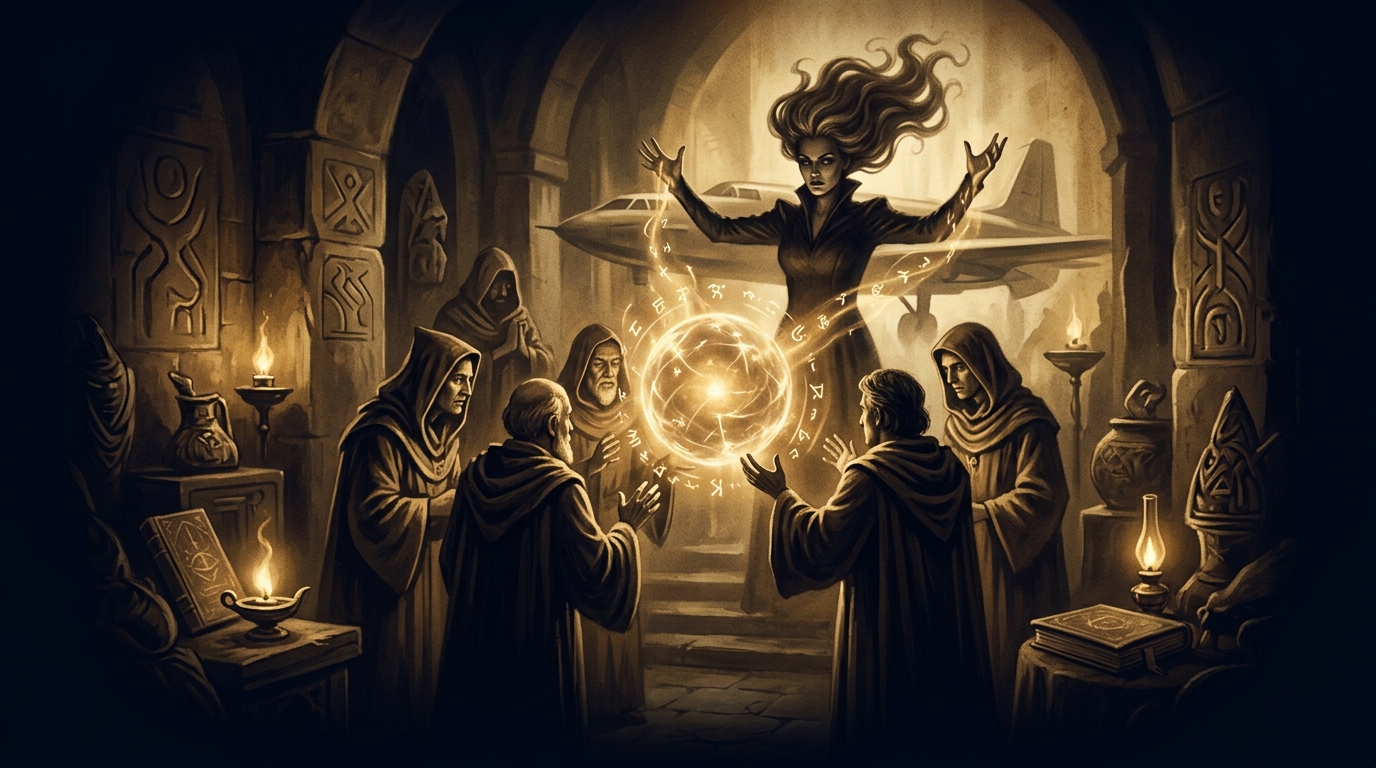
In popular culture and internet folklore, the Vril Society has expanded far beyond either its fictional origins or its contested historical claims. Certain communities describe Vril-channeling women known as 'Vrilerinnen' who allegedly made telepathic contact with extraterrestrial intelligences; others link Vril energy to the supposed Nazi flying-disc program ('Die Glocke' and related legends) or to a surviving Nazi colony in Antarctica. None of these elaborations have evidentiary support beyond self-referential chains of popular books, conspiracy forums, and fringe internet content. They are best understood as a species of modern mythology — culturally significant as expressions of how narratives about hidden power, forbidden knowledge, and elite occult manipulation continue to evolve, but not as historical documentation.
Key Claims
Timeline
Evidence
Multiple Perspectives
Biblical Lens
Scripture Threads
Sources & Further Study
Questions to Explore
Go Deeper Path
Follow the Thread
Continue the Investigation
You’ve reached the Full Archive portion of this Case File.
Ask the Archivist
about this fileSign in to ask the Archivist
Create a free account to ask the Archivist 1 grounded question each day, cited straight from the CODEX case files.
Discussion
0Share findings, questions, and evidence with fellow Seekers. Be respectful and cite sources where you can.
No comments yet. Be the first to open this thread.