
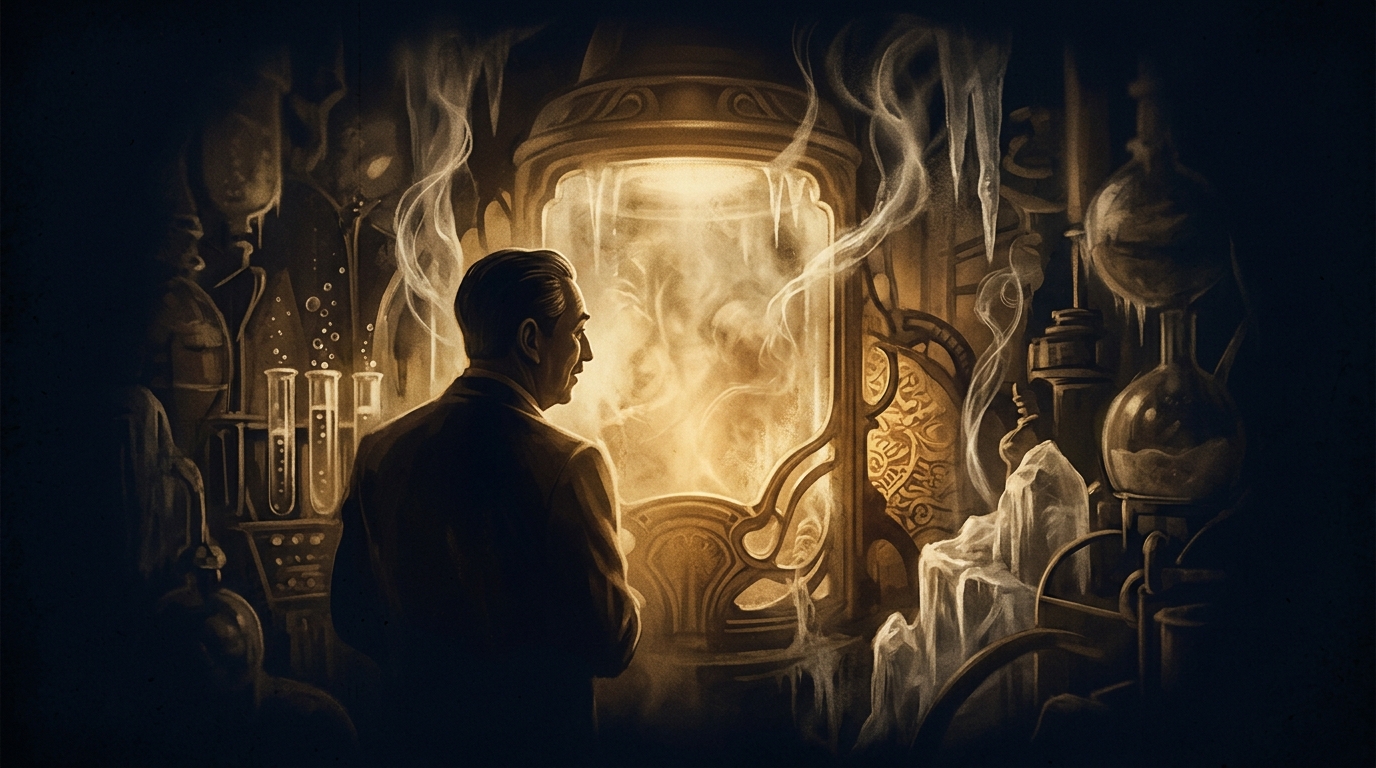
 Codex Illustration
Walt Disney Cryonics Legend
One of the most persistent legends in American popular culture holds that Walt Disney's body was cryonically preserved after his death in 1966 — a claim that is factually false, thoroughly documented as such, yet stubbornly immortal in the cultural imagination.
Overview
On December 15, 1966, Walt Disney died of lung cancer at St. Joseph's Hospital in Burbank, California. His death certificate, filed with Los Angeles County, records the cause of death as acute circulatory collapse secondary to carcinoma of the left lung. He was cremated on December 17, 1966 — two days after his death — and his ashes were interred at Forest Lawn Memorial Park in Glendale, California. These are documented historical facts, confirmed by public records, family testimony, and contemporary press accounts. No credible witness, document, or corroborating evidence has ever placed Disney's body in a cryonic preservation facility.
The legend appears to have emerged gradually in the early 1970s and gained significant traction through the 1980s and 1990s, eventually flourishing in the early internet era. The precise origin of the claim is difficult to trace with scholarly certainty, but cultural historians note that Disney's death predated the first documented human cryonic preservation — that of James Bedford, a psychology professor whose body was frozen on January 12, 1967, less than a month after Disney died. This temporal proximity has led some folklorists to speculate that public awareness of Bedford's widely reported case may have seeded the Disney legend retroactively, projecting the novel and sensational idea of cryonics onto one of the most mythologized figures in American cultural history.
The legend's persistence is not merely a product of confusion; it reflects deeper currents in how modern culture processes the deaths of its icons. Walt Disney had, during his lifetime, cultivated an almost mythological persona — the benevolent visionary behind eternal, animated worlds. His empire was built on stories of transformation, magic, and the suspension of disbelief. A man so associated with fantasy and futurity seemed, to the popular imagination, a fitting candidate for the ultimate technological fantasy: cheating death. Scholars of folklore and media studies, including those working in the tradition of Gary Alan Fine's research on contemporary legends, have observed that such stories typically attach to figures whose public identity already traffics in ideas of timelessness, control, or hidden power.
What makes this legend particularly instructive as a case study is what it reveals about the mechanics of myth-making in the media age. Unlike many urban legends that are difficult to verify or refute, the Disney cryonics story is empirically falsifiable — and has been falsified, repeatedly, by journalists, biographers, and cryonics researchers themselves. The Cryonics Institute and Alcor Life Extension Foundation, the two principal organizations in the American cryonics movement, have both stated that Disney was never among their clients, and the pioneer of the field, Robert Ettinger, made no reference to Disney in his foundational work. The legend's survival in the face of clear evidence to the contrary makes it a model case for understanding how mythological thinking operates within ostensibly rational, information-rich societies.
Key Claims
Timeline
Evidence
Multiple Perspectives
Biblical Lens
Scripture Threads
Sources & Further Study
Questions to Explore
Go Deeper Path
Follow the Thread
Continue the Investigation
You’ve reached the Full Archive portion of this Case File.
Ask the Archivist
about this fileSign in to ask the Archivist
Create a free account to ask the Archivist 1 grounded question each day, cited straight from the CODEX case files.
Discussion
0Share findings, questions, and evidence with fellow Seekers. Be respectful and cite sources where you can.
No comments yet. Be the first to open this thread.