
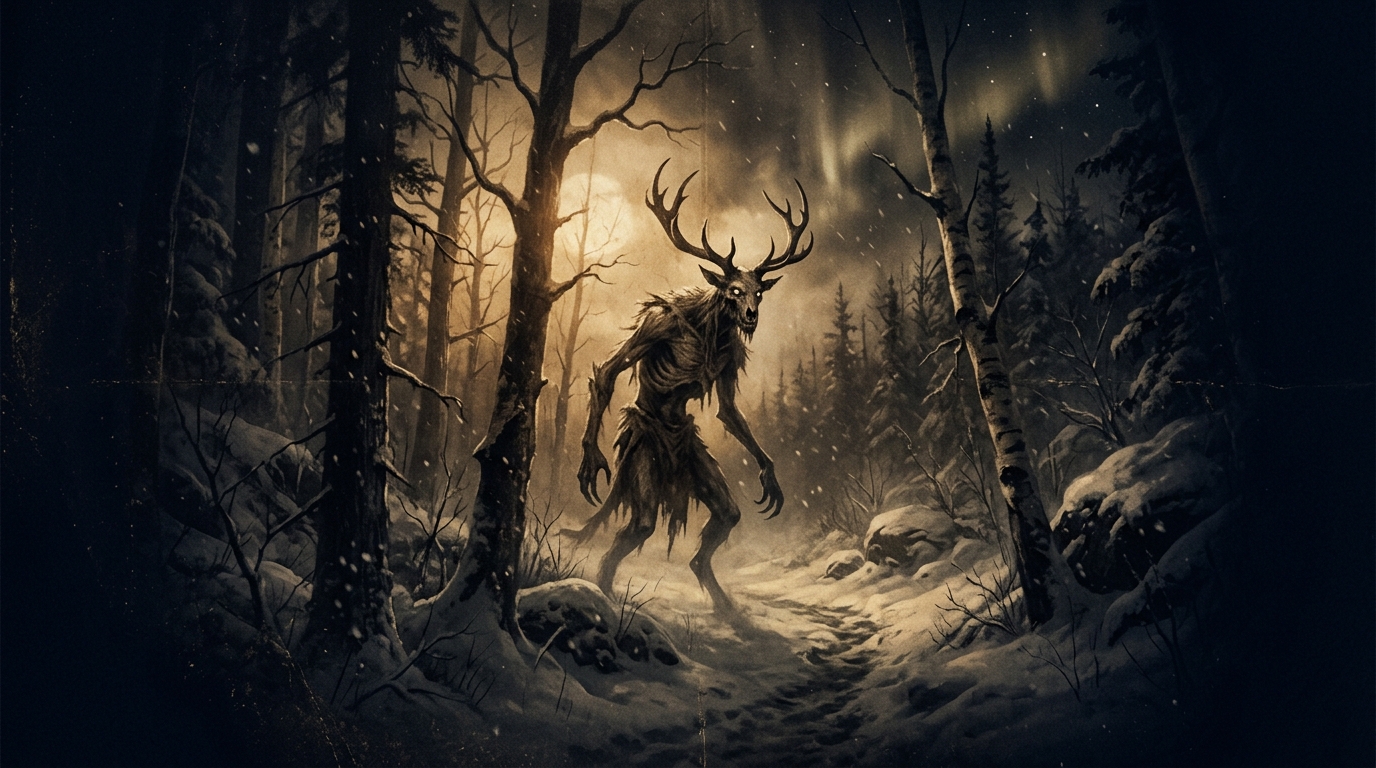
 Codex Illustration
Wendigo
A being of insatiable hunger from Algonquian-speaking peoples of the Great Lakes and subarctic regions, the wendigo occupies a liminal space between sacred cultural warning, documented psychological phenomenon, and enduring cryptid legend — a figure whose power lies precisely in what it reveals about human nature under extremity.
Overview
The wendigo (also rendered as windigo, wetiko, or wiindigoo depending on dialect and nation) is a being described across a broad range of Algonquian-speaking cultures, including the Ojibwe, Cree, Innu, and Algonquin peoples. Accounts vary considerably by community, but common threads include: an entity of extraordinary size, associated with winter and starvation, whose appetite is never satisfied, and which is intimately connected — in both origin and consequence — with the act of cannibalism. In many traditions, the wendigo is not merely a predator but a transformation: a human being who, having consumed human flesh (often under duress of famine), becomes partially or entirely subsumed by the spirit, growing larger with each act of consumption and finding its hunger only intensified rather than relieved. This recursive, escalating quality — the hunger that devours without satisfying — gives the legend a philosophical depth that has attracted serious attention from anthropologists, psychiatrists, and ethicists alike.
The academic record on wendigo beliefs is substantial, rooted in field ethnographies beginning in the late nineteenth century. Researchers such as Frank Speck, Marius Barbeau, and later A. Irving Hallowell documented the figure across multiple nations, noting its role as a social and moral warning embedded within a harsh ecological reality: in subarctic winter, starvation was not a remote possibility but a recurring existential threat. The wendigo legend, in this reading, served as a culturally codified prohibition against cannibalism — encoding the community's deepest taboo in the form of a monstrous, cautionary identity. Paul Radin and other scholars of comparative mythology have situated the wendigo within a broader cross-cultural pattern of transformation myths in which moral transgression produces physical monstrosity. Notably, the figure is not universally monstrous in all tellings; some Ojibwe oral traditions treat the wendigo with a complexity closer to tragic than terrifying.
The most clinically controversial outgrowth of the tradition is the proposed diagnostic category of 'wendigo psychosis' (also called windigo psychosis), first described in Western psychiatric literature in the early twentieth century. The condition was characterized as a culture-bound syndrome in which an individual — typically under conditions of severe stress or starvation — developed an obsessive fear of becoming a wendigo, or expressed cannibalistic urges framed within the cultural idiom. Historical records include accounts of individuals claiming wendigo possession who were subsequently executed by their communities, most notably a case involving a Cree man named Swift Runner, who was hanged in 1879 by Canadian authorities after confessing to killing and eating members of his family. The diagnostic category itself has since been critically re-examined: anthropologist Lou Marano published an influential 1982 paper in Current Anthropology arguing that 'wendigo psychosis' was largely a colonial misreading — that many reported cases reflected starvation-induced states, social conflict, or European projection rather than a discrete indigenous syndrome. The debate remains genuinely open among scholars.
In contemporary popular culture, the wendigo has migrated far from its Algonquian roots, appearing in horror fiction, video games, and internet folklore as a gaunt, antlered, skeletal creature — an image that owes as much to the artistic imagination of the late twentieth century as to any specific oral tradition. Indigenous scholars and community members, including Anishinaabe writers such as Louise Erdrich and essayists in the journal Decolonization, have raised legitimate concerns about the commodification and distortion of the figure, emphasizing that the wendigo remains a living element of sacred cultural knowledge for many communities. The CODEX archive treats the wendigo accordingly: as a genuinely documented cultural and psychological phenomenon, deserving scholarly seriousness and cultural respect — and as a lens through which perennial questions about greed, transformation, and the moral boundaries of the human are refracted with unusual clarity.
Key Claims
Timeline
Evidence
Multiple Perspectives
Biblical Lens
Scripture Threads
Sources & Further Study
Questions to Explore
Go Deeper Path
Follow the Thread
Continue the Investigation
You’ve reached the Full Archive portion of this Case File.
Ask the Archivist
about this fileSign in to ask the Archivist
Create a free account to ask the Archivist 1 grounded question each day, cited straight from the CODEX case files.
Discussion
0Share findings, questions, and evidence with fellow Seekers. Be respectful and cite sources where you can.
No comments yet. Be the first to open this thread.