
 Codex Illustration
World's Fair Reset
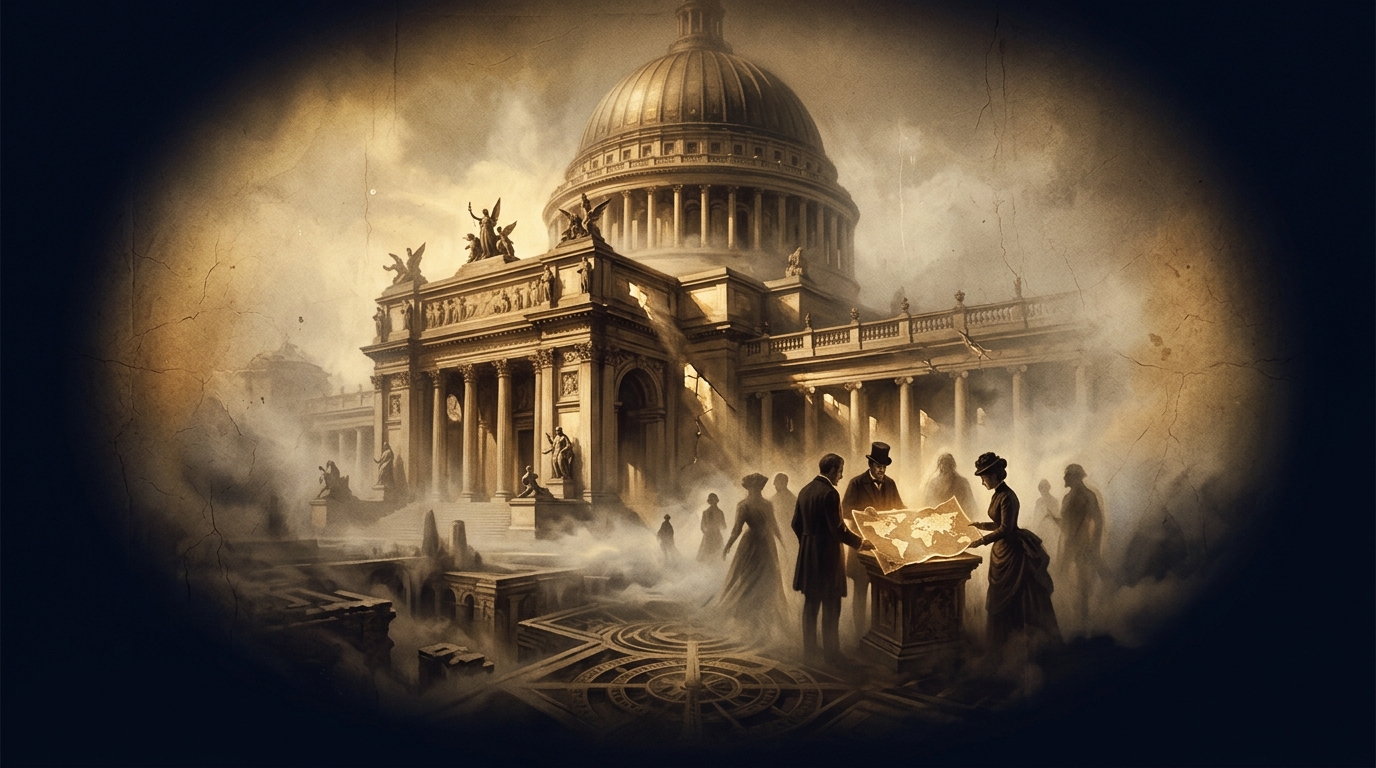
A circulating internet theory proposes that the grand neoclassical buildings of the late nineteenth-century World's Fairs — especially Chicago's 1893 'White City' — were not constructed by American workers but were remnants of a lost advanced civilization called 'Tartaria,' subsequently demolished to conceal a hidden global reset. The claim is entirely unsupported by documentary evidence and contradicts a vast and well-preserved historical record, yet its persistence raises genuine questions about how societies construct and distort collective memory.
Overview
Beginning roughly around 2016–2019 and accelerating through social media platforms, a loosely organized set of claims began circulating under the umbrella of 'Tartaria' or 'Mud Flood' theory. Proponents argue that the ornate Beaux-Arts and neoclassical exhibition halls of the World's Fairs — most famously the 1893 World's Columbian Exposition in Chicago, Illinois — were not purpose-built temporary structures, as mainstream history records, but were instead salvaged or repurposed buildings from a prior, more sophisticated global civilization. According to this framework, a catastrophic 'reset' event — variously described as a mud flood, a plague, a covert war, or an energy-weapon strike — wiped out the previous civilization, and the surviving power structures then systematically demolished the Fair's buildings and suppressed all evidence of the original builders. The theory assigns the name 'Tartaria' to this supposed civilization, loosely borrowing from genuine historical references to the Mongol-dominated territories of Central and Eastern Asia that appeared on early modern European maps.
What makes the World's Fair Reset claim particularly persistent is that it draws on genuine historical tensions that do warrant reflection. The 1893 White City was genuinely astonishing: an entire city of monumental white structures erected in under two years on a swampy lakefront site in Jackson Park, Chicago. Erik Larson's popular history 'The Devil in the White City' (2003) captures the near-miraculous speed of the construction, and architectural historians acknowledge that the Fair's neoclassical grandeur was deliberately theatrical — a propaganda exercise in American ambition and European aesthetic prestige. When the Fair closed, most of the 'White City' was demolished or destroyed by fire, leaving relatively little physical trace. To a viewer encountering only photographs, the disappearance does appear abrupt and unexplained. The theory exploits this genuine lacuna between the photographic record and surviving physical evidence.
However, the documentary record surrounding the World's Fairs is extraordinarily rich and utterly incompatible with the core claims of the reset theory. Construction contracts, payroll ledgers, photographic sequences documenting building progress, contemporary newspaper reporting, architectural drawings, labor union records, and the memoirs of architects such as Daniel Burnham and Louis Sullivan all confirm that these buildings were designed, contracted, and built in the conventional sense by identifiable workers and firms between approximately 1891 and 1893. The buildings were deliberately constructed from temporary materials — primarily a mixture of plaster, cement, and jute fiber called 'staff' — which is precisely why they did not survive long after the fair closed. The notion that these structures were concealed Tartarian remnants requires dismissing or fabricating alternative explanations for an archive spanning millions of documents across dozens of independent institutions on multiple continents.
The phenomenon is nonetheless culturally significant as a case study in what scholars of misinformation sometimes call 'anomaly hunting' — the selective assembly of genuine historical curiosities, photographic ambiguities, and real architectural puzzles into a narrative framework that feels revelatory precisely because it bypasses the slow, technical work of documentary research. The World's Fair Reset theory shares structural features with other 'hidden history' frameworks: a lost golden age, a catastrophic discontinuity, a conspiratorial suppression, and an elect community of 'awakened' researchers who have recovered the truth. Scholars of folklore, religious studies, and conspiracy theory — including Michael Barkun in 'A Culture of Conspiracy' (2003) — note that such frameworks fulfill deep psychological and quasi-spiritual functions regardless of their evidentiary basis.
Key Claims
Timeline
Evidence
Multiple Perspectives
Biblical Lens
Scripture Threads
Sources & Further Study
Questions to Explore
Go Deeper Path
Follow the Thread
Continue the Investigation
You’ve reached the Full Archive portion of this Case File.
Ask the Archivist
about this fileSign in to ask the Archivist
Create a free account to ask the Archivist 1 grounded question each day, cited straight from the CODEX case files.
Discussion
0Share findings, questions, and evidence with fellow Seekers. Be respectful and cite sources where you can.
No comments yet. Be the first to open this thread.