
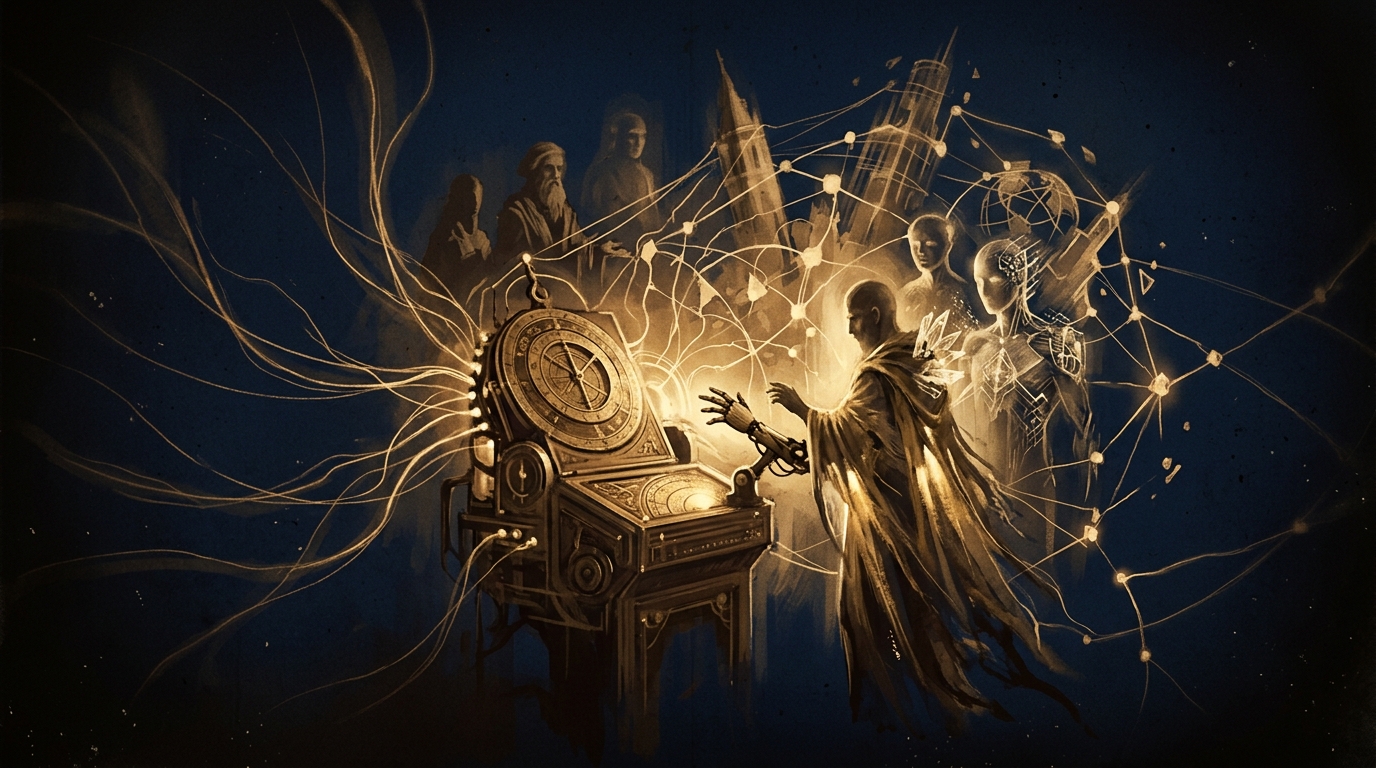
 Codex Illustration
Apocalypse Computer Models
Since the early 1970s, researchers and institutions have attempted to build mathematical models that simulate the collapse of civilization — and a growing class of AI-assisted systems now claims to forecast catastrophic risk with unprecedented granularity. Whether these tools represent genuine scientific foresight or a new mythology of algorithmic prophecy remains one of the more disquieting questions of the computational age.
Overview
The ambition to model civilizational collapse is not new. In 1972, a team at MIT — funded by the Club of Rome — published *The Limits to Growth*, a landmark systems-dynamics study using the World3 computer model to simulate interactions among population, industrial output, food production, resource depletion, and pollution. The model generated a suite of scenarios, several of which projected civilizational overshoot and collapse within the twenty-first century under business-as-usual conditions. Subsequent decades of scrutiny have produced a contested but enduring academic literature: some analysts argue the model's 'standard run' trajectory has tracked real-world data with uncomfortable accuracy; others criticize its structural assumptions as too aggregated to be reliable. What is documented is that *The Limits to Growth* inaugurated a genre — the quantitative civilizational forecast — that has grown steadily more sophisticated and more alarming with each passing decade.
The contemporary landscape of apocalypse modeling extends well beyond resource economics. Climate simulation suites — including CMIP (Coupled Model Intercomparison Project) ensembles run by institutions such as NCAR, GFDL, and the UK Met Office — now generate probabilistic trajectories for sea-level rise, regional collapse of agriculture, and cascading societal stress. Separately, epidemiological models gained sudden public visibility during the COVID-19 pandemic, when outputs from groups such as the Imperial College London COVID-19 Response Team directly shaped policy for hundreds of millions of people. Nuclear war risk models, pandemic preparedness simulations, and asteroid impact probability engines collectively constitute a loose but significant scientific infrastructure for imagining the end. These are, in the main, documented scientific endeavors with peer-reviewed methodologies — though their outputs are frequently contested, and their translation into popular discourse often strips away critical uncertainty ranges.
More speculative territory begins where formal science shades into AI-assisted forecasting and proprietary risk analytics. Organizations such as the Global Catastrophic Risk Institute, the Future of Humanity Institute (Oxford, now closed), and the Machine Intelligence Research Institute have argued, with varying degrees of rigor, that advanced AI systems may themselves constitute an extinction-level risk — and that modeling such risk requires grappling with the behavior of systems more cognitively capable than their designers. Meanwhile, a parallel and largely undocumented tradition claims that classified government programs have run 'deep future' simulations well beyond anything published in the open literature. Some of these claims intersect with the lore surrounding Project Looking Glass and similar alleged government time-modeling programs, for which no credible documentary evidence has surfaced. The line between peer-reviewed catastrophe modeling and speculative prophecy-by-algorithm is real, consequential, and poorly patrolled.
What gives this topic its peculiar cultural resonance is the way it maps onto ancient human anxieties about foreknowledge, fate, and the end of history. Civilizations have always sought oracles; the computer model is the oracle of the technocratic age. Critics — including philosophers such as Nassim Nicholas Taleb, whose work on fragility and black swans directly challenges the epistemological foundations of long-range risk modeling — argue that complex systems are inherently resistant to the kind of quantitative prediction these models attempt. Proponents counter that imperfect models with honest uncertainty bounds are still better than no model at all. Theologically and philosophically, the entire enterprise raises questions about human hubris, the nature of foreknowledge, and whether the desire to anticipate the end is wisdom or a form of anxiety that can itself distort decision-making. Whether one treats these models as serious science, cultural mythology, or something uncomfortably in between, they represent a defining artifact of the modern attempt to master contingency through computation.
Key Claims
Timeline
Evidence
Multiple Perspectives
Biblical Lens
Scripture Threads
Sources & Further Study
Questions to Explore
Go Deeper Path
Follow the Thread
Continue the Investigation
You’ve reached the Full Archive portion of this Case File.
Ask the Archivist
about this fileSign in to ask the Archivist
Create a free account to ask the Archivist 1 grounded question each day, cited straight from the CODEX case files.
Discussion
0Share findings, questions, and evidence with fellow Seekers. Be respectful and cite sources where you can.
No comments yet. Be the first to open this thread.