
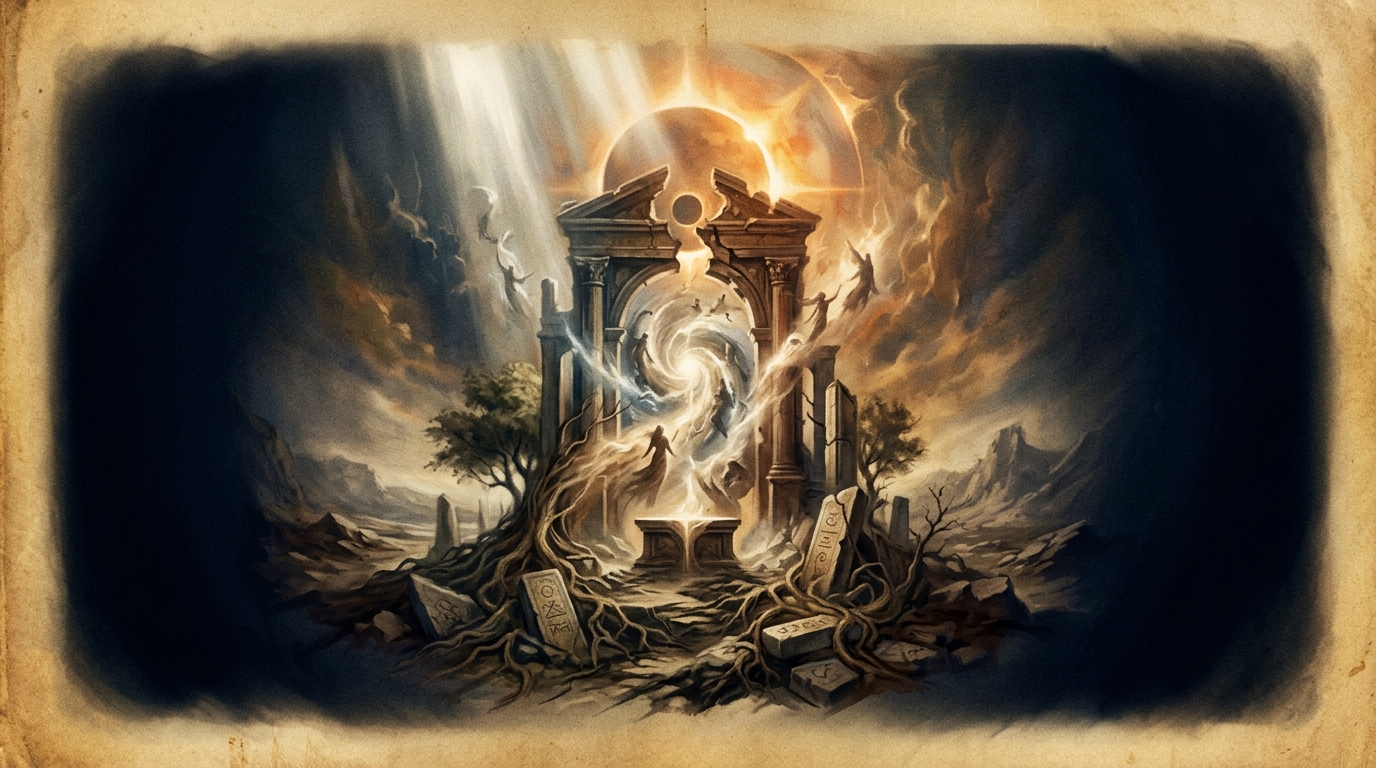
 Codex Illustration
Eschatology
Eschatology—the study of last things—stands at the intersection of theology, history, and cosmic drama, asking what the arc of creation ultimately bends toward and how the story of humanity and the divine council ends. From ancient Jewish apocalypticism to Christian millennialism to Islamic accounts of the final hour, eschatology has shaped civilizations, driven movements, and pressed the most urgent questions of human existence.
Overview
Eschatology derives from the Greek eschaton (last) and logos (study), encompassing doctrines concerning death, judgment, resurrection, the afterlife, and the consummation of history. As a formal theological discipline it is relatively modern, but its subject matter is among the oldest in religious literature. Ancient Mesopotamian texts grapple with mortality and cosmic order; Egyptian funerary religion is saturated with judgments of the dead; Zoroastrian cosmology posits a final renovation of the world (Frashokereti); and Second Temple Jewish texts—Daniel, the Book of Watchers in 1 Enoch, 4 Ezra, 2 Baruch—construct elaborate visions of cosmic conflict, resurrection, and divine vindication. The New Testament inherits, transforms, and radically reorients this tradition through the resurrection of Jesus, which early Christians understood as the firstfruits of a universal eschatological event already inaugurated.
Within Christian theology, eschatological systems have proliferated significantly. The primary fault lines concern the millennium of Revelation 20: amillennialism (the thousand years as a symbolic present reign), postmillennialism (history trending toward a Christianized world before Christ's return), and premillennialism (Christ returns before a literal thousand-year reign). Dispensationalism, developed in the nineteenth century by John Nelson Darby and popularized through the Scofield Reference Bible and later by Hal Lindsey and Tim LaHaye, introduced the concept of a pretribulation rapture—a relatively recent innovation with no clear patristic precedent. Historical premillennialism, by contrast, was the dominant view of the earliest church fathers, including Justin Martyr, Irenaeus, and Tertullian. The Eastern Orthodox tradition tends toward a cosmic, liturgical eschatology less preoccupied with prophetic timelines and more with theosis and the transfiguration of all creation.
The scholarly study of eschatology underwent a decisive turn with Johannes Weiss and Albert Schweitzer in the late nineteenth and early twentieth centuries, who argued that Jesus's entire ministry was framed by thoroughgoing apocalyptic expectation—a claim that remains contested but has permanently shaped critical scholarship. N. T. Wright subsequently argued for a 'inaugurated eschatology': the kingdom of God is both already present and not yet consummated, with the resurrection serving as the pivotal event. Jürgen Moltmann's 'theology of hope' grounded eschatology not in prediction but in the transformative pull of the future on the present, insisting that hope for ultimate renewal is the engine of ethical action in history. Richard Bauckham, Craig Keener, and G. K. Beale have contributed significant work on the Book of Revelation as Jewish apocalyptic literature addressed to first-century churches under imperial pressure, rather than as a cryptic calendar of modern geopolitical events.
From Michael Heiser's divine council perspective, eschatology is not merely about individual souls or church history but about the resolution of a cosmic rebellion. The disinheritance of the nations at Babel (Deuteronomy 32:8–9), the corruption of divine beings (Psalm 82), and the Watchers tradition of 1 Enoch all establish a narrative in which spiritual powers hostile to YHWH hold illegitimate dominion over the nations—a dominion that the death, resurrection, and ascension of Jesus begins to dismantle and that the eschaton fully resolves. The 'already/not yet' tension of New Testament eschatology, on this reading, is simultaneously a statement about the spiritual geography of the cosmos: the powers are defeated in principle at the cross (Colossians 2:15) but have not yet vacated their claimed territories, and the consummation involves not only human redemption but the public vindication of YHWH's sovereignty over all supernatural and earthly realms.
Timeline
Evidence
Multiple Perspectives
Biblical Lens
Scripture Threads
Sources & Further Study
Questions to Explore
Follow the Thread
Continue the Investigation
You’ve reached the Full Archive portion of this Case File.
Ask the Archivist
about this fileSign in to ask the Archivist
Create a free account to ask the Archivist 1 grounded question each day, cited straight from the CODEX case files.
Discussion
0Share findings, questions, and evidence with fellow Seekers. Be respectful and cite sources where you can.
No comments yet. Be the first to open this thread.