
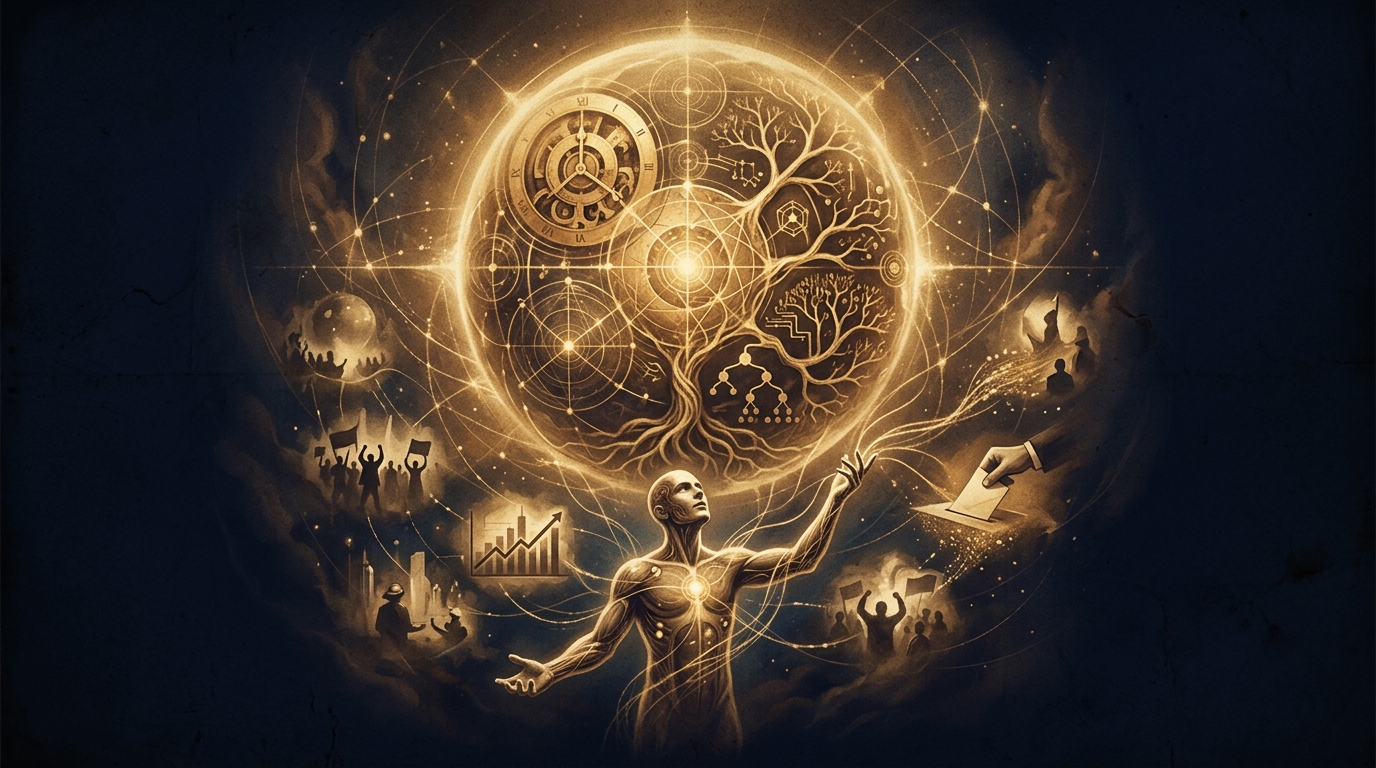
 Codex Illustration
Predictive Algorithms
Predictive algorithms — mathematical systems trained on historical data to forecast human behavior, social outcomes, and future events — have quietly become one of the most consequential and contested forces shaping modern life, raising urgent questions about determinism, autonomy, and who controls the map of the future.
Overview
Predictive algorithms are not a single technology but a family of computational methods — spanning statistical regression, decision trees, neural networks, and deep learning — united by a common ambition: to transform patterns in past data into reliable forecasts of what will happen next. From the credit scoring models that have sorted Americans into financial tiers since the 1950s, to the recidivism-prediction tools now influencing criminal sentencing, to the recommendation engines that shape what hundreds of millions of people read, watch, and believe, these systems operate largely invisibly while exerting documented influence over life outcomes. What makes them culturally and philosophically remarkable is not merely their technical sophistication but their implicit claim: that the future, at least in aggregate, is knowable — that human beings are, to a significant degree, legible machines.
The evidentiary record for predictive systems' capabilities is substantial, though often misrepresented in both directions. In controlled domains — weather modeling, actuarial insurance pricing, demand forecasting in logistics — prediction yields genuinely impressive accuracy. In complex social domains, the record is far more contested. ProPublica's 2016 investigation into the COMPAS recidivism algorithm documented measurable racial disparities in its risk scores, triggering an ongoing methodological debate among statisticians, legal scholars, and civil rights advocates. Researchers at the University of California and MIT have independently demonstrated that facial recognition and behavioral prediction systems trained on biased historical data tend to encode and amplify existing social inequities. The technical literature is clear on a central limitation: an algorithm trained on a history of injustice will, absent careful intervention, predict a future that resembles it.
Beyond law enforcement, predictive analytics have penetrated medicine, finance, social media, and geopolitics. Epidemiologists use probabilistic models to forecast disease spread — models that gained global prominence during the COVID-19 pandemic, when their outputs directly shaped policy affecting billions. Intelligence agencies in the United States, Israel, China, and elsewhere have reportedly invested heavily in behavioral prediction infrastructure, attempting to anticipate protest, radicalization, and foreign adversary decision-making. The Chinese Social Credit System — though frequently mischaracterized in Western media — represents one documented attempt to operationalize algorithmic behavioral scoring at a population scale. Meanwhile, commercial platforms such as Meta and Alphabet have built entire business models around predicting and nudging user attention with a precision that their own researchers have, in internal documents, described as troubling.
At the deepest level, predictive algorithms pose what philosophers of technology call the 'self-fulfilling prophecy problem': a prediction, once acted upon, can itself alter the conditions that generated it. A neighborhood labeled high-risk by a policing algorithm may receive increased surveillance, generating more arrests, which the algorithm then interprets as confirming its original assessment. This feedback loop — documented by scholars including Virginia Eubanks and Cathy O'Neil — suggests that the most dangerous quality of these systems is not inaccuracy but a certain kind of accuracy that forecloses the future it claims only to describe. In this sense, the deepest questions raised by predictive algorithms are not technological but anthropological and moral: What does it mean to be human if behavior is, in principle, foreseeable? And who bears responsibility when the map becomes the territory?
Key Claims
Timeline
Evidence
Multiple Perspectives
Biblical Lens
Scripture Threads
Sources & Further Study
Questions to Explore
Go Deeper Path
Follow the Thread
Continue the Investigation
You’ve reached the Full Archive portion of this Case File.
Ask the Archivist
about this fileSign in to ask the Archivist
Create a free account to ask the Archivist 1 grounded question each day, cited straight from the CODEX case files.
Discussion
0Share findings, questions, and evidence with fellow Seekers. Be respectful and cite sources where you can.
No comments yet. Be the first to open this thread.