
 Codex Illustration
The Church Fathers
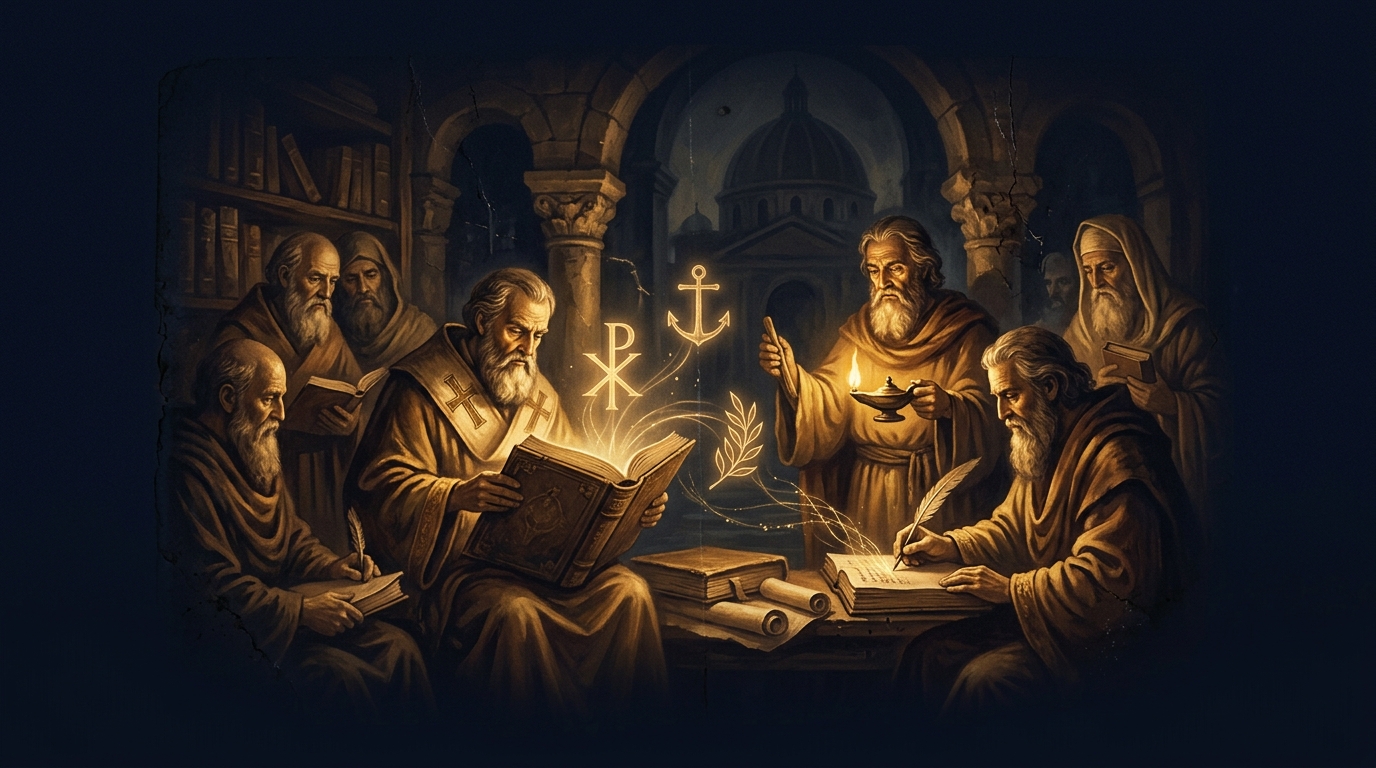
The Church Fathers were the theologians, bishops, and scholars of the first through eighth centuries whose writings shaped Christian doctrine, biblical interpretation, and ecclesial practice—leaving an intellectual legacy still vigorously debated in seminaries and universities today.
Overview
The designation 'Church Fathers' refers broadly to the Christian writers and teachers of the post-apostolic era whose works were regarded as authoritative guides to orthodox belief and practice. Scholars conventionally divide them into the Apostolic Fathers (those writing closest to the apostles, c. 90–150 AD), the Apologists (defenders of Christianity against Greco-Roman critics, c. 120–220 AD), and the later Patristic writers who wrestled with Trinitarian and Christological questions through the great councils of the fourth and fifth centuries. Figures such as Ignatius of Antioch, Justin Martyr, Irenaeus of Lyon, Origen of Alexandria, Tertullian, Athanasius, John Chrysostom, and Augustine of Hippo represent distinct theological temperaments, geographical contexts, and hermeneutical methods, yet together they constitute the principal conversation through which the New Testament canon was refined, heresies were defined and rebutted, and a coherent Christian worldview was articulated against both pagan philosophy and nascent Gnosticism.
The Fathers were not a monolithic bloc. Eastern and Western traditions diverged on questions of authority, the nature of grace, the procession of the Holy Spirit, and the proper method of biblical exegesis. The Alexandrian school—epitomized by Clement and Origen—favored allegory and saw the Scriptures as layered with spiritual meaning accessible through disciplined reason. The Antiochene school preferred a more literal, historical-grammatical reading, anticipating in several respects the hermeneutical concerns of modern biblical scholarship. These tensions were not merely academic; they shaped the outcomes of councils, the condemnation of teachings like Origen's speculative cosmology, and the ongoing negotiation between faith and Hellenistic philosophy that would define Western intellectual history.
Of particular note for students of biblical theology is the Fathers' engagement with texts and traditions that modern scholarship has revisited with fresh urgency. Several Fathers—Justin Martyr, Irenaeus, Clement of Alexandria, Tertullian, and Lactantius among them—explicitly accepted a version of the 'Watcher' tradition: that the 'sons of God' in Genesis 6 were fallen divine beings who co-habited with human women, producing the Nephilim. This reading, drawing partly on 1 Enoch and Second Temple Jewish interpretation, was mainstream in early Christianity before it was gradually supplanted by the 'Sethite' hypothesis championed by Julius Africanus and later Augustine. The Fathers thus stand as witnesses to an interpretive tradition that was historically prior and, as scholars like Michael Heiser have argued, more linguistically and contextually defensible.
The legacy of the Church Fathers is enormous and contested. Catholic, Orthodox, and Protestant traditions each appeal to patristic authority selectively, sometimes mining the same author for opposing conclusions. Critical scholarship examines the Fathers as historical actors embedded in specific social, political, and philosophical contexts—influenced by Stoicism, Middle Platonism, and the pressures of Roman imperial culture. The discipline of patristics today is a rigorous academic field, producing critical editions of texts, fresh translations, and ongoing reassessments of figures long domesticated by tradition. Whether one approaches them as inspired guides, fallible but essential voices, or simply as remarkable historical subjects, the Church Fathers remain indispensable to any serious engagement with the history of ideas in the Western world.
Timeline
Evidence
Multiple Perspectives
Biblical Lens
Scripture Threads
Sources & Further Study
Questions to Explore
Follow the Thread
Continue the Investigation
You’ve reached the Full Archive portion of this Case File.
Ask the Archivist
about this fileSign in to ask the Archivist
Create a free account to ask the Archivist 1 grounded question each day, cited straight from the CODEX case files.
Discussion
0Share findings, questions, and evidence with fellow Seekers. Be respectful and cite sources where you can.
No comments yet. Be the first to open this thread.