
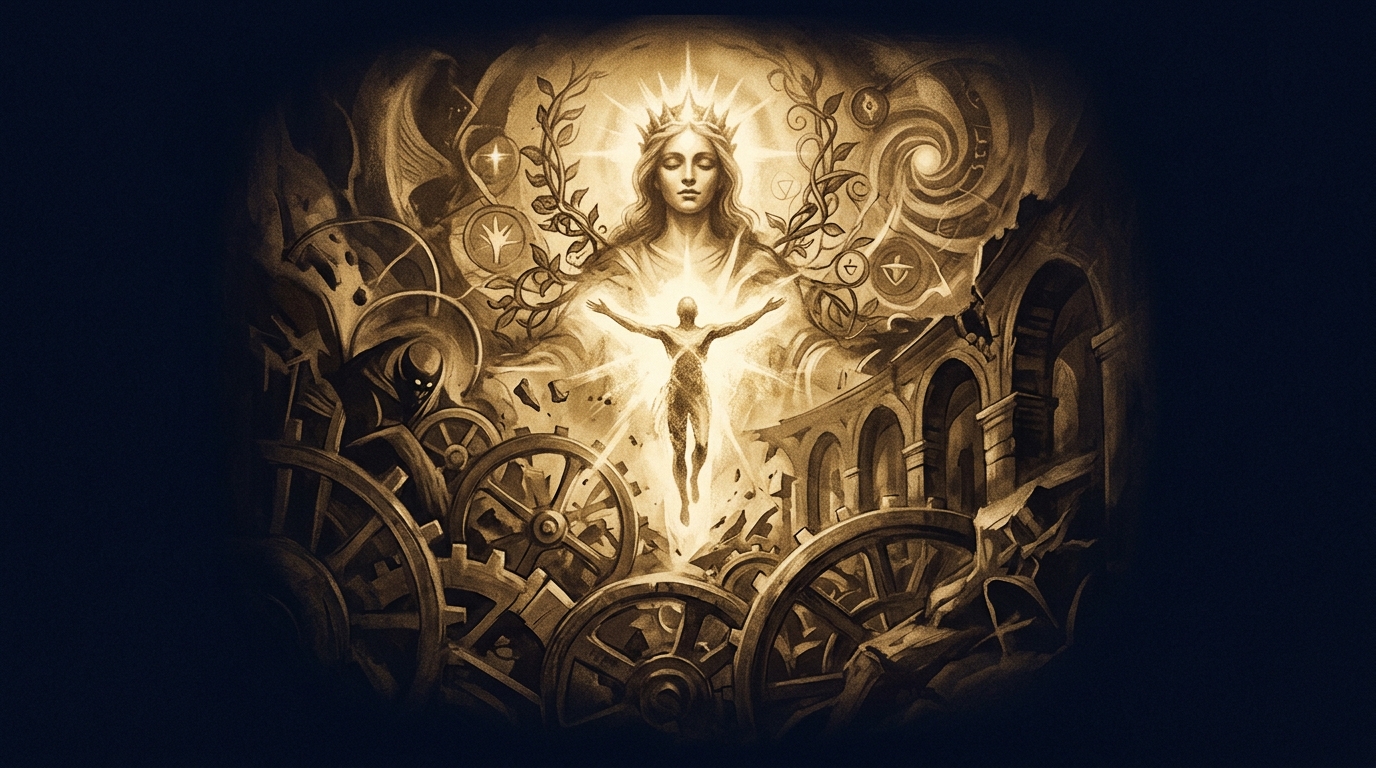
 Codex Illustration
Gnosticism
Gnosticism—a diverse family of ancient religious movements claiming that hidden knowledge (gnosis) could liberate the divine spark within humanity from an inferior material world created by a lesser god—represents one of the most provocative and enduring challenges to orthodox theology, blending Jewish, Christian, Platonic, and Near Eastern currents into a worldview that reframes creation, redemption, and cosmic hierarchy in radical ways.
Overview
Gnosticism is not a single, monolithic religion but rather an umbrella term for a constellation of ancient religious and philosophical movements, flourishing primarily in the first through fourth centuries CE, that shared a core conviction: the material world is a flawed or malevolent creation, the supreme divine reality is remote and unknowable, and salvation comes not through faith or works but through esoteric self-knowledge (gnosis). This knowledge typically involved understanding one's true divine origin, the identity of the creator god (often called the Demiurge, identified with the biblical God of the Old Testament in many systems), and the cosmic drama of how divine sparks became trapped in matter. Systems varied enormously—from the elaborate mythological architectures of Valentinus and Basilides to the simpler dualist frameworks of the Sethians and the Ophites—but the conviction that conventional religious teaching concealed a deeper, salvific truth ran through them all.
The historical origins of Gnosticism remain contested among scholars. The older history-of-religions school (Religionsgeschichtliche Schule) argued for pre-Christian Iranian or Mesopotamian origins, positing a primordial Gnostic myth of the redeemed redeemer that influenced early Christianity. The Nag Hammadi discovery of 1945 fundamentally transformed the field by providing primary texts—the Gospel of Thomas, the Gospel of Philip, the Apocryphon of John, and dozens of others—that could be studied directly rather than through the hostile summaries of heresiologists like Irenaeus, Tertullian, and Epiphanius. Scholarly consensus today, represented by researchers such as Bentley Layton, Karen King, and Elaine Pagels, tends to see Gnosticism as arising within the complex milieu of Second Temple Judaism and early Christianity, drawing on Platonic philosophy, Jewish apocalypticism, and angelological speculation rather than from a single pre-Christian source.
The cosmological framework that most Gnostic systems share has striking resonances with other traditions in the ancient Mediterranean and Near Eastern world. The concept of a hierarchy of divine intermediaries—Archons, Aeons, and powers governing the lower cosmos—finds parallels in Jewish Second Temple angelology, Platonic intermediary cosmology, and the kinds of divine council imagery documented in the Hebrew Bible by scholars like Michael Heiser. The Demiurge, in many Gnostic texts, is portrayed not as absolute evil but as ignorant—a subordinate divine being who mistakes himself for the highest god, a motif with intriguing echoes of Psalm 82's divine council scene. The presence of such figures raises profound theological questions about cosmic hierarchy, the nature of evil, and the fate of human souls that were vigorously debated by the Church Fathers.
Gnosticism's legacy extends far beyond the ancient world. It shaped the development of Christian orthodoxy by forcing the Church Fathers to articulate clear doctrines of creation, scripture, and Christ's humanity. It influenced medieval heresies such as Catharism and Bogomilism. In the modern era, Carl Jung found in Gnostic texts a prefiguration of his depth psychology, and the Nag Hammadi library continues to inspire reinterpretations of early Christianity's diversity. Contemporary popular culture—from Philip K. Dick's theological novels to films like The Matrix—draws heavily on Gnostic themes of a false reality concealing a deeper truth. The question of whether Gnosticism preserves authentic ancient esoteric traditions or represents a sophisticated but ultimately mistaken deviation from apostolic Christianity remains one of comparative religion's most generative debates.
Timeline
Evidence
Multiple Perspectives
Biblical Lens
Scripture Threads
Sources & Further Study
Questions to Explore
Follow the Thread
Continue the Investigation
You’ve reached the Full Archive portion of this Case File.
Ask the Archivist
about this fileSign in to ask the Archivist
Create a free account to ask the Archivist 1 grounded question each day, cited straight from the CODEX case files.
Discussion
0Share findings, questions, and evidence with fellow Seekers. Be respectful and cite sources where you can.
No comments yet. Be the first to open this thread.