
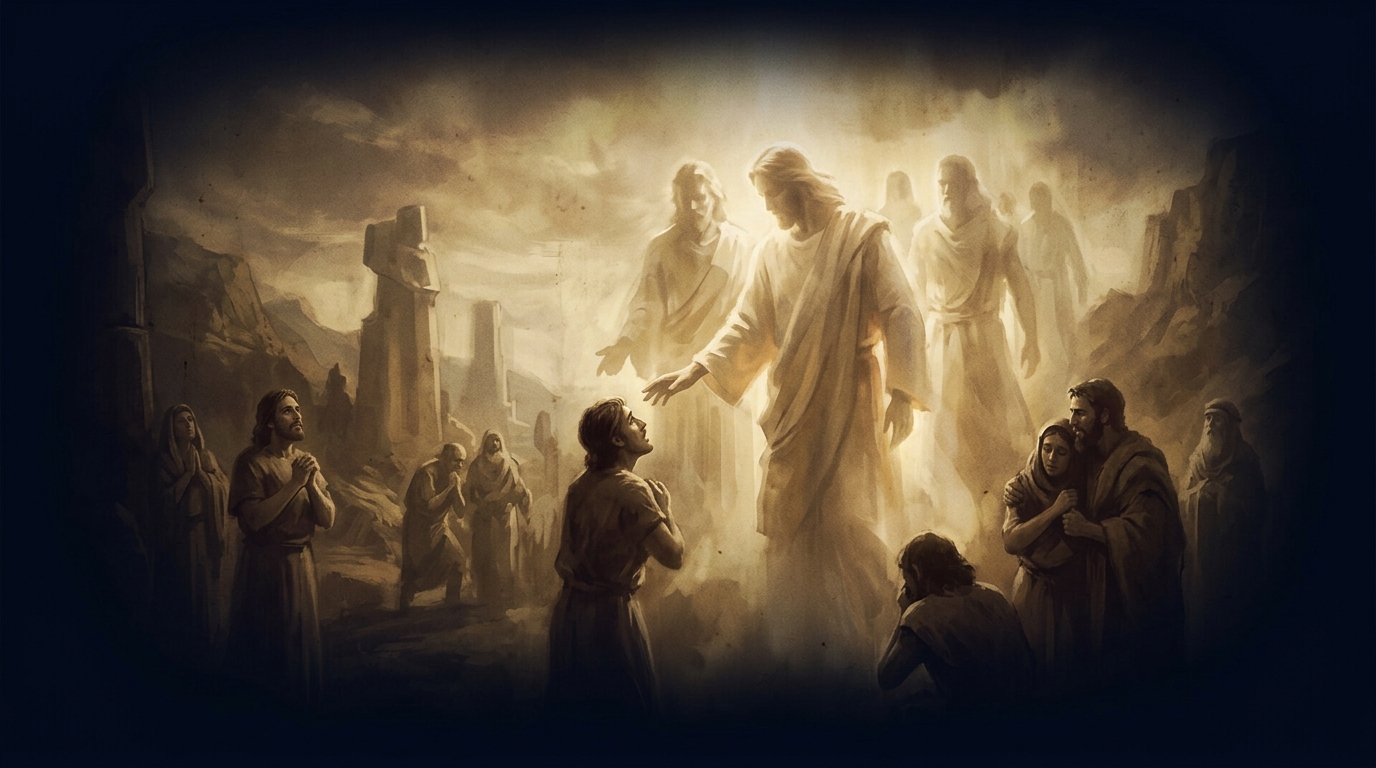
 Codex Illustration
Genesis 6 and the Sons of God
Genesis 6:1–4 records a cryptic and deeply contested episode in which 'sons of God' take human wives, producing the Nephilim—a passage that has generated centuries of interpretive controversy and sits at the intersection of biblical theology, ancient mythology, and questions about the nature of spiritual beings. Its meaning shapes how one reads the entire biblical metanarrative of cosmic rebellion, divine judgment, and redemption.
Overview
Genesis 6:1–4 stands as one of the most compressed and enigmatic passages in all of Scripture: 'When human beings began to increase in number on the earth and daughters were born to them, the sons of God saw that the daughters of humans were beautiful, and they married any of them they chose. The Nephilim were on the earth in those days—and also afterward—when the sons of God went to the daughters of humans and had children by them. They were the heroes of old, men of renown.' The brevity is striking. The Hebrew phrase bene ha-elohim—'sons of God'—appears elsewhere in the Old Testament (Job 1:6; 2:1; 38:7; Psalm 89:6–7) unmistakably referring to divine beings in the heavenly assembly, not mortal men. This lexical pattern is the foundation of the dominant ancient and now resurgent scholarly interpretation: the passage describes a transgression by supernatural beings who violated the boundary between the divine and human orders.
Three major interpretive traditions have competed throughout Jewish and Christian history. The 'angel' or 'Watcher' interpretation, attested in the Second Temple Jewish literature (1 Enoch 6–11, Jubilees 4–5, the Dead Sea Scrolls Community Rule), holds that divine beings literally descended and intermarried with human women, producing hybrid offspring. This was the dominant reading in early Judaism and appears to be reflected in the New Testament (2 Peter 2:4–5; Jude 6–7; 1 Peter 3:19–20). The 'Sethite' interpretation, popularized by Julius Africanus (c. 3rd century AD) and later by Augustine and John Calvin, reads 'sons of God' as the righteous line of Seth and 'daughters of men' as the corrupt line of Cain. The third, 'ancient ruler' interpretation holds that the phrase refers to mighty human kings who claimed divine status and accumulated harems—an ancient Near Eastern practice well-documented in Mesopotamian and Ugaritic kingship ideology. Each view carries significant theological freight and shapes how one understands the Flood narrative that immediately follows.
The scholarly resurgence of the angel interpretation in the late 20th and early 21st centuries is substantially driven by the work of Michael S. Heiser, whose careful philological and contextual analysis appears in The Unseen Realm (2015) and Supernatural (2015). Heiser demonstrates that bene ha-elohim is a technical term within the divine council worldview shared across the ancient Near East and embedded in Israel's own scriptures (cf. Psalm 82; Deuteronomy 32:8 LXX/DSS). He argues that the Sethite reading is a late theological correction that evacuates the text's intended cosmic drama and fails to account for the ANE literary context. Crucially, Heiser distinguishes between interpreting the text's own internal logic and making theological claims about what is possible—the scholar's task is to hear what the ancient author communicates within his cultural framework. The passage is thus best understood as depicting a rebellion within the divine hierarchy, a corruption of both divine and human orders that precipitates divine judgment.
The cultural resonance of Genesis 6:1–4 extends far beyond academic theology. The passage has been linked—with varying degrees of scholarly rigor—to flood narratives across cultures, to Mesopotamian traditions of apkallu sages and antediluvian kings, to Ugaritic descriptions of the divine assembly, and in popular culture to ancient astronaut speculation and conspiracy theories about hidden history. While these popular connections frequently overstate the evidence, the legitimate scholarly observation remains: the Genesis passage shares a conceptual world with ancient Near Eastern mythology without being simply derivative of it. The biblical account is a polemical retelling—asserting Yahweh's sovereignty, the culpability of lesser divine beings, and the catastrophic consequences of the transgression of divinely established boundaries.
Timeline
Evidence
Multiple Perspectives
Biblical Lens
Scripture Threads
Sources & Further Study
Questions to Explore
Follow the Thread
Continue the Investigation
You’ve reached the Full Archive portion of this Case File.
Ask the Archivist
about this fileSign in to ask the Archivist
Create a free account to ask the Archivist 1 grounded question each day, cited straight from the CODEX case files.
Discussion
0Share findings, questions, and evidence with fellow Seekers. Be respectful and cite sources where you can.
No comments yet. Be the first to open this thread.