
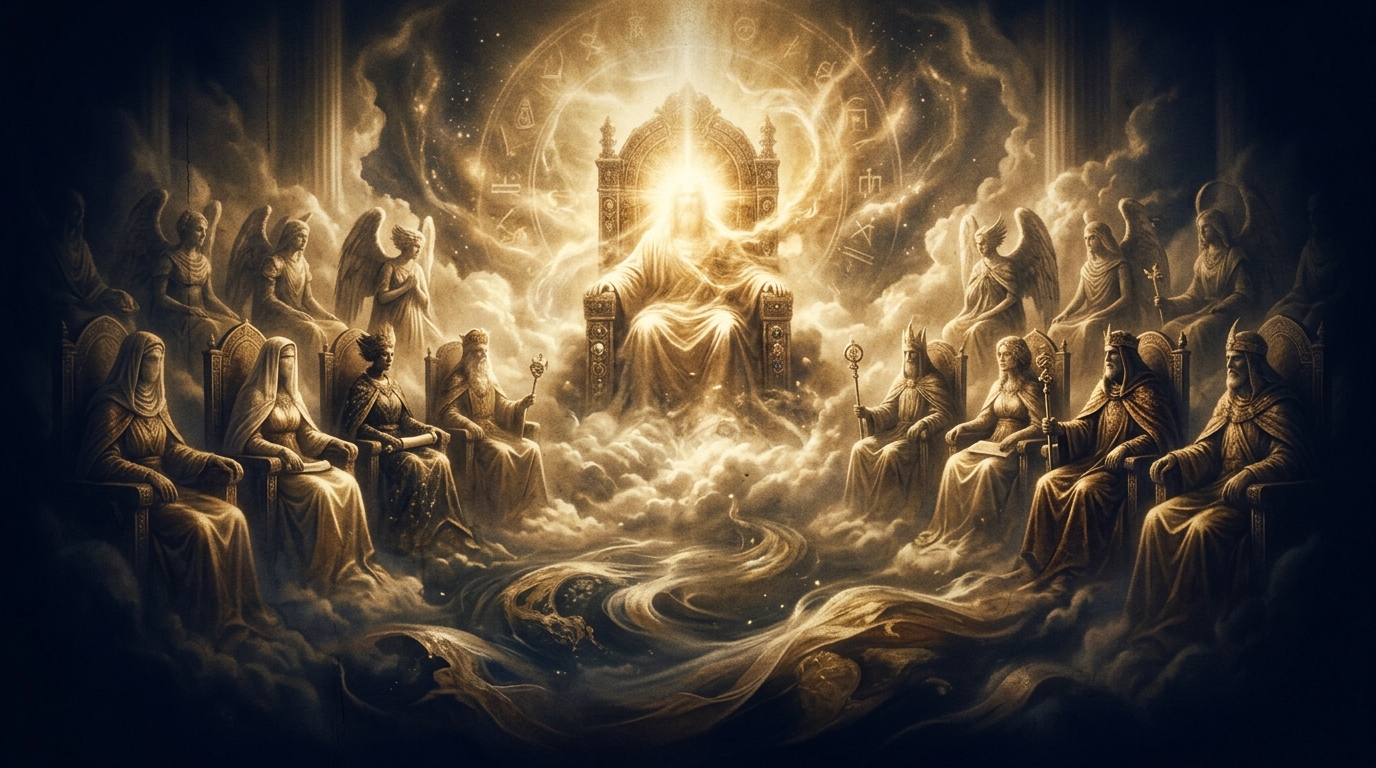
 Codex Illustration
The Divine Council
Across the Hebrew Bible and the ancient Near Eastern world, a celestial assembly of divine beings surrounds the throne of the Most High God — governing nations, rendering judgment, and setting the stage for the great cosmic drama of human history. The Divine Council is not a marginal curiosity but a structural framework woven into the Old Testament's understanding of God, angels, and the unseen order of the cosmos.
Overview
The concept of the Divine Council refers to the assembly of supernatural beings who surround YHWH in the Hebrew scriptures, functioning in roles analogous to a royal court or governing council. Far from a monotheistic anomaly, this framework reflects the broader ancient Near Eastern understanding of cosmic governance, in which a chief deity presided over a hierarchy of lesser divine beings. Texts such as 1 Kings 22:19–23, Job 1–2, Isaiah 6, and Psalm 82 all depict YHWH enthroned amid an assembly of spiritual beings who counsel, serve, report, and are judged. Scholars such as E. Theodore Mullen Jr., Frank Moore Cross, and most accessibly Michael S. Heiser have argued that this council theology is not borrowed paganism but the native theological idiom of ancient Israel — one that was progressively reframed to assert YHWH's unique sovereignty over all other elohim.
The critical term in this discussion is elohim, a Hebrew word that refers not merely to 'God' in the singular sense but to a class or realm of being — the supernatural domain. As Heiser has demonstrated through careful exegesis, the Bible uses elohim to describe YHWH, the members of his heavenly court, the deceased Samuel (1 Sam 28), and even idols — all of which share the quality of belonging to the spirit realm rather than the mortal one. This lexical insight, grounded in Ugaritic comparative linguistics and the Dead Sea Scrolls, dismantles the anachronistic assumption that every reference to 'gods' (elohim, plural) in the Hebrew Bible must imply polytheism or mistranslation. Rather, it reveals a consistent theological architecture: one supreme God who governs through a structured hierarchy of divine beings.
The Ancient Near Eastern context is indispensable here. At Ugarit, excavated from 1929 onward, texts in alphabetic cuneiform describe the council of El — the 'Assembly of the Gods' (pḥr 'ilm) — over which El presided alongside Baal and a host of divine sons. The Hebrew term 'sons of God' (bene elohim or bene ha-elohim) maps directly onto this Ugaritic assembly language, and the epithets applied to Israel's God — El Elyon, El Shaddai — echo titles found in these same Canaanite texts. Rather than proving dependence, most mainstream scholars interpret this as shared cultural vocabulary being repurposed to make a radically different theological claim: that YHWH alone is incomparable, that the other members of the council are creatures, not co-equals, and that they are accountable to divine judgment (Psalm 82).
The Divine Council framework has profound implications for biblical interpretation across both Testaments. The 'disinheritance' of the nations at Babel (Deuteronomy 32:8–9, especially in the Dead Sea Scrolls reading), the rebellion of the Watchers in Genesis 6 and the Book of Enoch tradition, the territorial spiritual conflict in Daniel 10, and the ultimate reclamation of the nations through the Messiah all form a coherent narrative arc when the council backdrop is understood. In the New Testament, Paul's language of 'principalities and powers,' 'thrones and dominions,' and 'rulers of this age' (Eph. 1:21; Col. 1:16; 1 Cor. 2:8) presupposes this same invisible governing structure — one that Christ's death, resurrection, and ascension decisively overcomes. The Divine Council, far from being a footnote, is arguably the unseen scaffolding of the entire biblical drama.
Timeline
Evidence
Multiple Perspectives
Biblical Lens
Scripture Threads
Sources & Further Study
Questions to Explore
Follow the Thread
Continue the Investigation
You’ve reached the Full Archive portion of this Case File.
Ask the Archivist
about this fileSign in to ask the Archivist
Create a free account to ask the Archivist 1 grounded question each day, cited straight from the CODEX case files.
Discussion
0Share findings, questions, and evidence with fellow Seekers. Be respectful and cite sources where you can.
No comments yet. Be the first to open this thread.