
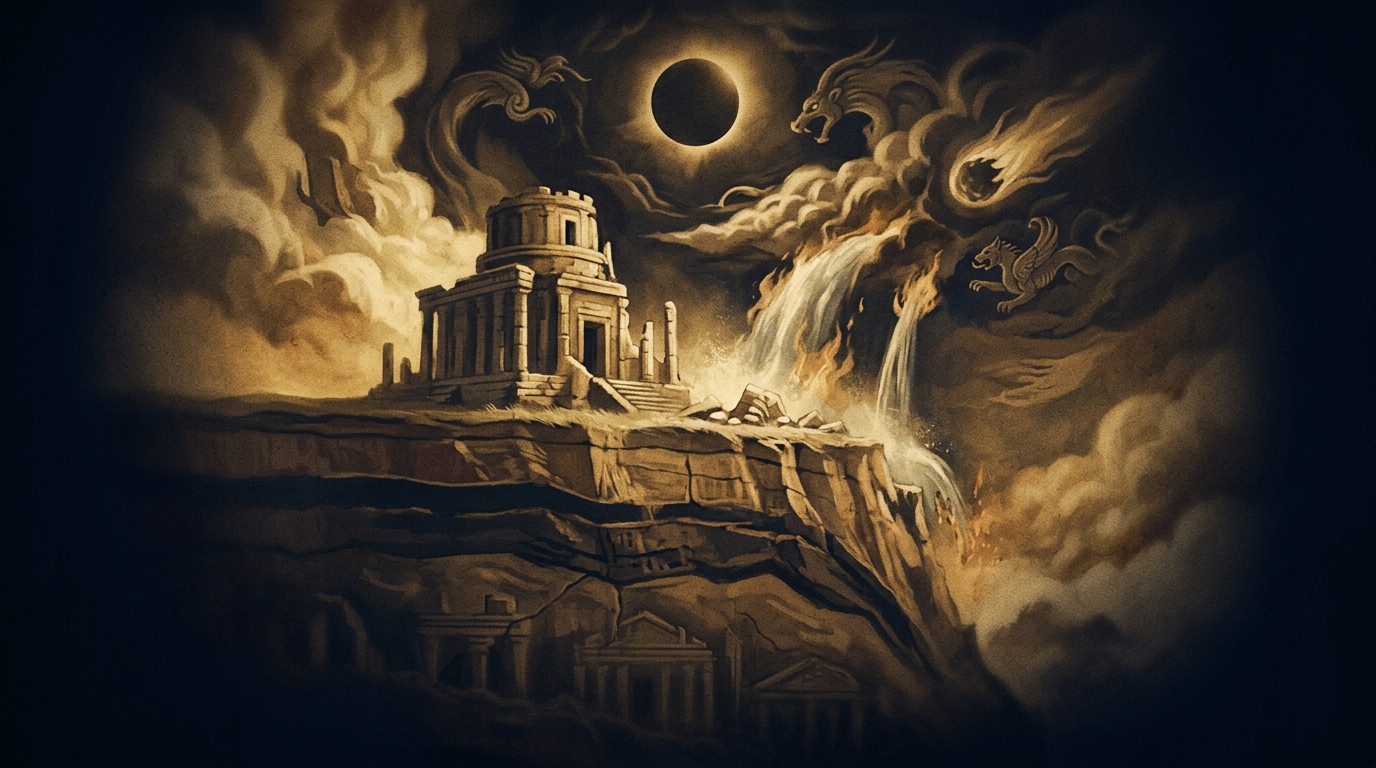
 Codex Illustration
Cyclical Global Catastrophes
Across geology, mythology, and archaeology, a persistent and unsettling pattern emerges: the possibility that Earth has suffered recurring civilizational resets — catastrophes so severe they have left their imprint in the stratigraphic record, the collective memory of ancient peoples, and the ruins of unexpectedly sophisticated pre-disaster cultures.
Overview
The hypothesis that global catastrophes recur on discernible cycles is not, in its core form, a fringe proposition. Mainstream geology documents at least five major mass extinction events in Earth's deep history, the most recent of which — the Cretaceous-Paleogene extinction approximately 66 million years ago — wiped out roughly 75 percent of all species and is firmly attributed to a bolide impact. More proximate to human experience, the Younger Dryas period (c. 12,900–11,700 BP) represents an abrupt and severe climatic reversal at the end of the last Ice Age, one whose causes remain scientifically contested. A growing body of peer-reviewed research, including work published under the banner of the Younger Dryas Impact Hypothesis by researchers such as James Kennett (UC Santa Barbara), proposes that a fragmenting cometary or asteroidal body struck or airburst over the Laurentide Ice Sheet, triggering wildfires, megafaunal extinctions, and a collapse of the Clovis culture in North America. While this hypothesis remains debated, it has accumulated substantial physical evidence — nano-diamonds, platinum anomalies, and a globally distributed black mat sediment layer — that demands serious scientific engagement.
Beyond the geological record, the cultural dimension is equally striking. Virtually every ancient civilization preserves traditions of a catastrophic flood, a destruction of a prior age, or a periodic renewal of the world. The Sumerian King List describes antediluvian rulers with impossibly long reigns, followed by a break and a restoration; the Epic of Gilgamesh preserves one of the oldest flood narratives outside the Hebrew Bible. Mesoamerican traditions, including the Aztec concept of the Five Suns and the Maya Long Count calendar, explicitly encode a cosmology of successive world-ages, each terminated by a specific catastrophic mechanism — flood, fire, wind, earthquake. The Greek tradition preserved in Plato's dialogues Timaeus and Critias records an Athenian priestly tradition, attributed to Solon's visit to Egypt, describing periodic celestial conflagrations that periodically 'purge' civilizations from the face of the Earth. Whether these traditions represent independent mythologization of genuine geological events, or are entirely symbolic cosmological frameworks, remains a genuine scholarly question with no settled consensus.
The modern catastrophist tradition as a scholarly movement has a complex and sometimes controversial history. Immanuel Velikovsky's Worlds in Collision (1950) proposed that Venus was ejected from Jupiter and caused historical catastrophes recorded in ancient texts — a claim almost universally rejected by astronomers and planetary scientists. However, not all catastrophism should be measured by Velikovsky's extremes. More rigorous contributors include J Harlen Bretz, whose initially ridiculed hypothesis that the Channeled Scablands of Washington State were carved by catastrophic glacial flooding was eventually vindicated and became established geology. Graham Hancock's popular works, particularly Fingerprints of the Gods (1995) and America Before (2019), argue for a sophisticated pre-12,800 BP civilization erased by the Younger Dryas impact event, though mainstream archaeologists dispute the evidential basis for claiming pre-Clovis architectural civilization. Randall Carlson, a geological researcher and independent scholar, has produced detailed catalogues of geological anomalies consistent with megaflood episodes that command more respectful treatment from some professionals, even where his broader conclusions remain contested.
The deeper philosophical and scientific question underlying all of this is whether Earth's catastrophic history exhibits genuine cyclicity — regular, predictable periods of civilizational destruction — or whether large-scale catastrophes are stochastic events whose apparent periodicity is an artifact of pattern-seeking cognition and incomplete records. Some researchers have proposed astrophysical mechanisms for cyclicity: the periodicity of the solar system's oscillation through the galactic plane, the proposed hypothetical Planet X perturbing the Oort Cloud, or the periodicity of coronal mass ejection events of the kind proposed by researcher Douglas Vogt and others. None of these mechanisms have achieved scientific consensus. What does remain is a genuinely open empirical question: are the geological, mythological, and archaeological records of catastrophe telling a coherent story of periodic destruction and renewal — or are we, as a pattern-seeking species, assembling scattered discontinuities into a narrative that comforts as much as it unsettles?
Key Claims
Timeline
Evidence
Multiple Perspectives
Biblical Lens
Scripture Threads
Sources & Further Study
Questions to Explore
Go Deeper Path
Follow the Thread
Continue the Investigation
You’ve reached the Full Archive portion of this Case File.
Ask the Archivist
about this fileSign in to ask the Archivist
Create a free account to ask the Archivist 1 grounded question each day, cited straight from the CODEX case files.
Discussion
0Share findings, questions, and evidence with fellow Seekers. Be respectful and cite sources where you can.
No comments yet. Be the first to open this thread.