
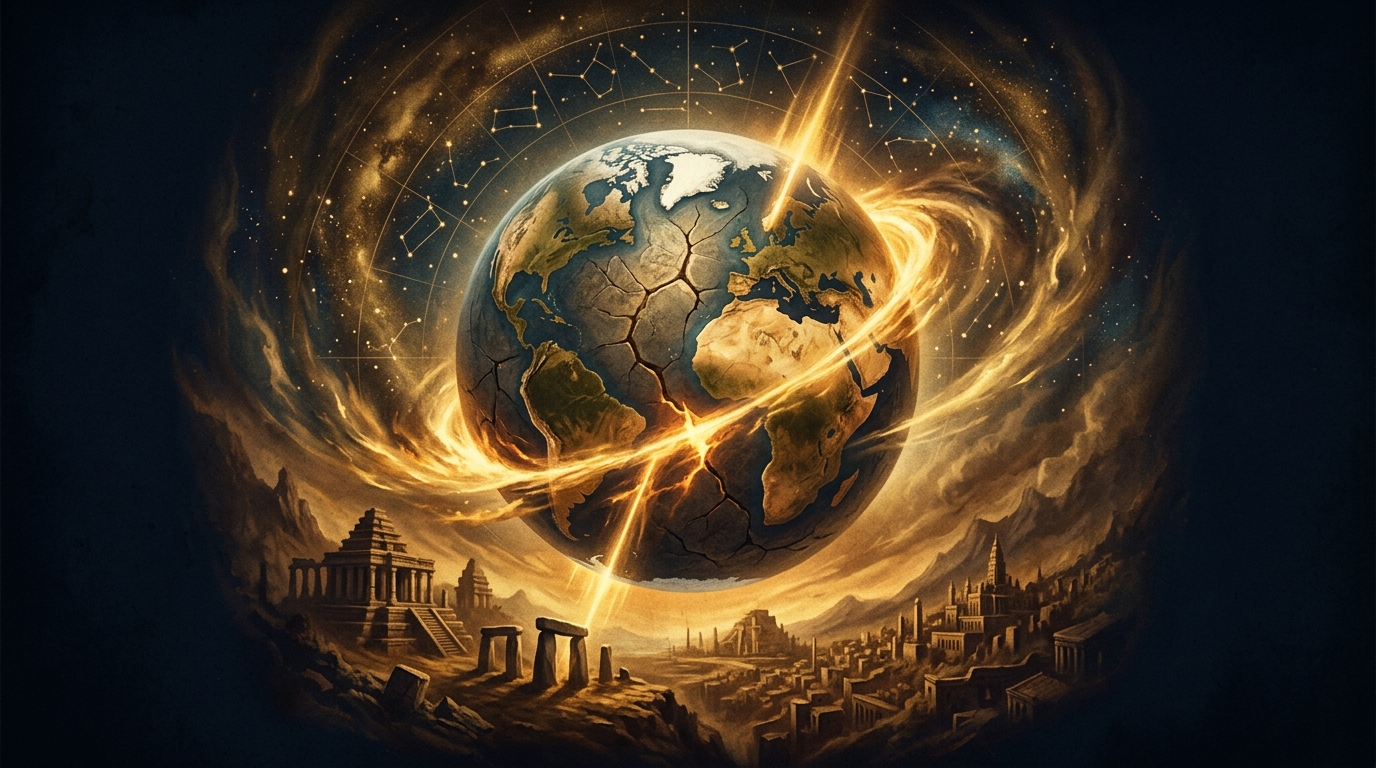
 Codex Illustration
Pole Shift Theory
Pole shift theory proposes that Earth's geographic or magnetic poles have undergone dramatic, possibly rapid displacements in the geological past — a hypothesis that ranges from rigorously debated science to sweeping claims of civilizational destruction and hidden prehistory.
Overview
At its most scientifically grounded, pole shift theory encompasses two distinct but often conflated phenomena: geomagnetic reversal — the documented, gradual process by which Earth's magnetic poles swap orientation over thousands to hundreds of thousands of years — and true polar wander (TPW), a geological mechanism by which the solid outer shell of the Earth reorients relative to the planet's rotational axis. Both processes are accepted in varying degrees by mainstream geology and paleomagnetism. The paleomagnetic record, preserved in volcanic and sedimentary rock, demonstrates that geomagnetic reversals have occurred hundreds of times in Earth's history, with the last major reversal — the Brunhes-Matuyama event — estimated at approximately 780,000 years ago. True polar wander is a slower, more contested mechanism, with evidence suggesting it has caused meaningful but gradual shifts in Earth's crustal position over millions of years. These are not fringe claims: they are published, peer-reviewed science, though significant uncertainty remains about rates, triggers, and consequences.
The controversy intensifies when the geological concept is extended into the human timescale. The hypothesis that a catastrophic pole shift occurred within the last twelve thousand years — disrupting or destroying advanced prehistoric civilizations and leaving behind flood myths, displaced megafaunal remains, and anomalous archaeological sites — has attracted serious popular writers and, occasionally, credentialed researchers. Charles Hapgood, a professor at Keene State College, argued in his 1958 book 'Earth's Shifting Crust' that the lithosphere could displace rapidly as a unit, shifting continents toward the equator and triggering global catastrophe. Hapgood's correspondence with Albert Einstein is documented; Einstein wrote a cautious but engaged foreword to an earlier version of the manuscript, acknowledging the geological puzzle while stopping short of endorsement. Hapgood's mechanism was subsequently critiqued by mainstream geologists who found it physically implausible given what is now understood about plate tectonics, which had not yet been fully articulated when Hapgood wrote.
The theory's cultural traction draws from several convergent sources: the sudden extinction of Pleistocene megafauna (mammoths, giant sloths, short-faced bears) at the end of the last glacial maximum; the near-universal presence of flood narratives across ancient cultures; the apparently sophisticated astronomical and geometric knowledge embedded in sites like Göbekli Tepe, the Great Pyramid, and various megalithic complexes; and the peculiar geographic positioning of Antarctica, which some researchers argue may have been partially ice-free and inhabited within cultural memory. Modern iterations of the hypothesis — found in the work of Graham Hancock, Randall Carlson, and others — invoke the Younger Dryas Impact Hypothesis as a possible mechanism for a catastrophic reset of Earth's surface conditions around 12,900 years ago, though this impact hypothesis itself remains actively contested within geology and archaeology. The pole shift framing often serves as the explanatory scaffold for a broader 'lost civilization' narrative, one that academia largely rejects but that continues to generate substantive popular discourse.
Scholars and scientists have raised several rigorous objections. The physics of a rapid crustal displacement sufficient to displace poles by tens of degrees within human memory appears to contradict what is known about the Earth's rotational dynamics and the viscosity of the mantle. Geomagnetic excursions — short-lived, partial shifts in magnetic pole position — are documented but are distinct from full crustal displacement events. The Younger Dryas boundary layer shows evidence consistent with either a cosmic impact or extraordinary volcanism, but neither scenario requires or confirms a pole shift. The association of flood myths with a single global catastrophic event rather than with regionally distinct deluges is a contested interpretive move. And yet the scientific debate is genuinely open in important ways: the cause of Pleistocene megafaunal extinction remains unresolved, the Younger Dryas onset was unusually abrupt, and the paleogeographic history of Antarctica is more complex than a simple 'always frozen' narrative. The archive holds the file open: some claims here are documented science, some are debated hypothesis, and some are speculation in the dress of geology.
Key Claims
Timeline
Evidence
Multiple Perspectives
Biblical Lens
Scripture Threads
Sources & Further Study
Questions to Explore
Go Deeper Path
Follow the Thread
Continue the Investigation
You’ve reached the Full Archive portion of this Case File.
Ask the Archivist
about this fileSign in to ask the Archivist
Create a free account to ask the Archivist 1 grounded question each day, cited straight from the CODEX case files.
Discussion
0Share findings, questions, and evidence with fellow Seekers. Be respectful and cite sources where you can.
No comments yet. Be the first to open this thread.