
 Codex Illustration
Comparative Mythology
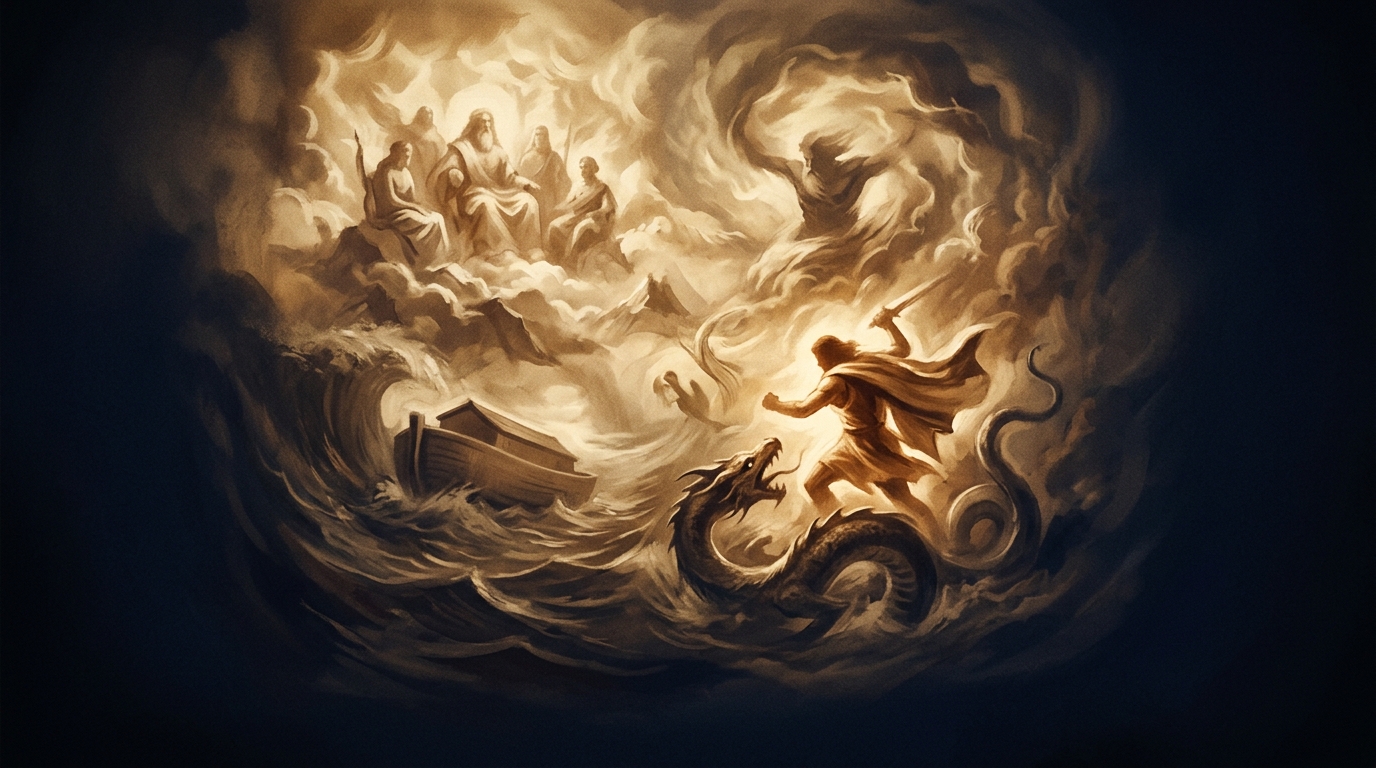
Across every known civilization, strikingly similar mythological narratives appear independently: primordial floods, sky-gods, dragon-slaying heroes, and divine councils. Comparative mythology asks whether these parallels reveal a shared human psychology, a common prehistoric memory, or something stranger still.
Overview
Comparative mythology emerged as a formal discipline in the nineteenth century, when scholars such as Friedrich Max Müller and Andrew Lang began cataloguing the uncanny resemblances between the myths of widely separated cultures. The observation that a great flood narrative appears in Mesopotamia, Greece, India, Mesoamerica, and sub-Saharan Africa simultaneously launched a field and a controversy: were these parallels the product of diffusion (cultural transmission along trade and migration routes), independent invention driven by universal human cognition, or evidence of a shared historical event? Each position has attracted rigorous defenders and remains genuinely contested in contemporary academic literature.
The twentieth century transformed comparative mythology through the work of scholars such as Joseph Campbell, who argued in The Hero with a Thousand Faces (1949) that a single 'monomyth' underlies heroic narratives globally, and Georges Dumézil, who identified a tripartite social and cosmological structure common to Indo-European mythologies. Mircea Eliade contributed the concept of the 'eternal return' and the sacred mountain as a universal axis mundi, while Claude Lévi-Strauss applied structural linguistics to myth, arguing that mythological narratives encode binary oppositions fundamental to human thought. These frameworks, though sometimes criticized for over-systematizing diverse materials, remain foundational reference points in the field.
Ancient Near Eastern scholarship has brought particular precision to the enterprise. The discovery and decipherment of the Ugaritic Ras Shamra texts in the 1930s revealed a Canaanite pantheon — El seated on his divine council, the storm-god Baal defeating a sea-dragon — whose structural resemblances to both Mesopotamian and biblical texts were undeniable. Scholars such as Frank Moore Cross, John Day, and Michael Heiser have argued that these parallels illuminate the literary and theological context in which the Hebrew Bible was composed, without reducing biblical theology to mere mythology. The relationship is one of shared cultural grammar rather than simple borrowing.
The discipline today is genuinely interdisciplinary, drawing on cognitive science, evolutionary psychology, archaeogenetics, and digital humanities. Researchers such as E. Thomas Lawson and Pascal Boyer approach myth through the lens of cognitive science, arguing that counterintuitive agents — gods, demons, monsters — are especially memorable and thus culturally persistent. Meanwhile, the emerging field of archaeomythology, associated with scholars like Marija Gimbutas and, more cautiously, J.P. Mallory, attempts to trace mythological motifs back to prehistoric populations using both linguistic reconstruction and material culture. The field thus sits at a productive intersection of the humanistic and the scientific, and its conclusions remain appropriately provisional.
Timeline
Evidence
Multiple Perspectives
Biblical Lens
Scripture Threads
Sources & Further Study
Questions to Explore
Follow the Thread
Continue the Investigation
You’ve reached the Full Archive portion of this Case File.
Ask the Archivist
about this fileSign in to ask the Archivist
Create a free account to ask the Archivist 1 grounded question each day, cited straight from the CODEX case files.
Discussion
0Share findings, questions, and evidence with fellow Seekers. Be respectful and cite sources where you can.
No comments yet. Be the first to open this thread.