
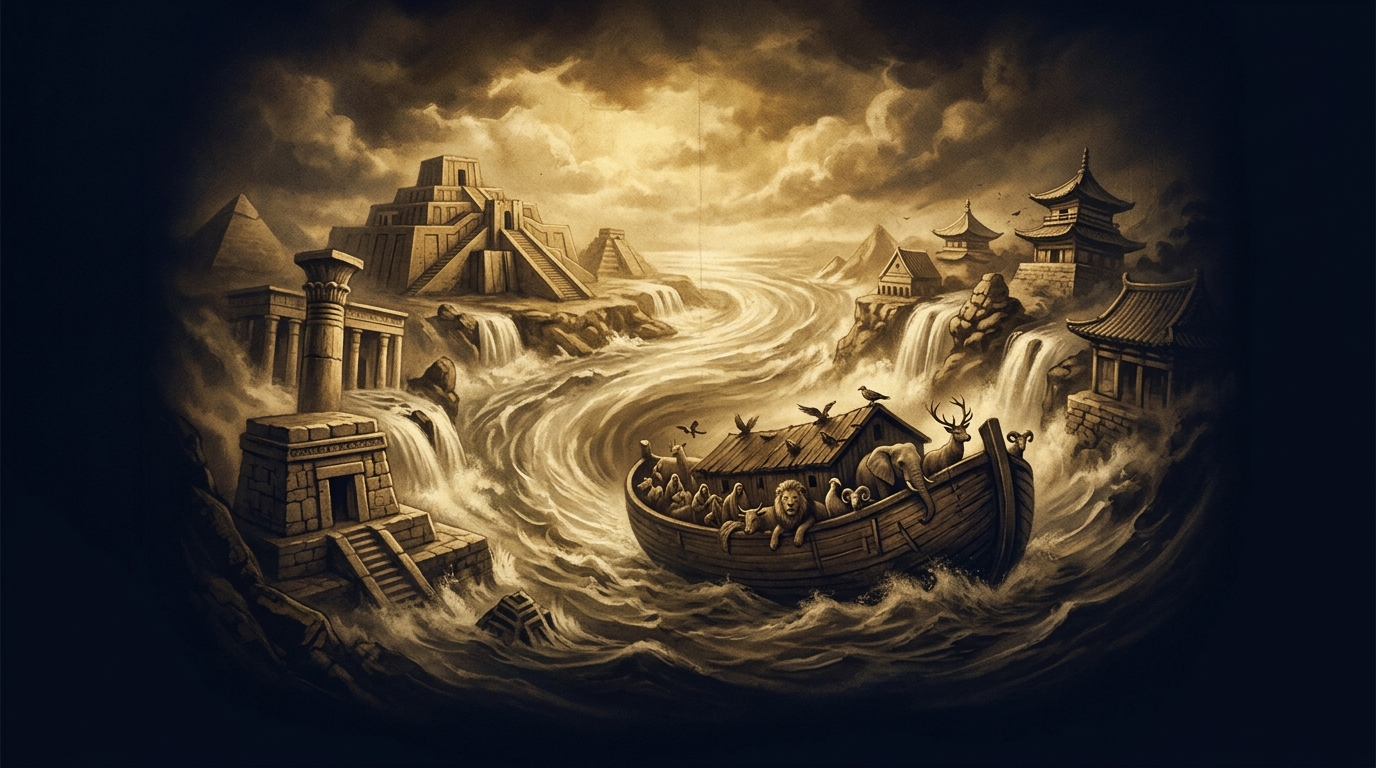
 Codex Illustration
Flood Myths Across Cultures
Across every inhabited continent, ancient cultures independently preserved vivid accounts of a catastrophic deluge that reshaped the world and winnowed humanity to a remnant — a convergence so widespread it has captivated scholars, theologians, and scientists for centuries. Whether understood as historical memory, theological charter, or universal archetype, the flood myth stands as one of the most persistent and consequential narratives in human civilization.
Overview
Flood narratives appear in the oral and written traditions of cultures separated by vast distances and millennia: the Sumerian Eridu Genesis (c. 2300 BC), the Akkadian Atrahasis Epic (c. 1700 BC), the Epic of Gilgamesh (c. 1200 BC in its standard Babylonian form), the Hebrew account in Genesis 6–9, the Hindu tale of Manu in the Shatapatha Brahmana, the Greek myths of Deucalion and Pyrrha, the Mesoamerican traditions of the Popol Vuh, and hundreds of indigenous accounts from Aboriginal Australia, North America, sub-Saharan Africa, and Polynesia. Scholars have catalogued over 200 distinct flood traditions worldwide. The recurring structural elements — divine displeasure, a chosen survivor, the building of a vessel or seeking of high ground, the survival of animals, and the eventual resettlement of the earth — raise the foundational question of whether these stories share a common historical kernel, diffused from a single source, or arise independently from universal psychological or geological experience.
The Ancient Near Eastern textual tradition is particularly significant because it provides the closest literary parallels to the Genesis account. The Atrahasis Epic names its flood hero Utnapishtim (also called Ziusudra in Sumerian sources), who is warned by a sympathetic deity, builds a large vessel, survives the inundation, releases birds to test for dry land, and receives divine blessing afterward — a sequence strikingly parallel to Noah's narrative in Genesis. Critically, mainstream scholarship does not regard these parallels as evidence that Genesis borrowed wholesale from Babylonian sources; rather, most biblical scholars argue that both traditions drew upon shared cultural memory within the ancient Near Eastern milieu, each theologically shaped by its own understanding of the divine. The monotheistic reframing in Genesis — a single sovereign God acting in moral judgment rather than a quarreling pantheon responding to overpopulation — represents a theologically distinctive transformation of the shared tradition.
Geological and archaeological research has produced several hypotheses for a naturalistic basis underlying some flood traditions. William Ryan and Walter Pitman's 1997 Black Sea Flood hypothesis proposed that a catastrophic breach of the Bosphorus around 5600 BC inundated the Black Sea basin, potentially displacing populations whose memory of the event propagated through subsequent cultures. Plato scholar and geologist Cesare Emiliani and others have pointed to post-glacial sea-level rises at the end of the Last Glacial Maximum (c. 12,000–8,000 BC) as a plausible trigger for widespread trauma encoded in oral tradition. More recently, the Younger Dryas Impact Hypothesis (associated with researchers such as James Kennett) has proposed a cosmic impact or airburst event c. 10,800 BC as the trigger for a period of rapid climatic disruption. None of these hypotheses has achieved full scientific consensus, and most mainstream geologists attribute global flood myths to diverse local flooding events rather than a single planetary catastrophe.
Theologically, the flood narrative has served as one of the most foundational texts in Jewish, Christian, and Islamic tradition, encoding themes of divine justice, covenantal mercy, new creation, and human accountability. The Qur'an's account of Nuh (Noah) preserves recognizable structural parallels while emphasizing submission to divine will. In Christian typological reading, the flood prefigures baptism and the death-and-resurrection pattern (see 1 Peter 3:20–21). For scholars in the tradition of Michael Heiser, the Genesis flood account cannot be read in isolation from the broader divine council drama: the incursion of the sons of God in Genesis 6:1–4, the corruption of humanity, and the divine decision to unmake and remake the created order all represent movements within a cosmic theological narrative that ancient audiences would have recognized as a challenge to rival cosmological claims.
Timeline
Evidence
Multiple Perspectives
Biblical Lens
Scripture Threads
Sources & Further Study
Questions to Explore
Follow the Thread
Continue the Investigation
You’ve reached the Full Archive portion of this Case File.
Ask the Archivist
about this fileSign in to ask the Archivist
Create a free account to ask the Archivist 1 grounded question each day, cited straight from the CODEX case files.
Discussion
0Share findings, questions, and evidence with fellow Seekers. Be respectful and cite sources where you can.
No comments yet. Be the first to open this thread.