
 Codex Illustration
Göbekli Tepe
Discovered beneath a Kurdish hilltop in southeastern Turkey, Göbekli Tepe is a monumental ritual complex dating to approximately 9600–8000 BC, predating Stonehenge by six millennia and overturning foundational assumptions about the relationship between religion, civilization, and agriculture.
Overview
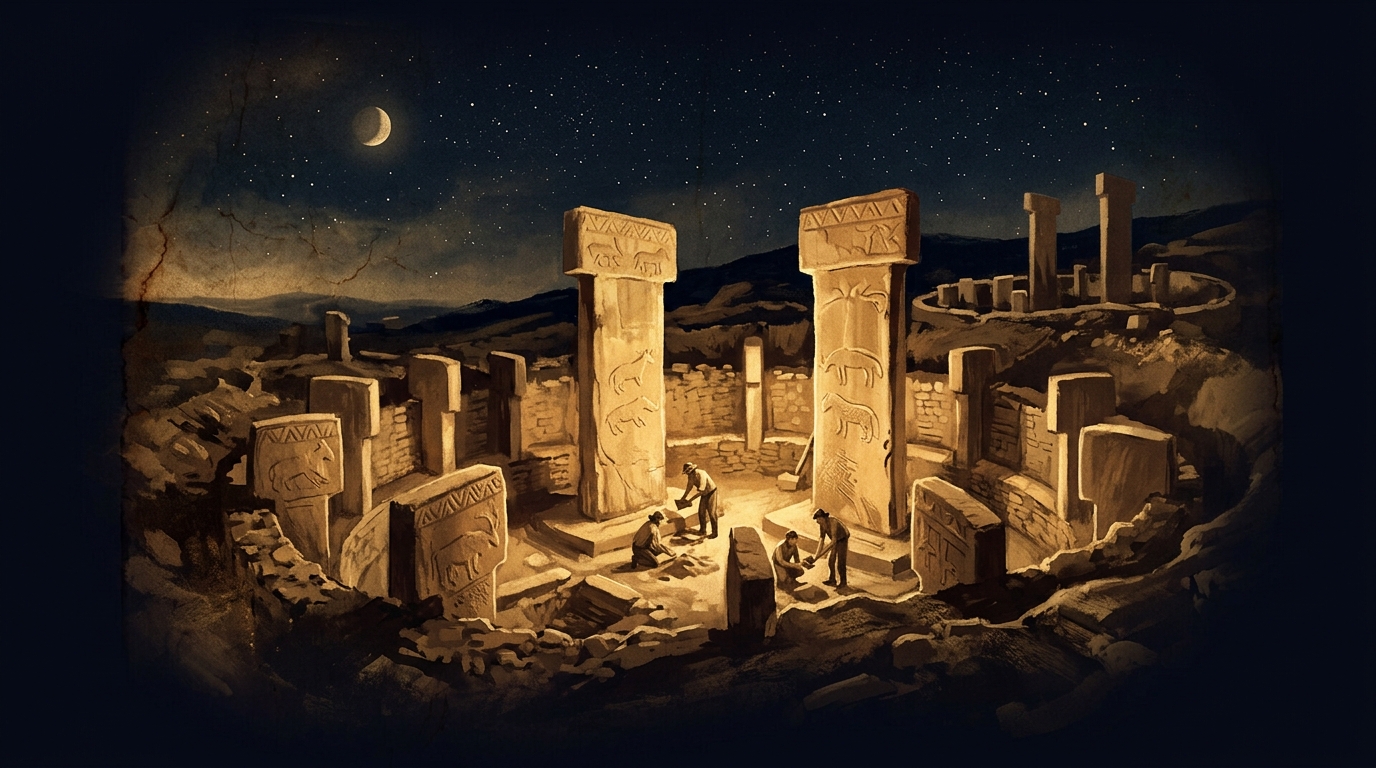
Göbekli Tepe — literally 'Pot-bellied Hill' in Turkish — sits atop the Taurus Mountain foothills near Şanlıurfa, in the region historically identified as Upper Mesopotamia. German archaeologist Klaus Schmidt, excavating from 1995 until his death in 2014, revealed a series of circular stone enclosures adorned with elaborately carved T-shaped pillars, many bearing reliefs of foxes, serpents, vultures, scorpions, aurochs, and abstract anthropomorphic forms. The site's oldest layers (Layer III) have been reliably dated by radiocarbon analysis to the Pre-Pottery Neolithic A period, roughly 9600–8800 BC, making it the oldest known large-scale ritual architecture on Earth. The scale and sophistication of the construction — some pillars standing over five meters tall and weighing up to twenty tons — demand a degree of social organization previously thought impossible for mobile hunter-gatherer communities of that era.
The site fundamentally challenged the 'Neolithic Revolution' model, which held that sedentism, agriculture, and surplus food production were preconditions for monumental architecture and organized religion. Schmidt himself argued, controversially but with substantial support, that it may have been the reverse: that the demands of constructing and maintaining a communal ritual center drew populations into sustained cooperation, and that this social gravitational pull may have accelerated the domestication of local wild cereals and animals. Göbekli Tepe thus repositions religion — or at least organized, architecturally expressed communal ritual — as a driver rather than a product of civilization, a thesis that continues to animate debate across archaeology, anthropology, and the history of religion.
The iconography carved into the pillars remains only partially understood. The central tall pillars in each enclosure may represent stylized anthropomorphic beings, with carved arms and hands visible on some examples, suggesting the presence of semi-abstract divine or ancestral figures. Vultures, often depicted carrying human heads or orbs, have been interpreted by some scholars as references to funerary sky-burial rites or cosmic mythology. A carved scene on Pillar 43 — sometimes called the 'Vulture Stone' — has attracted particular scholarly attention, with proposals ranging from a memorial of a catastrophic cosmic event (Andrew Collins, Rodney Hale) to conventional funerary symbolism. Around 8000 BC the site appears to have been deliberately and carefully backfilled with debris, an act of intentional burial whose motivation remains among archaeology's most tantalizing open questions.
Gobekli Tepe has also attracted a substantial layer of popular and speculative interpretation far exceeding the archaeological evidence. Claims of connections to the biblical Garden of Eden (advanced partly because Şanlıurfa lies near the headwaters of rivers associated with Eden geography), to Atlantis, to ancient astronauts, or to a lost global civilization predating known history circulate widely in popular media. Scholars uniformly regard these interpretations as unsupported by the material record. What is genuinely extraordinary about Göbekli Tepe requires no embellishment: it represents a paradigm-altering discovery that compels a fundamental reconsideration of when, why, and how humans first organized themselves around shared sacred space.
Timeline
Evidence
Multiple Perspectives
Biblical Lens
Scripture Threads
Sources & Further Study
Questions to Explore
Follow the Thread
Continue the Investigation
You’ve reached the Full Archive portion of this Case File.
Ask the Archivist
about this fileSign in to ask the Archivist
Create a free account to ask the Archivist 1 grounded question each day, cited straight from the CODEX case files.
Discussion
0Share findings, questions, and evidence with fellow Seekers. Be respectful and cite sources where you can.
No comments yet. Be the first to open this thread.